

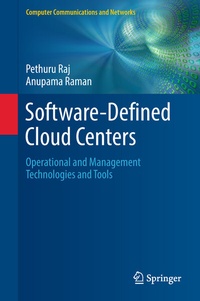
Software-Defined Cloud Centers
Description

This practical text/reference provides an exhaustive guide to setting up and sustaining software-defined data centers (SDDCs). Each of the core elements and underlying technologies are explained in detail, often supported by real-world examples. The text illustrates how cloud integration, brokerage, and orchestration can ensure optimal performance and usage of data resources, and what steps are required to secure each component in a SDDC. The coverage also includes material on hybrid cloud concepts, cloud-based data analytics, cloud configuration, enterprise DevOps and code deployment tools, and cloud software engineering.
Topics and features: highlights how technologies relating to cloud computing, IoT, blockchain, and AI are revolutionizing business transactions, operations, and analytics; introduces the concept of Cloud 2.0, in which software-defined computing, storage, and networking are applied to produce next-generation cloud centers; examines software-defined storage for storage virtualization, covering issues of cloud storage, storage tiering, and deduplication; discusses software-defined networking for network virtualization, focusing on techniques for network optimization in data centers; reviews the qualities and benefits of hybrid clouds, that bridge private and public cloud environments; investigates the security management of a software-defined data center, and proposes a framework for managing hybrid IT infrastructure components; describes the management of multi-cloud environments through automated tools, and cloud brokers that aim to simplify cloud access, use and composition; covers cloud orchestration for automating application integration, testing, infrastructure provisioning, software deployment, configuration, and delivery. This comprehensive work is an essential reference for all practitioners involved with software-defined data center technologies, hybrid clouds, cloud service management, cloud-based analytics, and cloud-based software engineering.More details
Other editions
Additional editions
Persons
Dr. Pethuru Raj is Chief Architect of the Site Reliability Engineering (SRE) Division at Reliance Jio Infocomm Ltd. (RJIL), Bangalore, India. His other publications include the Springer titles Automated Workflow Scheduling in Self-Adaptive Clouds and (with Mrs. Raman) High-Performance Big-Data Analytics.
Mrs. Anupama Raman works at Flipkart Internet India Pvt Ltd, Bangalore, India.
Content
The Distinct Trends and Transitions in the Information Technology (IT) Space.- Demystifying Software-Defined Cloud Environments.- Software-Defined Storage (SDS) for Storage Virtualization.- Software-Defined Networking (SDN) for Network Virtualization.- The Hybrid Cloud: The Journey towards Hybrid IT.- Security Management of a Software Defined Data Center.- Cloud Service Management.- Multi-Cloud Brokerage Solutions and Services.- Automated Multi-Cloud Operations and Container Orchestration.- Multi-Cloud Management: Technologies, Tools and Techniques.
