

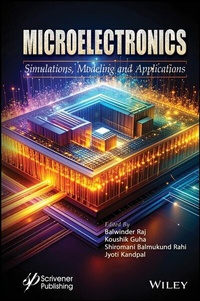
Microelectronics
Description

Unlock the future of nanotechnology with this essential guide, which provides an exhaustive exploration of solutions to overcome the physical limits of silicon and optimize the performance of next-generation nanoscale semiconductor devices.
As the role of microelectronics grows in today's world, there is a need for new material solutions that move away from the limited conductivity of silicon to improve the electronic properties in nanoscale semiconductor devices. This unique guide exhaustively explores a number of topics, including 2D materials, microelectronic devices, large VLSI circuit design, and leakage mitigation techniques. The book showcases in-depth analyses of microelectronic device structures and their applications, properties, and characterization. With its easy-to-understand approach, this book is an excellent resource for novices and experts alike.
More details
Other editions
Additional editions
Persons
Balwinder Raj, PhD is an Associate Professor and an Associate Dean of Academics at the National Institute of Technology Jalandhar with more than 15 years of teaching and research experience. He has authored and co-authored eight books, 15 book chapters, and more than 150 research papers in peer-reviewed national and international journals and conferences. His areas of interest include classical and non-classical nanoscale semiconductor device modeling, nanoelectronics, FinFET-based memory design, and low-power VLSI design.
Koushik Guha, PhD is an Associate Professor and Head of the Department of Electronics and Communication Engineering at the National Institute of Technology Silchar. He has published more than 200 papers in international journals and conferences of repute, 35 book chapters, and two books. His current research interests include mimicking human body functions using micro-electro-mechanical systems (MEMS) technology, MEMS energy harvesting, design and development of smart sensors for IoT, and VLSI circuit design and optimization.
Shiromani Balmukund Rahi, PhD is an Assistant Professor in the School of Information and Communication Technology at Gautam Buddha University. He has published 25 research articles, two conference proceedings, 25 book chapters for various book projects, and seven books. His research focuses on the development of ultra-low power devices such as tunnel FETs and negative capacitance FETs.
Jyoti Kandpal, PhD is an Assistant Professor in the Department of Electronics and Communication Engineering at Graphic Era Hill University. She has more than 40 publications to her cresit in international journals and conferences. Her research interests include low-power VLSI design and high-performance digital circuit design.
Content
Preface xiii
Acknowledgment xxi
1 2D Materials for Microelectronic Devices 1
Shasi Sarmah, Krishanku Upamanyu, Nilpawan Sarma, Hirendra Das and Pranjal Saikia
2 Microelectronic Devices 39
Bidhan Pramanick and Anto Manuel
3 Insights Review of Microelectronic Devices 73
Rambabu Kusuma and Roshan Bodile
4 Novel Devices with Carbon and Graphene 103
M. Vinoth
5 Carbon and Graphene Devices with Applications 129
R. Suba Lakshmi, S. Aditya and R. Aarthi
6 III-V Compound Semiconductor Devices 161
Priyanka Chetia, Hirendra Das and Pranjal Saikia
7 Dopingless Heterojunction Tunnel FET and its Application 191
Basudha Dewan
8 Silicon Nanowire Field Effect Transistor and Its Applications 215
Mekonnen Getnet Yirak and Rishu Chaujar
9 Impact of Material and Structural Engineering in Double-Gate Junction Underlap Dual-Gate FinFETs 247
Manaswini Mishra and Ananya Dastidar
10 Nanoelectronic System Design for RF Energy Harvesting 277
Manash Pratim Sarma and Kandarpa Kumar Sarma
11 Fin Field-Effect Transistor-Based Digital Logic Circuits Using 7-nm Regime 309
Sarika M. Jagtap, Viraj R. Sonawane, Bhushankumar N. Shinde, Rasika M. Chandramore and Dyaneshwar D. Ahire
12 MEMS Sensors and Its Applications 335
Shaveta, R. K. Bhan and Rishu Chaujar
13 Investigation of MEMS Sensors and Applications 367
Amuthameena S., Vaishnavi R., Gayathri G. and Karlyn Cynthia F.M.
14 Piezoelectric MEMS Sensors and its Applications 393
Tikendrajit Chetia and Bolin Chetia
15 Design Exploration of PVT-Tolerant Pre-Amplifiers for Seizure Monitoring 425
Sarin Vijay Mythry
16 Advanced Electroencephalography and Its Influence on Neuroscience Applications 451
Sarin Vijay Mythry
17 Bridging Memory and Computation: Reimagining Digital Logics through Memristor Technology 475
Dayananda Singh Khwairakpam and Vandana Devi Wangkheirakpam
18 Nanowire Synapse for Accelerating Neuromorphic Computing 497
Hemanta Kumar Mondal, Prasenjit Maji and Kunal Dhibar
About the Editors 525
Index 527
Preface
Modeling and simulation of semiconductor materials, devices, and circuits have been the driving force for the development of semiconductor technology and have contributed significantly to a comprehensive understanding of their operation. Moreover, it is estimated that Technology Computer Aided Design (TCAD) can reduce the cost of the technology, circuits, and system development, hence reducing time-to-market. The ever-increasing demand for more advanced technologies is driving the shrinking of critical dimensions of integrated circuit (IC) devices. Recent investigations in microelectronics have concentrated on further enhancing device performance while addressing the challenges associated with continuous scaling. Analysis using state-of the-art device modeling has helped the process of miniaturization of MOSFETs through recent decades in characterizing their parameters and predicting their behavior in material, device, and system level. Moreover, modeling and simulation provide a deeper understanding of the critical issues surrounding device scaling and its impact on circuit system level, including functionality and reliability of its operation.
Chapter 1: The isolation of graphene has marked a bold turn in materials science away from 2D materials. The distinguishing feature is a crystalline structure that can be one or two atomic layers thick, with 2D materials, including extraordinary mechanical, electrical, and optical properties, whose values differ substantially from those of their bulk counterparts. This particular profile opens up an avenue of very transformative possibilities regarding 2D materials in the area of microelectronic, optoelectronic, and nanotechnological fields. The intrinsic properties of 2D materials hold layered configurations, which are held together by weak van der Waals forces. Therefore, exfoliation into monolayers is made easy; one can stack various kinds of 2D materials to form heterostructures, thereby giving the material adaptive properties that can be tailored for targeted applications.
Chapter 2: Microelectronics is a broad area that includes electronics, mechanical engineering, computer science, and control engineering. The recent technological developments in microelectronic systems have made human living more orderly and pleasant. Microelectronic devices are used in various sectors and are very much needed to improve their capabilities, accuracy, and efficiency. However, the fast growth in every sector is causing environmental problems. Deforestation, poor waste management, and air, land, and water pollution increase severe risks to human health and well-being. The microelectronics field provides better solutions to these challenges by spanning industrial safety, automotive technology, air quality monitoring, early disease diagnosis, and many others. Economic growth and technological advancement are required simultaneously for societal benefits. Balancing these requirements with sustainable practices may mitigate environmental impacts. Society can foster creativity and improve the planet for future generations with the range of technologies available in microelectronics.
Chapter 3: The continued scaling of semiconductor devices to smaller dimensions has posed significant challenges for traditional planar MOSFETs, including short-channel effects, power dissipation, and leakage currents. To overcome these limitations, various advanced transistor architectures have emerged. FinFETs are widely adopted in sub-22-nm nodes due to their 3D fin structure, which improves electrostatic control, reduces leakage, and enhances drive current. This makes FinFETs ideal for both low-power systems and high-performance applications. Tunnel FETs (TFETs) use quantum tunneling to provide an alternate route to current conduction allowing for a subthreshold swing of less than 60 mV per decade. This feature makes TFETs particularly appealing for ultra-low-power applications, as they provide great energy efficiency. However, one major problem for TFETs is raising their on-state current, which is lower than that of traditional transistors, such as MOSFETs or FinFETs, restricting their use in high-performance applications. Despite this, the potential of TFETs for power-sensitive devices continues to drive research efforts aimed at improving their overall performance and scalability. Nanowire FETs (NW-FETs) utilize a cylindrical, multi-gate design that completely surrounds the channel offering excellent electrostatic control and scalability for future technology nodes. Similarly, nanosheet FETs provide a planar, multi-gate approach with stacked nanosheets enabling further scaling and enhanced performance.
Chapter 4: The exploration of novel devices utilizing carbon and graphene materials has catalyzed significant advancements in diverse fields, including electronics, energy storage, and nanotechnology. Two-dimensional carbon allotrope graphene is recognized for its exceptional mechanical strength, thermal stability, and electrical conductivity. These exceptional properties enable the development of high-performance devices such as transistors, sensors, and flexible electronics. The development of novel devices incorporating carbon and graphene materials has emerged as a transformative area in modern electronics, energy storage, and nanotechnology. Carbon-based materials, particularly graphene, are celebrated for their exceptional electrical conductivity, mechanical strength, and thermal properties, which make them suitable for a variety of innovative applications. Due to its special electrical characteristics, graphene, a single sheet of carbon atoms organized in a two-dimensional honeycomb lattice, can be used to create flexible electronic components, high-performance transistors, and sensors. Multifunctional devices with improved performance have emerged as a result of recent developments in the production and integration of graphene with other materials.
Chapter 5: The insatiable quest for smaller and more powerful electronic devices has pushed the boundaries of silicon-based technology to their limits, as further advancements in silicon technology does not guarantee better performance of the devices making it obsolete and forcing the researchers to look for an alternative material with promising characteristics. Carbon and graphene, with their exceptional properties, offer a reasonable path forward. This chapter explores recent advances in novel devices utilizing these materials. Carbon nanotubes (CNTs) and graphene possess extraordinary mechanical and electrical properties positioning them as prime materials for high-performance transistors, sensors, and energy storage applications. CNTFETs and graphene-based transistors have demonstrated significant potential in various applications, from digital (inverters, NAND gate, processors) and analog circuits (operational amplifiers, filters, comparators, oscillators) to flexible electronics and quantum devices. Furthermore, carbon- and graphene-based materials offer unique advantages for biosensors capable of detecting proteins, cells, and viruses. Carbon-based solar cells improve efficiency and stability compared to traditional solar cells, and as for memristors, they are well suited in the construction of non-volatile memory and in neuromorphic computing. Graphene remains an excellent candidate for high-speed transistors and sensors due to its high electron mobility and lower resistivity. Additionally, its flexibility and transparency render it ideal for wearable electronic devices, including touch screens and displays. Also, it offers an excellent platform for creating advanced quantum devices.
Chapter 6: In the fast-paced landscape of electronics and optoelectronics, III-V compound semiconductors are pioneering a new era in technology due to their remarkable electronic characteristics, including direct bandgap and high electron mobility. These qualities make III-V compounds ideal for high-speed devices and advanced photonic applications. This chapter presents the latest advancements in III-V compound semiconductors, detailing their unique physical and chemical properties alongside cutting-edge fabrication techniques. By leveraging these materials, researchers and engineers are achieving remarkable performance improvements in various electronic and optoelectronic devices. Notable examples include LEDs (light-emitting diodes), solar cells, and photodetectors. The chapter focuses on the distinct properties of III-V compounds that enable efficient charge transport and photon emission, which are both critical for next-generation applications. It also explores recent innovations in device fabrication and integration that have expanded the functional scope of these semiconductors across different platforms allowing for new capabilities and improved device efficiencies. Furthermore, the chapter outlines strategic approaches for optimizing device performance, discussing enhanced material designs, and tuning methods that address challenges such as thermal stability and device longevity. In closing, the chapter offers a forward-looking perspective on III-V materials highlighting opportunities for discovering new compounds, refining synthesis processes, and expanding application domains. It also addresses the pressing challenges in the field proposing future research directions to further unlock the potential of III-V compounds. This chapter aims to inspire continued innovation in this transformative field supporting the ongoing evolution of electronics and optoelectronics.
Chapter 7: In this chapter, an analysis between the split-gate doping-free heterojunction tunnel-field-effect-transistor (SG-DG-HJ-TFET) and...
