

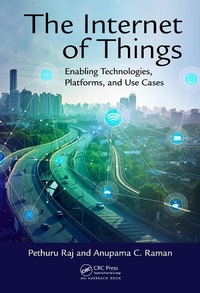
The Internet of Things
Enabling Technologies, Platforms, and Use Cases
1st Edition
Published on 24. February 2017
392 pages
978-1-351-98193-4 (ISBN)
Description

As more and more devices become interconnected through the Internet of Things (IoT), there is an even greater need for this book,which explains the technology, the internetworking, and applications that are making IoT an everyday reality.
The book begins with a discussion of IoT "ecosystems" and the technology that enables them, which includes:
Wireless
Infrastructure and Service Discovery Protocols
Integration Technologies and Tools
Application and Analytics Enablement Platforms
A chapter on next-generation cloud infrastructure explains hosting IoT platforms and applications. A chapter on data analytics throws light on IoT data collection, storage, translation, real-time processing, mining, and analysis, all of which can yield actionable insights from the data collected by IoT applications. There is also a chapter on edge/fog computing.
The second half of the book presents various IoT ecosystem use cases. One chapter discusses smart airports and highlights the role of IoT integration. It explains how mobile devices, mobile technology, wearables, RFID sensors, and beacons work together as the core technologies of a smart airport. Integrating these components into the airport ecosystem is examined in detail, and use cases and real-life examples illustrate this IoT ecosystem in operation. Another in-depth look is on envisioning smart healthcare systems in a connected world. This chapter focuses on the requirements, promising applications, and roles of cloud computing and data analytics. The book also examines smart homes, smart cities, and smart governments.
The book concludes with a chapter on IoT security and privacy. This chapter examines the emerging security and privacy requirements of IoT environments. The security issues and an assortment of surmounting techniques and best practices are also discussed in this chapter.
The book begins with a discussion of IoT "ecosystems" and the technology that enables them, which includes:
Wireless
Infrastructure and Service Discovery Protocols
Integration Technologies and Tools
Application and Analytics Enablement Platforms
A chapter on next-generation cloud infrastructure explains hosting IoT platforms and applications. A chapter on data analytics throws light on IoT data collection, storage, translation, real-time processing, mining, and analysis, all of which can yield actionable insights from the data collected by IoT applications. There is also a chapter on edge/fog computing.
The second half of the book presents various IoT ecosystem use cases. One chapter discusses smart airports and highlights the role of IoT integration. It explains how mobile devices, mobile technology, wearables, RFID sensors, and beacons work together as the core technologies of a smart airport. Integrating these components into the airport ecosystem is examined in detail, and use cases and real-life examples illustrate this IoT ecosystem in operation. Another in-depth look is on envisioning smart healthcare systems in a connected world. This chapter focuses on the requirements, promising applications, and roles of cloud computing and data analytics. The book also examines smart homes, smart cities, and smart governments.
The book concludes with a chapter on IoT security and privacy. This chapter examines the emerging security and privacy requirements of IoT environments. The security issues and an assortment of surmounting techniques and best practices are also discussed in this chapter.
More details
Edition
1. Auflage
Language
English
Place of publication
London
United Kingdom
Publishing group
Taylor & Francis Ltd
Target group
Professional and scholarly
Product notice
Reflowable
Illustrations
75 s/w Abbildungen
75 Illustrations, black and white
ISBN-13
978-1-351-98193-4 (9781351981934)
Copyright in bibliographic data and cover images is held by Nielsen Book Services Limited or by the publishers or by their respective licensors: all rights reserved.
Schweitzer Classification
Other editions
Additional editions
Pethuru Raj | Anupama C. Raman
The Internet of Things
Enabling Technologies, Platforms, and Use Cases
Book
07/2022
1st Edition
Auerbach
€81.95
Shipment within 10-20 days
Pethuru Raj | Anupama C. Raman
The Internet of Things
Enabling Technologies, Platforms, and Use Cases
Book
03/2017
1st Edition
Auerbach Publishers Inc.
€184.90
Shipment within 15-20 days
Persons
Pethuru Raj PhD has been working as a cloud infrastructure architect in the IBM Global Cloud Center of Excellence (CoE), IBM India Bangalore. He finished the CSIR-sponsored PhD degree in Anna University, Chennai and continued the UGC-sponsored postdoctoral research in the department of Computer Science and Automation, Indian Institute of Science, Bangalore. He also was granted a couple of international research fellowships (JSPS and JST) to work as a research scientist for 3.5 years in two leading Japanese universities. He has been contributing book chapters for a number of technology books that are being edited by internationally acclaimed professionals. The CRC Press, USA had also released his first solo book titled as "Cloud Enterprise Architecture" in the year 2012. He has edited and authored a book on the title "Cloud Infrastructures for Big Data Analytics" published by IGI International USA in March 2014. In association with another IBMer, he finished a book on the title "Smarter Cities: the Enabling Technologies and Tools" published by the CRC Press, USA in 2015. He has also authored a book on the Docker technology and it is being published by Packtpub, UK in 2015. He has been collaborating with a few authors to publish a book on the title "High-Performance Big Data Analytics" to be published by Springer-Verlag in the year 2015.
Anupama Raman is currently working as Curriculum Architect for Smarter Cities Brand of IBM and she is a part of Business Analytics team of IBM. She is a certified Storage Area Networking expert and is also a certified Data Center Architect. She is also certified in Cloud infrastructure and Services Management. Apart from these technical certifications, in the field of writing, she is a certified Information Mapping professional and in the field of project management, she is a certified Scrum master. She holds an M. Tech degree in Computer Science and Engineering and is currently pursuing MBA in IT Management. She has presented and published over 20 research papers in various national and international conferences and she has also written numerous book chapters with various national and international publishers. She has authored a book titled Intelligent Cities - Enabling Technologies and Platforms which was published by CRC Press in June 2015. She has also written a book on Big Data Analytics which will be published by Springer Verlag in December 2015. She is regular columnist of Forbes and has authored several articles for Forbes India.
Anupama Raman is currently working as Curriculum Architect for Smarter Cities Brand of IBM and she is a part of Business Analytics team of IBM. She is a certified Storage Area Networking expert and is also a certified Data Center Architect. She is also certified in Cloud infrastructure and Services Management. Apart from these technical certifications, in the field of writing, she is a certified Information Mapping professional and in the field of project management, she is a certified Scrum master. She holds an M. Tech degree in Computer Science and Engineering and is currently pursuing MBA in IT Management. She has presented and published over 20 research papers in various national and international conferences and she has also written numerous book chapters with various national and international publishers. She has authored a book titled Intelligent Cities - Enabling Technologies and Platforms which was published by CRC Press in June 2015. She has also written a book on Big Data Analytics which will be published by Springer Verlag in December 2015. She is regular columnist of Forbes and has authored several articles for Forbes India.
Content
Foreword
Preface
Acknowledgments
About the Authors
1 Demystifying the IoT Paradigm
2 Realization of IoT Ecosystem Using Wireless Technologies
3 Infrastructure and Service Discovery Protocols for the IoT Ecosystem
4 The Integration Technologies and Tools for IoT Environments
5 The Enablement Platforms for IoT Applications and Analytics
6 The Next-Generation Clouds for IoT Applications and Analytics
7 Describing the Emerging Field of IoT Data Analytics
8 Expounding the Edge/Fog Computing Paradigm
9 Envisioning Futuristic Smart Airports Using IoT Integration
10 Envisioning Smart Health Care Systems in a Connected World
11 Smart Use Cases of IoT
12 Security Management of an IoT Ecosystem
Index
Preface
Acknowledgments
About the Authors
1 Demystifying the IoT Paradigm
2 Realization of IoT Ecosystem Using Wireless Technologies
3 Infrastructure and Service Discovery Protocols for the IoT Ecosystem
4 The Integration Technologies and Tools for IoT Environments
5 The Enablement Platforms for IoT Applications and Analytics
6 The Next-Generation Clouds for IoT Applications and Analytics
7 Describing the Emerging Field of IoT Data Analytics
8 Expounding the Edge/Fog Computing Paradigm
9 Envisioning Futuristic Smart Airports Using IoT Integration
10 Envisioning Smart Health Care Systems in a Connected World
11 Smart Use Cases of IoT
12 Security Management of an IoT Ecosystem
Index
