

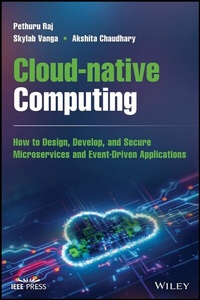
Cloud-native Computing
Description

In Cloud-Native Computing: How to Design, Develop, and Secure Microservices and Event-Driven Applications, a team of distinguished professionals delivers a comprehensive and insightful treatment of cloud-native computing technologies and tools. With a particular emphasis on the Kubernetes platform, as well as service mesh and API gateway solutions, the book demonstrates the need for reliability assurance in any distributed environment.
The authors explain the application engineering and legacy modernization aspects of the technology at length, along with agile programming models. Descriptions of MSA and EDA as tools for accelerating software design and development accompany discussions of how cloud DevOps tools empower continuous integration, delivery, and deployment.
Cloud-Native Computing also introduces proven edge devices and clouds used to construct microservices-centric and real-time edge applications. Finally, readers will benefit from:
* Thorough introductions to the demystification of digital transformation
* Comprehensive explorations of distributed computing in the digital era, as well as reflections on the history and technological development of cloud computing
* Practical discussions of cloud-native computing and microservices architecture, as well as event-driven architecture and serverless computing
* In-depth examinations of the Akka framework as a tool for concurrent and distributed applications development
Perfect for graduate and postgraduate students in a variety of IT- and cloud-related specialties, Cloud-Native Computing also belongs in the libraries of IT professionals and business leaders engaged or interested in the application of cloud technologies to various business operations.
More details
Other editions
Additional editions
Persons
Pethuru Raj, PhD, is Chief Architect and Vice-President for the Site Reliability Engineering Division of Reliance Jio Platforms in Bangalore. He has more than twenty-two years' experience in the IT industry.
Skylab Vanga works as a hybrid cloud architect at Kyndrl Solution Pvt Ltd. in Bangalore. He has more than thirteen years' experience in the IT industry.
Akshita Chaudhary has more than four years' experience working in product-based organizations such as Reliance Jio Platforms Ltd.
Content
Preface
Chapter 1 - The Dawning of Digital Era
Chapter 2 - Leveraging the Cloud-Native Computing Model for the Digital Era
Chapter 3 - Kubernetes Architecture, Best Practices and Patterns
Chapter 4 - The Resiliency and Observability Aspects of Cloud-native Applications
Chapter 5 - Creating Kubernetes Clusters on Private Cloud (VMware vSphere)
Chapter 6: Creating Kubernetes Clusters on Public Cloud (Microsoft Azure)
Chapter 7: Design, Development and Deployment of Event-driven Microservices Practically
Chapter 8 - Serverless Computing for the Cloud-native Era
Chapter 9 - Demonstrating a Serverless Application using Knative on a Kubernetes Cluster
Chapter 10 - Delineating Cloud-native Edge Computing
Chapter 11 - Setting up a Kubernetes Cluster using Azure Kubernetes Service (AKS)
Chapter 12 - Reliable Cloud-native Applications through Service Mesh
Chapter 13 - Cloud-native Computing: The Security Challenges and the Solution Approaches
Chapter 14 - Microservices Security: The Concerns and the Solution Approaches
Chapter 15 - Apache Kafka: Setup, Monitor and Secure Kubernetes cluster.
Preface
Undoubtedly the cloud phenomenon is adventuring in the fast track. It all started with server virtualization. Then came a litany of automated tools to simplify and streamline IT environment operations. That is, several complicated tasks such as job/task scheduling, load balancing, workload consolidation, configuration management, capacity planning and provisioning, and resource allocation and monitoring get neatly automated and accelerated through a host of pioneering algorithms, platforms, optimized processes, specialized accelerators, and toolsets. Precisely speaking, the much-touted server virtualization in conjunction with scores of cutting-edge technologies and state-of-the-art tools has laid down a stimulating foundation for the mesmerizing era of cloud computing. The agility, adaptivity, and affordability natively enshrined in cloud environments have led to the grandiose realization of fully virtualized cloud environments. Besides server virtualization, we started to experience storage and network virtualization implementations. This phase is being typically termed as software-defined cloud computing (often referred to as Cloud 2.0). In short, the cloudification concept has resulted in highly optimized and organized IT environments for frequently deploying and efficiently delivering next-generation digital life applications and services. The world is definitely enthralled with a plethora of fresh possibilities and opportunities, which are being instigated by the noteworthy advancements in the cloud IT landscape. The new modernization, migration, hosting, delivery, and operating models articulated and accentuated by the versatile and resilient cloud phenomenon are being pronounced as the way forward for artistically producing and running highly sophisticated digital applications in plenty.
The current buzzword in the IT industry is none other than the paradigm of cloud-native computing, which is all about meticulously leveraging all the distinct capabilities of cloud computing to build and run portable, extensible, available, composable, and reliable applications. Cloud-native technologies and tools have the wherewithal to empower organizations to have scores of service-oriented, event-driven, process-aware, knowledge-filled, cloud-agnostic, and people-centric applications running in modern IT environments such as public, private, hybrid, and edge clouds. Microservices as the agile software design and development technique, containers as an immutable infrastructure and optimal runtime for microservices, container orchestration platforms such as Kubernetes with declarative APIs, API gateways as the aggregator and adaptor in the microservice world, service meshes as resiliency platforms, observability and remediation solutions, and so on greatly exemplify and elevate this new phenomenon of cloud-native computing. Cloud-native architectures and applications are modular (loosely or lightly coupled and cohesive), resilient, robust, observable, and versatile. Combined with a bevy of nimble automation and orchestration tools, the cloud-native concepts allow software engineers to build, operate, and improve highly impactful and inspiring cloud-native systems with minimal toil.
Software applications have become increasingly complicated yet sophisticated with users demanding intimate and orchestrated functionalities and facilities. Numerous third-party applications spread across disparate and distributed cloud environments are being technologically integrated in order to guarantee an integrated and insightful look and feel for users. End users expect rapid responsiveness, intuitive and informative interfaces, innovative features to be consistently incorporated, and zero downtime. Businesses insist for quick accommodation of business and technology changes in software solutions and services. The cloud-native computing paradigm has all in it to empower the software engineering community decisively.
This book is specially planned and prepared to delineate the nitty-gritty of cloud-native computing and how it is to impact the software and hardware engineering precepts in bringing forth connected, composable, and cognitive systems for the ensuing knowledge era.
Chapter 1- The Dawning of the Digital Era - With the faster maturity and solidity of digitization and digitalization technologies and tools, the dreamt digital era is all set to mesmerize the whole world. There are several path-breaking digitization and edge technologies (sensors, stickers, RFID tags, barcodes, microcontrollers, beacons, LED lights, etc.). These technological innovations and disruptions have solidly and succulently enabled the digitization movement. Thereby today we are being surrounded by so many digital elements, which turn out to be computational, communicative, sensitive, perceptive, vision-enabled, decision-making, responsive, and active. Digital entities have facilitated the mainstream computing in our everyday environments such as homes, hotels, and hospitals. All kinds of physical, mechanical, and electrical systems in our midst are being transitioned into digital assets through the above-mentioned digitization and edge technologies. It is projected that there will be trillions of digital assets in the planet Earth in the years to come. Then came the connectivity technologies. Resultantly digital elements are now being integrated with one another in the neighborhood and with the cloud-hosted software services and databases over the Internet, which is being projected as the world largest communication infrastructure. Such an integration empowers digital assets to gain additional capabilities from remote entities. Digital elements are publicly discoverable and network accessible. Context-aware applications are bound to thrive and will be delivered to humans in an unobtrusive manner. The IoT paradigm typically represents the strategically sound combination of digitization/edge and connectivity technologies.
Chapter 2- The Cloud-Native Computing Paradigm for the Digital Era - With a series of ground-breaking technologies, the cloud-native computing paradigm is being proclaimed as the futuristic and flexible model for building and deploying highly scalable, available, and reliable applications across cloud environments. The product and tool vendors have come out with a litany of products for elegantly building and releasing cloud-native systems.
Chapter 3- Kubernetes Architecture, Best Practices, and Patterns - Without an iota of doubt, the Kubernetes (K8s) platform is being touted as the game changer in the IT operations space. The field of software engineering, especially the domain of software deployment, has received a strong boost with the arrival of Kubernetes. The growing IT operational and management complexities are being methodically mitigated through the growing power of Kubernetes. For the increasingly connected and containerized world, Kubernetes is being applauded as the pioneering IT solution that automates and accelerates the application deployment, management, and maintenance of containerized applications. That is, besides auto-scaling, auto-healing of containerized infrastructure modules if anything goes amiss, is being accomplished through Kubernetes. Further on, Kubernetes had laid down an invigorating foundation for visualizing and realizing multi-container composite applications that are process-aware and business-critical. Kubernetes in conjunction with microservices architecture (MSA), containerization, and enterprise DevOps tools has simplified and speeded up the idea of cloud-native computing to flourish across with the nourishment from product and tool vendors.
Chapter 4- The Observability, Chaos Engineering, and Remediation for Cloud-Native Reliability - Experts reason that cloud-native applications are being designed and developed to be deployed and run in any cloud environment. The widely circulated optimization features of cloud infrastructures are being meticulously used by cloud-native services and application to be distinctive and delightful in their offerings and outputs. As noted in the first chapter, cloud infrastructures have gained some unique characteristics such as elasticity to guarantee workload scalability. Further on, the various DevOps tools built and used for enterprise IT environments are being remedied to achieve the much-wanted continuous integration, delivery, deployment, and improvement in cloud IT environments. Containers have emerged as the most optimal application deployment runtime. There are platform solutions for appropriately managing container life cycle activities. Microservices guarantee agile software design and development. As microservices are the key building-block for cloud-native apps, it is easy to create versatile and resilient cloud-native applications through configuration changes and service composition.
Chapter 5- Creating Kubernetes Clusters on Private Cloud (VMware vSphere) - This is purely a practical chapter. All the details regarding setting up a Kubernetes cluster on VMware vSphere cloud environment are given in this chapter. This is for explaining how a Kubernetes-managed private cloud environment can be established and sustained.
Chapter 6- Creating Kubernetes Clusters on Public Cloud (Microsoft Azure) - In this chapter, we are tutoring about creating Kubernetes clusters on...
