

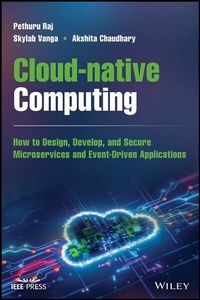
Cloud-native Computing
Description

In Cloud-Native Computing: How to Design, Develop, and Secure Microservices and Event-Driven Applications, a team of distinguished professionals delivers a comprehensive and insightful treatment of cloud-native computing technologies and tools. With a particular emphasis on the Kubernetes platform, as well as service mesh and API gateway solutions, the book demonstrates the need for reliability assurance in any distributed environment.
The authors explain the application engineering and legacy modernization aspects of the technology at length, along with agile programming models. Descriptions of MSA and EDA as tools for accelerating software design and development accompany discussions of how cloud DevOps tools empower continuous integration, delivery, and deployment.
Cloud-Native Computing also introduces proven edge devices and clouds used to construct microservices-centric and real-time edge applications. Finally, readers will benefit from:
* Thorough introductions to the demystification of digital transformation
* Comprehensive explorations of distributed computing in the digital era, as well as reflections on the history and technological development of cloud computing
* Practical discussions of cloud-native computing and microservices architecture, as well as event-driven architecture and serverless computing
* In-depth examinations of the Akka framework as a tool for concurrent and distributed applications development
Perfect for graduate and postgraduate students in a variety of IT- and cloud-related specialties, Cloud-Native Computing also belongs in the libraries of IT professionals and business leaders engaged or interested in the application of cloud technologies to various business operations.
More details
Other editions
Additional editions
Persons
Pethuru Raj, PhD, is Chief Architect and Vice-President for the Site Reliability Engineering Division of Reliance Jio Platforms in Bangalore. He has more than twenty-two years' experience in the IT industry.
Skylab Vanga works as a hybrid cloud architect at Kyndrl Solution Pvt Ltd. in Bangalore. He has more than thirteen years' experience in the IT industry.
Akshita Chaudhary has more than four years' experience working in product-based organizations such as Reliance Jio Platforms Ltd.
Content
Preface
Chapter 1 - The Dawning of Digital Era
Chapter 2 - Leveraging the Cloud-Native Computing Model for the Digital Era
Chapter 3 - Kubernetes Architecture, Best Practices and Patterns
Chapter 4 - The Resiliency and Observability Aspects of Cloud-native Applications
Chapter 5 - Creating Kubernetes Clusters on Private Cloud (VMware vSphere)
Chapter 6: Creating Kubernetes Clusters on Public Cloud (Microsoft Azure)
Chapter 7: Design, Development and Deployment of Event-driven Microservices Practically
Chapter 8 - Serverless Computing for the Cloud-native Era
Chapter 9 - Demonstrating a Serverless Application using Knative on a Kubernetes Cluster
Chapter 10 - Delineating Cloud-native Edge Computing
Chapter 11 - Setting up a Kubernetes Cluster using Azure Kubernetes Service (AKS)
Chapter 12 - Reliable Cloud-native Applications through Service Mesh
Chapter 13 - Cloud-native Computing: The Security Challenges and the Solution Approaches
Chapter 14 - Microservices Security: The Concerns and the Solution Approaches
Chapter 15 - Apache Kafka: Setup, Monitor and Secure Kubernetes cluster.
