

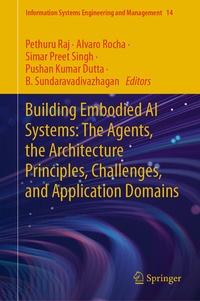
Building Embodied AI Systems: The Agents, the Architecture Principles, Challenges, and Application Domains
Description

This book is primed to demystify the emerging and evolving trend of embodied systems. It explains how these unique systems facilitate establishing smarter environments such as multi-specialty hospitals, manufacturing floors, warehouses, retail stores, defense zones, eating joints, entertainment plazas, etc., in detail for the benefit of our esteemed readers. To get a complete and actionable understanding of any mission-critical environment, we must deploy embodied systems. These systems, such as robots, drones, etc., are physical entities that are embedded and empowered with software systems. They interact with the environment in real time, providing context-aware services. There are chapters exclusively delineating the technologies behind the realization and deployment of such enigmatic systems. The prominent industrial use cases are explained in the latter chapters.
More details
Other editions
Additional editions
Content
Chapter 1. Building Embodied AI Systems: The Agents, the Architectural Principles, Challenges and Application Domains.- Chapter 2. Demystifying Embodied AI.- Chapter 3. Navigating the Nexus: Unravelling Challenges, Ethics, and Applications of Embodied AI in Drone Technology through the Lens of Computer Vision.- Chapter 4. Artificial Intelligence Algorithm Models For Agents Of Embodiment For Drone Applications.- Chapter 5. Artificial intelligence algorithms and models for embodied agents: enhancing autonomy in drones and robots.- Chapter 6. Enhanced Security and Privacy from Industry 4.0 and 5.0 Vision.- Chapter 7. Exploring applications: intelligent drones and robots in industrial settings.- Chapter 8. The Industrial Revolution: Harnessing Embodied AI Systems.- Chapter 9. Synergistic Fusion: Vision-Language Models in Advancing Autonomous Driving and Intelligent Transportation Systems.- Chapter 10. Health Care Industry Use Cases of Embodied AI.- Chapter 11. Computing, clouds, analytics and artificial intelligence at the edge.-...Etc.
