

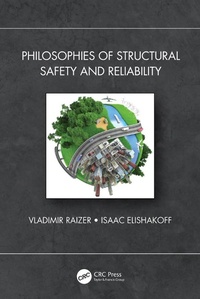
Philosophies of Structural Safety and Reliability
1st Edition
Published on 28. July 2022
286 pages
978-1-000-55072-6 (ISBN)
Description

Uncertainty is certain to be found in structural engineering, making it crucial to structure design. This book covers three competing philosophies behind structural safety and reliability: probabilistic analysis, fuzzy set-based treatments, and the convex approach.
Explaining the theory behind probabilistic analysis, fuzzy set-based treatments, and the convex approach in detail, alongside their implementation, use, and benefits, the book compares and contrasts these methods, enabling the reader to solve problems associated with uncertainty. These uncertainty issues can be seen in civil engineering structures, risk of earthquakes, impact of rough seas on ships, and turbulence affecting aerospace vehicles. Building on the authors' many years of experience in the field, Philosophies of Structural Safety and Reliability is an essential guide to structural uncertainty. Topics covered in the book include properties of materials and their structural deterioration, safety factor and reliability, risk evaluation and loads, and their combinations.
This book will be of interest to students and professionals in the fields of aerospace, civil, mechanical, marine, and ocean engineering.
Explaining the theory behind probabilistic analysis, fuzzy set-based treatments, and the convex approach in detail, alongside their implementation, use, and benefits, the book compares and contrasts these methods, enabling the reader to solve problems associated with uncertainty. These uncertainty issues can be seen in civil engineering structures, risk of earthquakes, impact of rough seas on ships, and turbulence affecting aerospace vehicles. Building on the authors' many years of experience in the field, Philosophies of Structural Safety and Reliability is an essential guide to structural uncertainty. Topics covered in the book include properties of materials and their structural deterioration, safety factor and reliability, risk evaluation and loads, and their combinations.
This book will be of interest to students and professionals in the fields of aerospace, civil, mechanical, marine, and ocean engineering.
More details
Edition
1. Auflage
Language
English
Place of publication
London
United Kingdom
Publishing group
Taylor & Francis Ltd
Target group
College/higher education
Illustrations
26 Tables, black and white; 91 Line drawings, black and white; 91 Illustrations, black and white
ISBN-13
978-1-000-55072-6 (9781000550726)
Copyright in bibliographic data and cover images is held by Nielsen Book Services Limited or by the publishers or by their respective licensors: all rights reserved.
Schweitzer Classification
Other editions
Additional editions
Vladimir Raizer | Isaac Elishakoff
Philosophies of Structural Safety and Reliability
Book
08/2024
1st Edition
CRC Press
€71.70
Shipment within 10-20 days
Vladimir Raizer | Isaac Elishakoff
Philosophies of Structural Safety and Reliability
Book
07/2022
1st Edition
CRC Press
€206.70
Shipment within 10-20 days
Persons
Isaac Elishakoff is Professor at Florida Atlantic University. Previously ASME distinguished lecturer, he has published over 370 papers and is associate editor of four journals.
Vladimir Razier is at FC&T Corporation in San Diego California, after working as Professor in the Department of Structural Mechanics at Moscow State Engineering University.
Vladimir Razier is at FC&T Corporation in San Diego California, after working as Professor in the Department of Structural Mechanics at Moscow State Engineering University.
Content
Preface
1. Introduction
2. Historical Notes
3. Safety Factor and Reliability index
4. Evaluation of Failure Probability
5. Alternative Definitions of the Fuzzy Safety Factor
6. Convex Models of Uncertainty
7. Systems and Components
8. Loads and Their Combinations
9. Properties of Materials and Structural Deterioration
10. Risk Evaluation and Optimal Probabilistic Design
11. Natural Disasters and Structural Survivability
12. Conclusion
1. Introduction
2. Historical Notes
3. Safety Factor and Reliability index
4. Evaluation of Failure Probability
5. Alternative Definitions of the Fuzzy Safety Factor
6. Convex Models of Uncertainty
7. Systems and Components
8. Loads and Their Combinations
9. Properties of Materials and Structural Deterioration
10. Risk Evaluation and Optimal Probabilistic Design
11. Natural Disasters and Structural Survivability
12. Conclusion
