

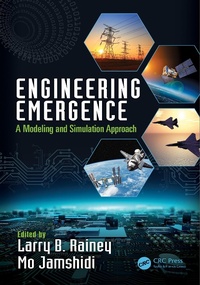
Engineering Emergence
A Modeling and Simulation Approach
Published on 3. September 2018
566 pages
978-1-351-69484-1 (ISBN)
Description

This book examines the nature of emergence in context of man-made (i.e. engineered) systems, in general, and system of systems engineering applications, specifically. It investigates emergence to interrogate or explore the domain space from a modeling and simulation perspective to facilitate understanding, detection, classification, prediction, control, and visualization of the phenomenon. Written by leading international experts, the text is the first to address emergence from an engineering perspective.
"System engineering has a long and proud tradition of establishing the integrative view of systems. The field, however, has not always embraced and assimilated well the lessons and implications from research on complex adaptive systems. As the editors' note, there have been no texts on Engineering Emergence: Principles and Applications. It is therefore especially useful to have this new, edited book that pulls together so many of the key elements, ranging from the theoretical to the practical, and tapping into advances in methods, tools, and ways to study system complexity. Drs. Rainey and Jamshidi are to be congratulated both for their vision of the book and their success in recruiting contributors with so much to say. Most notable, however, is that this is a book with engineering at its core. It uses modeling and simulation as the language in which to express principles and insights in ways that include tight thinking and rigor despite dealing with notably untidy and often surprising phenomena."
- Paul K. Davis, RAND and Frederick S. Pardee RAND Graduate School
The first chapter is an introduction and overview to the text.
The book provides 12 chapters that have a theoretical foundation for this subject.
Includes 7 specific example chapters of how various modeling and simulation paradigms/techniques can be used to investigate emergence in an engineering context to facilitate understanding, detection, classification, prediction, control and visualization of emergent behavior.
The final chapter offers lessons learned and the proposed way-ahead for this discipline.
"System engineering has a long and proud tradition of establishing the integrative view of systems. The field, however, has not always embraced and assimilated well the lessons and implications from research on complex adaptive systems. As the editors' note, there have been no texts on Engineering Emergence: Principles and Applications. It is therefore especially useful to have this new, edited book that pulls together so many of the key elements, ranging from the theoretical to the practical, and tapping into advances in methods, tools, and ways to study system complexity. Drs. Rainey and Jamshidi are to be congratulated both for their vision of the book and their success in recruiting contributors with so much to say. Most notable, however, is that this is a book with engineering at its core. It uses modeling and simulation as the language in which to express principles and insights in ways that include tight thinking and rigor despite dealing with notably untidy and often surprising phenomena."
- Paul K. Davis, RAND and Frederick S. Pardee RAND Graduate School
The first chapter is an introduction and overview to the text.
The book provides 12 chapters that have a theoretical foundation for this subject.
Includes 7 specific example chapters of how various modeling and simulation paradigms/techniques can be used to investigate emergence in an engineering context to facilitate understanding, detection, classification, prediction, control and visualization of emergent behavior.
The final chapter offers lessons learned and the proposed way-ahead for this discipline.
Reviews / Votes
"System engineering has a long and proud tradition of establishing the integrative view of systems. The field, however, has not always embraced and assimilated well the lessons and implications from research on complex adaptive systems. As the editors' note, there have been no texts on Engineering Emergence: Principles and Applications. It is therefore especially useful to have this new, edited book that pulls together so many of the key elements, ranging from the theoretical to the practical, and tapping into advances in methods, tools, and ways to study system complexity. Drs. Rainey and Jamshidi are to be congratulated both for their vision of the book and their success in recruiting contributors with so much to say. Most notable, however, is that this is a book with engineering at its core. It uses modeling and simulation as the language in which to express principles and insights in ways that include tight thinking and rigor despite dealing with notably untidy and often surprising phenomena."- Paul K. Davis, RAND and Frederick S. Pardee RAND Graduate School
More details
Language
English
Place of publication
London
United Kingdom
Publishing group
Taylor & Francis Ltd
Target group
Professional and scholarly
Product notice
Reflowable
Illustrations
41 Tables, black and white; 181 Line drawings, black and white; 21 Halftones, color
File size
6,07 MB
ISBN-13
978-1-351-69484-1 (9781351694841)
Copyright in bibliographic data and cover images is held by Nielsen Book Services Limited or by the publishers or by their respective licensors: all rights reserved.
Schweitzer Classification
Other editions
Additional editions
Book
09/2020
1st Edition
CRC Press
€75.50
Shipment within 15-20 days
Book
08/2018
1st Edition
CRC Press
€274.10
Shipment within 10-20 days
Persons
Larry B. Rainey, Ph.D. is Founder and Senior Partner at Integrity Systems and Solutions of Colorado, LLC, a consulting firm that specializes in modeling and simulation within missile defense and space operations domains. Dr. Rainey has also worked for the Missile Defense Agency and other U.S. Department of Defense organizations that address system of systems challenges. He has also been an assistant professor of systems engineering at the Colorado Technical University in Colorado Springs, Colorado and a visiting assistant professor of astronautical engineering at the Air Force Institute of Technology at Wright-Patterson Air Force Base, Ohio. He is the executive editor of four other major texts on the application of modeling and simulation and the author of many technical articles addressing the applications of systems theory and cybernetics to real world problems.
Content
Section I Introduction and Overview 1. Introduction and Overview for Engineering Emergence: A Modeling and Simulation Approach 2. System of Systems Engineering-An Overview Section II Theoretical Perspectives 3. DEVS-Based Modeling and Simulation Framework for Emergence in System of Systems 4. Sources for Emergence and Development of System of Systems 5. Leveraging Deterministic Chaos to Mitigate Combinatorial Explosions 6. Phenomenological and Ontological Models for Predicting Emergence 7. System of Systems Process Model 8. An Ontology of Emergence 9. Modeling and Validation Challenges for Complex Systems 10. Foundations for the Modeling and Simulation of Emergent Behavior Systems 11. Characterizing Emergent Behavior in Systems of Systems 12. Engineered to Be Secure 13. Cyber Insecurity Is Growing 14. The Challenge of Performing Research Which Will Contribute Helpful Engineering Knowledge Concerning Emergence Section III Theoretical Perspectives with Practical Applications 15. Examination of Emergent Behavior in the Ballistic Missile Defense System: A Modeling and Simulation Approach 16. Simulating Variable System Structures for Engineering Emergence 17. Emergence as a Macroscopic Feature in Man-Made Systems 18. Monterey Phoenix-Behavior Modeling Approach for the Early Verification and Validation of System of Systems Emergent Behaviors 19. A Model-Based Approach to Investigate Emergent Behaviors in Systems of Systems 20. InterDyne: A Simulation Method for Exploring Emergent Behavior Deriving from Interaction Dynamics 21. Emergence in the Context of System of Systems Section IV Summary 22. Lessons Learned and the Proposed Way-Ahead
