

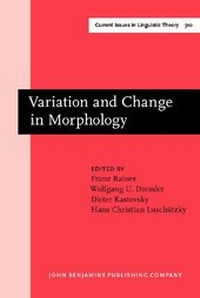
Variation and Change in Morphology
Selected papers from the 13th International Morphology Meeting, Vienna, February 2008
1st Edition
Published on 24. February 2010
VII, 249 pages
978-90-272-8852-3 (ISBN)
Description

The papers in this volume derive from the 13th International Morphology Meeting (Vienna 2008). They all address the main topic of the meeting, viz. variation and change in morphology. Inflectional and derivational morphology are represented on equal terms. The focus is on cases of language-internal variation, such as pattern competition, base variation, form-function mismatches, or morphological pleonasm. Other recurring themes are language contact as a cause of variation, the output-orientedness of morphological patterns, and linguistic economy.The contributions cover a wide variety of languages, both Indo-European (Romance, Germanic and Slavic; Latin, Lithuanian and Romani) and non-Indo-European (Hungarian, Maay, Chinese).
More details
Other editions
Additional editions
Franz Rainer | Wolfgang U. Dressler | Dieter Kastovsky
Variation and Change in Morphology
Selected papers from the 13th International Morphology Meeting, Vienna, February 2008
Book
02/2010
John Benjamins Publishing Co
€111.30
Shipment within 10-15 days
Persons
Content
- Variation and Change in Morphology
- Editorial page
- Title page
- LCC data
- Table of contents
- Foreword & acknowledgements
- Editors' introduction
- 1. What the volume is not about
- 2. Overview
- 3. Kinds of variation
- 4. Causes for variation and change
- 5. Variation and output-orientation
- 6. Variation, change and economy
- References
- Affixation vs. conversion
- 1. Introduction
- 2. Method
- 3. Competing processes
- 3.1 -En suffixation vs. conversion
- 3.2 Phonological
- 3.3 Semantic
- 3.4 Historical
- 3.5 Current usage
- 4. Discussion
- 5. Conclusions
- References
- The -alis/-aris allomorphy revisited
- 1. Introduction
- 2. The incidence of liquids in general
- 3. Cooccurrence constraints on l
- 3.1 The -alis/-aris allomorphy: Data
- 3.2 The phonology of the -alis/-aris allomorphy
- 3.3 Adjectives in -ilis/ile
- 3.4 Non-coronal C + V + l suffixes
- 3.5 Diminutives
- 4. Cooccurrence constraints on r
- 4.1 or/-oris and -ur/-uris
- 4.2 Other derivational r-suffixes
- 4.3 Inflectional endings with r
- 4.4 r in pre-stem morphology
- 5. Conclusion
- References
- French property nouns based on toponyms or ethnic adjectives
- 1. Introduction
- 2. The problem
- 2.1 Adjective-based -ité EPNs
- 2.2 EPNs directly formed on toponyms
- 3. The data
- 3.1. Methodology
- 3.2 Three EPN base types
- 3.3 Heterogeneous quantitative results
- 4. The analysis
- 4.1. Base variation: not a matter of meaning
- 4.2 Base variation: A matter of form
- 4.2.1 Avoidance strategies
- 4.2.2 Preference strategies
- 4.2.3 Combining strategies
- 4.3 Experiment: Student survey
- 5. Conclusion
- References
- Morphological variation in the construction of French names for inhabitants
- 1. Introduction
- 1.1 Basic assumptions
- 1.2 Aims of the paper
- 2. Description of the derivation: Structure
- 2.1 Stem modification
- 2.2 Suffixation
- 2.3 Summary
- 3. Theoretical discussion
- 3.1. Argumentation for the output orientation
- 3.2 Theoretical aspects: graduality, surface factors
- 4. Conclusion
- References
- The invisible hand of grammaticalization
- 1. Introduction
- 2. Form/meaning mismatches in morphology
- 3. The ge-prefix and the perfect periphrasis
- 4. The IPP and the expansion of the perfect periphrasis in MHG
- 5. Conclusion
- References
- Paradigmatic realignment and morphological change
- 1. Introduction
- 2. Paradigmatic reorganization
- 3. Network Morphology and separationism
- 4. Deponency and paradigm linkage in Network Morphology
- 5. Diachronic deponency in Network Morphology
- 5.1 Activation of deponents
- 5.2 Passivation of deponents
- 5.3 Realignment and virtual paradigms
- 5.3.1 Neo-deponents and virtual paradigms
- 5.3.2 Variation and virtual paradigms
- 6. Concluding remarks
- References
- Areal-typological aspects of word-formation
- 1. Introduction
- 2. Aktionsart-formation
- 3. Conspicuous similarities in the aktionsart-systems in the Sprachbund
- 3.1 Formal similarities in the make-up of certain complex verbs
- 3.2 Some differences in the aktionsart-systems of the Sprachbund
- 4. Aktionsarten in Yiddish, Hungarian and Romani
- 4.1 Aktionsarten in Yiddish
- 4.2 Hungarian aktionsarten
- 4.3 Romani preverbs
- 4.3.1 Hungarian contact
- 4.3.2 Slavic contact
- 4.3.3 German contact
- 5. Outside of the Sprachbund
- 6. Conclusion
- References
- Variation and change in morphology and syntax
- 1. Introduction
- 2. Romance object agreement in typological perspective
- 2.1. Controller and conditions
- 2.2 Domain
- 2.3 Target and features
- 2.4 Intermediate summary
- 3. Variation and change in the morphology and syntax of Romance object agreement
- 3.1 Loss of object agreement despite preservation of participial inflection
- 3.2 Mutually independent changes in morphology and syntax
- 3.3 Morphosyntactic and morphological features interacting with syntactic change
- 3.4 Preservation of the agreement rule despite (partial) loss of participial inflection
- 4. An example of non-morphology-free syntax
- 5. Conclusion
- References
- Optional multiple plural marking in Maay
- 1. Introduction
- 2. Optional ME in Maay
- 3. An OCM analysis
- 4. Conclusion
- References
- Lettered words
- 1. Introduction
- 2. Lettered words as innovations in Chinese morphology
- 2.1 Bypassing traditional borrowing processes
- 2.2 Resolving the mismatch
- 2.3 Congruence between English morphemes and Chinese Zì
- 2.4 Compounds are integrated as hybrid words
- 3. Corpus study of lettered words
- 3.1 Research questions
- 3.2 Results
- 3.3 Discussion
- 4. Conclusions
- References
- Word creation
- 1. Introduction
- 2. The linguistic status of word creation
- 2.1 Creative techniques vs. regular rules or models of word formation
- 2.2 Creative techniques vs. similar unintentional operations
- 3. Communicative functions of word creation
- 4. A typology of creative techniques
- 4.1 Preliminary remarks
- 4.2 The typology
- 4.2.1 Word creation with and without linguistic input
- 4.2.2 Modification of an existing source form vs. extragrammatical word formation
- 4.2.3 Shortening
- 4.2.4 Alienation
- 4.2.5 Extragrammatical derivation
- 4.2.6 Blending
- 5. Concluding remarks
- Bibliography
- Pleonastic morphology dies hard
- 1. Introduction to morphological conservatism
- 2. Synchronic facts of standard Lithuanian
- 2.1 Definiteness marking
- 2.2 Beyond adjectives
- 2.3 Problems to be solved
- 2.3.1 Against clitics
- 2.3.2 Economy and naturalness
- 3. Glimpses of the past
- 4. Variation
- 4.1 The Lithuanian dialect cluster
- 4.2 North of the border
- 5. Conclusions
- Abbreviations
- References
- Index of languages and terms
- Index of subjects and terms
- The series CURRENT ISSUES IN LINGUISTIC THEORY
