

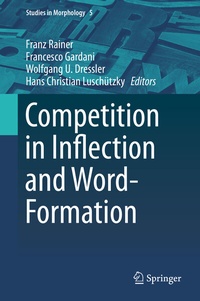
Competition in Inflection and Word-Formation
Description

This is the first volume specifically dedicated to competition in inflection and word-formation, a topic that has increasingly attracted attention. Semantic categories, such as concepts, classes, and feature bundles, can be expressed by more than one form or formal pattern. This departure from the ideal principle "one form - one meaning" is particularly frequent in morphology, where it has been treated under diverse headings, such as blocking, Elsewhere Condition, Pa?ini's Principle, rivalry, synonymy, doublets, overabundance, suppletion and other terms. Since these research traditions, despite the heterogeneous terminology, essentially refer to the same underlying problems, this volume unites the phenomena studied in this field of linguistic morphology under the more general heading of competition.
The volume features an extensive state of the art report on the subject and 11 research papers, which represent various theoretical approaches to morphology and addressa wide range of aspects of competition, including morphophonology, lexicology, diachrony, language contact, psycholinguistics, sociolinguistics and language acquisition.
More details
Other editions
Additional editions
Content
Competition in morphology: A historical outline; Gardani, Francesco, Franz Rainer & Hans Christian Luschützky.- Part I: Derivational morphology.- Competitors and alternants in linguistic morphology; Aronoff, Mark.- Competition in derivation: What can we learn from French doublets in -age and -ment? Fradin, Bernard.- Competition between event-denoting deverbal nouns and nominal infinitives in Italian; Varvara, Rossella & Roberto Zamparelli.- Rivalry and lack of blocking among Italian and German diminutives in adult and child language; Dressler, Wolfgang U., Lavinia Merlini Barbaresi, Sonja Schwaiger, Jutta Ransmayr, Sabine Sommer-Lolei and Katharina Korecky-Kröll.- Blocking as a function of the nature of linguistic representations: Where psycholinguistics and morphology meet; Versloot, Arjen & Eric Hoekstra.- Part II: Inflectional morphology.- When nobody wins; Gorman, Kyle & Charles Yang.- Competition in Frisian past participles; Anne Merkuur,Jan Don, Eric Hoekstra & Arjen Versloot.- Overabundance: A canonical typology; Anna M. Thornton.- An apparently noncanonical pattern of morphotactic competition; Gregory Stump.- Part III: Multiword expressions and compounding.- Competition between morphological words and multiword expressions; Francesca Masini.- Chinese adjective-noun combinations; Xu Zheng.
