

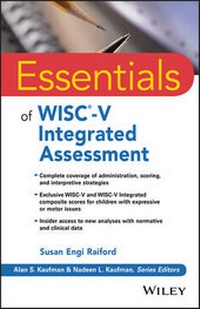
Essentials of WISC-V Integrated Assessment
Description

More details
Other editions
Additional editions
Person
Content
Acknowledgments xiii
Series Preface xv
About the Companion Website xvii
Resources on the Companion Website xix
WISC-V Integrated Interpretive Assistant 1.0 xix
Appendix A xix
Appendix B xx
One Overview 1
Historical Perspectives on the Process Approach to Cognitive Assessment 3
Development of the WISC-V Integrated 7
Key Revisions 7
Subtests 9
Composite Scores 19
Test Structure 19
New Essentials Composite Scores 21
Validity 23
Intercorrelation Studies 23
Standardization and Psychometric Properties 27
Comprehensive Test References 29
Test Yourself 30
Answers 31
References 31
Two Intelligent WISC-V Integrated Administration 35
Kathleen M. Rollins and Susan Engi Raiford
Test Materials 37
Physical Environment 39
Establishing and Maintaining Rapport 40
Subtest Administration Order 41
Selection of Subtests 42
Fairness 43
Start Points, Reverse Rules, and Discontinue Rules 45
Start Points 45
Reverse Rules 47
Discontinue Rules 47
Timing 50
Demonstration, Sample, and Teaching Items 50
Repetitions, Prompts, and Queries 51
Repetitions 51
Prompts 52
Queries 52
Recording Responses 53
Subtest-by-Subtest Administration 54
Verbal Comprehension Subtests 54
Visual Spatial Subtest 63
Fluid Reasoning Subtests 64
Working Memory Subtests 70
Processing Speed Subtests 75
Frequently Asked Questions: Subtest Administration 84
Test Yourself 86
Answers 87
References 87
Three WISC-V Integrated Scoring 91
Kathleen M. Rollins and Susan Engi Raiford
Scoring Subtests 91
Verbal Comprehension Subtests 91
Visual Spatial Subtest 94
Fluid Reasoning Subtests 94
Working Memory Subtests 97
Processing Speed Subtests 99
WISC-V Integrated Scores 106
Item Scores 106
Total Raw Scores 106
Standard Scores 106
Raw Scores 107
Step-by-Step: WISC-V Integrated Subtest-Level and Index Scores 108
Obtain Total Raw Scores 108
Obtain Scaled Subtest-Level Scores 110
Obtain Sums of Scaled Scores 111
Obtain Composite Scores 112
Using Q-global to Obtain the WISC-V Integrated Score Report 114
Ability-Achievement and Pattern of Strengths and Weaknesses Comparisons in Q-global 117
Frequently Asked Questions: Scoring 119
Test Yourself 120
Answers 122
References 122
Four Intelligently and Intuitively Incorporating the Integrated into WISC-V Interpretation 123
New Essentials Composite Scores 123
Essentials Expanded Index Scores 125
Nonmotor Composite Scores 131
Interpretative Strategies 133
Step 1. Examine Global Performance 134
Step 2. Report and Describe the Global Composite Score 142
Step 3. Select the Specific Composite Scores 142
Step 4. Report and Describe the Specific Composite Scores 147
Step 5. Report and Describe the Scaled Scores 147
Step 6. Report Index-Level Strengths and Weaknesses 148
Step 7. Report Subtest-Level Strengths and Weaknesses 152
Step 8. Evaluate Index-Level Pairwise Comparisons 154
Step 9. Evaluate Subtest- and Process-Level Pairwise Comparisons 157
Step 10. Report Base Rates/Percentile Norms (Longest Span or Sequence, Errors, Process Observations, and Coding Recall) 160
Step 11. Report Qualitative Aspects of Performance 171
Test Yourself 176
Answers 177
References 177
Five Review of the WISC-V Integrated 179
Ron Dumont and John O. Willis
Changes From the WISC-IV Integrated to the WISC-V Integrated 180
Subtests that were Eliminated 181
New Subtests 181
Administration Changes 182
Special Group Studies 183
Comparison of WISC-V and WISC-V Integrated Scores 186
Miscellaneous Comments 186
Standardization 189
Reliability 189
Validity 189
Administration 190
Conclusion 193
Test Yourself 193
Answers 195
References 195
Six Clinical Applications 197
Use of the WISC-V Integrated with Common School-Age Referral Questions 197
Children with Intellectual Giftedness 198
Children with Intellectual Disability 204
Children with Specific Learning Disorder in Reading 207
Children with Specific Learning Disorder in Math 208
Children with Attention-Deficit/Hyperactivity Disorder 209
Children with Traumatic Brain Injury 211
Children with Language Disorder-Expressive and Language Disorder-Receptive and Expressive 212
Children with Autism Spectrum Disorders 216
Summary of Special Group Performance 219
Test Yourself 220
Answers 222
References 222
Seven Illustrative Case Reports 225
Case Report: Jillian R.: Attention-Deficit/Hyperactivity Disorder 226
Referral Questions and Answers 227
Answers to Referral Questions 227
Evaluation Methods and Procedures 229
Current Symptoms 230
Background and History 231
Mental Status and Behavioral Observations 233
Test Results and Interpretation 235
Summary and Diagnostic Impressions 241
Recommendations 242
Appendix: Test Data 245
Wechsler Intelligence Scale for Children-Fifth Edition (WISC-V) and WISC-V Integrated 245
Case Report: Dennis E.: Specific Learning Disorder in Mathematics 254
Referral Questions and Answers 255
Answers to Referral Questions 255
History of Presenting Problem 256
Mental Status and Behavioral Observations 257
Test Results and Interpretation 257
Summary and Diagnostic Impressions 261
Recommendations 262
Appendix: Test Data 263
Wechsler Intelligence Scale for Children-Fifth Edition (WISC-V) and WISC-V Integrated 263
Test Yourself 267
Answers 268
About the Author 269
Contributors 271
Index 273
One
OVERVIEW
Why did this student score so low on WISC-V Arithmetic? Is it a problem with calculation speed, working memory, or math computation? It would help to be sure, so I could decide what to recommend.
I wonder if her visual working memory, if I could measure it, would be in the average range like her WISC-V Auditory Working Memory Index? It's important to know, so I can be surer about what accommodations to recommend.
These WISC-V results are odd. What do they mean? The child received a scaled score of 5 on Block Design but a scaled score of 10 on Visual Puzzles.
If this child didn't have to retrieve information and could just recognize it instead, would it maybe help as a modification?
These questions, and many others, can be addressed using the Wechsler Intelligence Scale for Children-Fifth Edition Integrated (WISC-V Integrated; Wechsler & Kaplan, 2015). The WISC-V Integrated is a companion measure of the most widely used intelligence test for children in the world, the Wechsler Intelligence Scale for Children-Fifth Edition (WISC-V; Wechsler, 2014). It enables practitioners to learn more about the cognitive processes and test-taking behaviors that affect performance on the WISC-V that also affect school performance.
The WISC-V was a substantial revision of this popular test, which continues the progressive trend of recent Wechsler intelligence scale revisions that mirror contemporary advances in intelligence theory, neuropsychology, cognitive neuroscience, and psychometric methodology. Major modifications were made to the content and structure of the WISC-V to reflect these advances. The WISC-V Integrated subtests can be used to understand WISC-V results in greater detail to enable practitioners to test hypotheses about WISC-V results and to inform intervention recommendations.
For example, where the WISC-V has Verbal Comprehension subtests (Similarities, Vocabulary, Information, and Comprehension), which each requires verbal expression of the responses, the WISC-V Integrated has multiple-choice versions of these subtests with the same items that allow selection of a response from among options that are read aloud to the child and viewed in a stimulus book. These are ideally suited for obtaining an estimate of verbal abilities without requiring expressive language.
The WISC-V Integrated also contains two index scores: the Multiple Choice Verbal Comprehension Index (MCVCI) and the Visual Working Memory Index (VWMI). These scores provide reliable and valid estimates of specific abilities that can be used in concert with the WISC-V index scores in a similar manner to the WISC-V Integrated subtests, which are used to understand WISC-V subtest performance. The index scores are useful in specific situations (e.g., conducting evaluations of children who may have expressive difficulties or challenges or obtaining a broader assessment of a particular area of concern, such as working memory problems).
This book expands on the selection of index scores to provide Essentials composite scores for situations in which appropriate measures of ability ideally would not involve motor skills (e.g., for a child with motor delays) or not rely on expressive responses (e.g., a child with language disorder with expressive impairment). These Essentials composite scores mirror the published WISC-V composite scores in some cases. For example, a Full Scale Score that does not require motor performance is included, as is a Full Scale Score that does not require expressive responses. Others among the Essentials composite scores were constructed as similar nonexpressive or nonmotor parallels of composite scores that were created by other authors (i.e., Flanagan & Alfonso, 2017; Kaufman, Raiford, & Coalson, 2016) and included in books to accommodate practical needs or interpretation using a Cattell-Horn-Carroll (CHC) framework.
The online resources for this book include an interpretive program that automatically calculates the Essentials composite scores not available within the published test and provides data relevant to comparisons of those index scores with WISC-V composite scores. These additional index scores were developed to enhance interpretation in special clinical situations (e.g., an expanded index score that is derived from more subtests on the cognitive domain, an index score that does not require expressive responses) and theoretical perspectives (e.g., CHC). The online resources that accompany this book include the WISC-V Integrated Interpretive Assistant 1.0, scoring software that calculates norms for the Essentials composite scores and walks the practitioner through the interpretive approach in Chapter 4, including numerous score comparisons not available in the published test that can more fully inform interpretation.
The WISC-V Integrated scores can be interpreted from a normative perspective. That is, a child's cognitive processes can be understood by comparing scores to those obtained by others of approximately the same age (i.e., comparison to a normative reference group). This comparison helps practitioner to understand how the child benefits from modifications or scaffolding in tasks relative to other children his or her age.
The WISC-V Integrated scores can also be interpreted from an intrapersonal perspective. A total raw score from a WISC-V subtest can be compared directly to a total raw score from a corresponding WISC-V Integrated adaptation subtest, because they have the same item content. This enables inferences about which cognitive processes affected performance on the WISC-V subtest and provides information about how a child might better succeed with accommodations or modifications for schoolwork.
The performance on WISC-V items of subtests with corresponding WISC-V Integrated adaptation subtests (e.g., Vocabulary and Vocabulary Multiple Choice, Arithmetic and Arithmetic Process Approach) can also be compared to learn more about the child's specific knowledge of content. For example, if the definition of cat is not expressed in response to an open-ended question, the child may be able to select the best meaning from among five response options, such as (a) An animal, (b) It eats cat food, (c) It runs, (d) It's furry, (e) It's small.
The goal of this book is to provide a go-to reference for novice examiners and proficient practitioners using the WISC-V Integrated. Administration, scoring, and interpretive information is clearly and succinctly covered in successive chapters, incorporating the familiar Rapid Reference, Caution, and Don't Forget boxes that are hallmark features of the Essentials series. The author, who was the lead WISC-V and WISC-V Integrated research director, also includes Behind the Scenes boxes that offer insights into the test development process. Test questions are included at the conclusion of each chapter to highlight critical content.
HISTORICAL PERSPECTIVES ON THE PROCESS APPROACH TO COGNITIVE ASSESSMENT
The process approach to cognitive assessment has its roots in ideas put forth by Heinz Werner (1937), who proposed that cognitive assessment that involves careful and systematic observation of problem-solving strategies yields information that is more rich and useful than correct-incorrect scoring. He suggested that cognitive task performance involves multiple, dynamic processes. Any of these processes may contribute individually or in combination with others to exert an influence on responses and performance. For example, a child may have difficulty with Block Design because of low motor skills, but another child low performance on the same task may be related to impaired visual spatial processing. Although both may score similarly on Block Design, the poor performance traces back to two different origins.
Process approaches to assessment recognize that in completing any cognitive task, regardless of its complexity, a number of mental processes are involved. These processes can range from simple (e.g., sensing, perceiving, motor functioning) to more complex (e.g., reasoning, decision making) (Kaufman et al., 2016). A problem with any of these processes can result in difficulties completing the overall task. The process approach aims to understand the reasons for low scores through identifying the cognitive processes that operate jointly on performance, breaking them down to more-specific components in a stepwise fashion or altering the task in some manner and testing hypotheses with tasks that involve fewer or different cognitive processes. For example, the hypothesis that low motor skills resulted in a lower Block Design score could be more closely examined by presenting the completed design and multiple pictured sets of blocks in a stimulus book and asking the examinee to select the set of blocks that, when assembled, make the design.
There are many approaches that have focused on understanding the cognitive processes involved in performance on the Wechsler scales, beginning with an approach first used by David Wechsler. He stated that "individuals attaining identical scores on intelligence tests cannot always be classified in the same way" (Wechsler, 1944, p. 12). Always a clinician, his approach was somewhat psychoanalytic in nature. It described how poor performance could result from various issues with cognitive processes and that information at the task and item level...
