

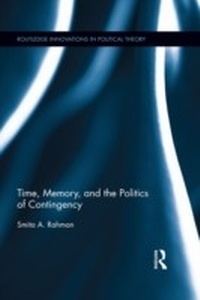
Time, Memory, and the Politics of Contingency
1st Edition
Published on 11. July 2014
144 pages
978-1-317-66832-9 (ISBN)
Description

In recent years, there has been an increased attention to temporality in political theory, and such attention is sorely needed. For too long political theory, with the exception of occasional phenomenological forays, has remained grounded in a particular experience of time as linear and sequential. This book aims to unsettle the dominant framework by putting time itself, and the experience of time in everyday life, at the center of its critical analysis.
Smita Rahman focuses on the experience of time as one where past, present, and future intermingle with each other and refuse to adhere to a sequential structure. Rather than trying to tame the flux of time, this book places this "out of joint" experience of time at the center of its analysis of global politics. Rahman takes the highly abstract concept of time and decenters it to speak to a wide range of political issues across disciplines. She does so by exposing the cultural construction of the foundational concept of time in political theory and attending closely to the challenges of cultural incommensurability that it encounters in a globalized world of difference. Specifically, the book looks at interrogation practices in Afghanistan, the challenges of coping with the burdens of collective memory in Algeria, South Africa, and Rwanda, the difficulty of uncritically applying such a framework to the Muslim world through the language of secularism, and finally at the beginnings of democratic emergence in Bangladesh to explore a politics of contingency.
By focusing on issues of contemporary global politics through the lens of political theory, this book draws on literature across disciplines and explores the complex image of time by engaging the work of thinkers for whom time and memory have emerged as a critical issue of analysis, and unpacking the politics of contingency that emerge from such a reading. The book's new insights on political temporality will interest scholars of contemporary political theory, comparative political theory, critical theory, human rights, conflict studies, and religion and politics.
Smita Rahman focuses on the experience of time as one where past, present, and future intermingle with each other and refuse to adhere to a sequential structure. Rather than trying to tame the flux of time, this book places this "out of joint" experience of time at the center of its analysis of global politics. Rahman takes the highly abstract concept of time and decenters it to speak to a wide range of political issues across disciplines. She does so by exposing the cultural construction of the foundational concept of time in political theory and attending closely to the challenges of cultural incommensurability that it encounters in a globalized world of difference. Specifically, the book looks at interrogation practices in Afghanistan, the challenges of coping with the burdens of collective memory in Algeria, South Africa, and Rwanda, the difficulty of uncritically applying such a framework to the Muslim world through the language of secularism, and finally at the beginnings of democratic emergence in Bangladesh to explore a politics of contingency.
By focusing on issues of contemporary global politics through the lens of political theory, this book draws on literature across disciplines and explores the complex image of time by engaging the work of thinkers for whom time and memory have emerged as a critical issue of analysis, and unpacking the politics of contingency that emerge from such a reading. The book's new insights on political temporality will interest scholars of contemporary political theory, comparative political theory, critical theory, human rights, conflict studies, and religion and politics.
Reviews / Votes
"Taking to heart critiques of progressive and salvific "universal" history, and of linear, homogeneous, conceptions of time consonant with it, this book gracefully sets aside any nostalgia for such time and history, and any desire to redeem an idea of the political still tethered to a wishful consensual time. Rahman gently, sincerely, and fluently invites us to a politics that submits itself to the shape of lives that continue to jar the reign of empty time, whether in the bloody, repetitive, farce of encountering the Other in liberal multiculturalism or the interrogation chamber, or in the rememberings and forgettings dictated by nation and state that paralyse becomings and overcomings, or still yet in the unrewarded but hopeful audacities of those who dare to stage moments of fugitive democracy in the backwaters of our supposedly shared global present. The book compels us to think difference in terms of dissonant but coexisting regimes of time, to moor ourselves ethically to the unruly and undisciplined nature of time as well as memory, and to continue to think, imagine, and desire global justice from these necessary dislocations. It is refreshingly free of the defensive and dizzying anxieties that infect many other proposed politics of contingency, as it is interested not in lamenting our fragilities or bemoaning the curses of history and time, but in what we might be keeping from happening when we do so, and in what our expectations for and from political action might look like if we embraced contingency as a constitutive and affirmative principle of politics rather than a problem for it. In doing so, this book performs its message. It is, thus, a gift for any reader interested in articulating a shared possibility in a discrepant world".-Asma Abbas, Bard College at Simon's Rock
"Time, Memory, and the Politics of Contingency at once argues for and enacts a prismatic image of time by excavating disjointed experiences of temporality past and present, from both within and beyond the familiar coordinates of the Western philosophical tradition. An eloquent call to take the disobedient rhythms of lived time not as problem in need of regularization and discipline, but as a clue to the eddies of memory and anticipation that shape and constrain the possibilities of political action in the present."
- Roxanne L. Euben, Ralph Emerson and Alice Freeman Palmer Professor of Political Science, Wellesley College
More details
Series
Edition
1. Auflage
Language
English
Place of publication
London
United Kingdom
Publishing group
Taylor & Francis Ltd
Target group
College/higher education
File size
0,63 MB
ISBN-13
978-1-317-66832-9 (9781317668329)
Copyright in bibliographic data and cover images is held by Nielsen Book Services Limited or by the publishers or by their respective licensors: all rights reserved.
Schweitzer Classification
Other editions
Additional editions
Smita A. Rahman
Time, Memory, and the Politics of Contingency
Book
04/2016
1st Edition
Routledge
€65.00
Shipment within 10-20 days
Smita A. Rahman
Time, Memory, and the Politics of Contingency
Book
07/2014
1st Edition
Routledge
€231.00
Shipment within 10-20 days
Person
Smita A. Rahman is Associate Professor of Political Science at DePauw University. She works at the intersection of Contemporary and Comparative political theory. In particular, she is interested in exploring how foundational concepts in political theory rupture and become contested in a globalized world of difference.
Content
Introduction 1. The Limits of "Our Time" 2. "Our Time" and the Transcendental Image of Thought 3. Complex Time, Memory, and the Ethics of Affirmation 4. The Politics of Memory 5. Secular Time and the Politics of Renewal Conclusion: Memories of War and the Politics of Contingency
