

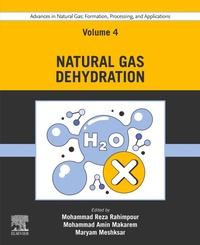
Advances in Natural Gas: Formation, Processing, and Applications. Volume 4: Natural Gas Dehydration
Published on 5. March 2024
570 pages
978-0-443-19222-7 (ISBN)
Description

Advances in Natural Gas: Formation, Processing, and Applications is a comprehensive eight-volume set of books that discusses in detail the theoretical basics and practical methods of various aspects of natural gas from exploration and extraction, to synthesizing, processing and purifying, producing valuable chemicals and energy. The volumes introduce transportation and storage challenges as well as hydrates formation, extraction, and prevention.
Volume 4 titled Natural Gas Dehydration introduces in detail different natural gas dehydration methods. The book covers absorption with different solvents such as glycols, ionic liquids, and DES which is one of the important dehydration techniques, as well as natural gas dehydration with adsorption-based technologies utilizing various materials including zeolites, carbonaceous sorbents, metal oxides, etc. It discusses in detail membrane-based processes with various types (such as hollow-fiber, polymeric, zeolite membranes) and includes novel technologies for sweetening natural gas by using direct cooling and compression, supersonic technology and micro-reactors.
- Introduces natural gas dehydration concepts and challenges
- Describes various absorption and adsorption processes for natural gas dehydration
- Discusses novel methods for natural gas dehydration including membrane and supersonic technologies
More details
Other editions
Additional editions
Mohammad Reza Rahimpour | Mohammad Amin Makarem | Maryam Meshksar
Advances in Natural Gas: Formation, Processing, and Applications. Volume 4: Natural Gas Dehydration
Formation, Processing, and Applications. Volume 4: Natural Gas Dehydration
Book
03/2024
Elsevier
€240.50
Shipment within 15-20 days
Content
PrefaceAcknowledgmentsAbout the Editors SECTION 1. Natural Gas Dehydration Concepts1. Introduction to natural gas dehydration methods and technologies2. Challenges of wet natural gas3. Environmental Challenges of Natural Gas Dehydration Technologies SECTION 2. Absorption Techniques for Natural Gas Dehydration4. Glycol absorbents for natural gas dehydration5. Ionic liquids for natural gas dehydration6. Deep eutectic solvents for natural gas dehydration SECTION 3. Adsorption Techniques for Natural Gas Dehydration7. Swing processes for natural gas dehydration: pressure, thermal, vacuum, electrical and mixed swing processes8. Carbonaceous sorbents for natural gas dehydration9. Zeolite and molecular sieves for natural gas dehydration10. Metal-oxide adsorbents and mesoporous silica for natural gas dehydration SECTION 4. Membrane Technology for Natural Gas Dehydration11. Hollow-fiber membranes for natural gas dehydration12. Zeolite membranes for natural gas dehydration13. Polymeric membranes for natural gas dehydration SECTION 5. Other Technologies for Natural Gas Dehydration14. Supersonic technology for natural gas dehydration
