

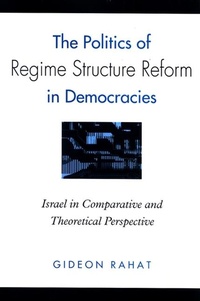
The Politics of Regime Structure Reform in Democracies
Description

This book examines the success or failure of initiatives aimed at reforming regime structures in democracies, particularly their electoral and government systems. Through a comparative analysis of the several attempts at this type of reform in Israel over more than four decades, Gideon Rahat begins with the failed attempts at electoral reform in the 1970s and 1980s. He then analyzes Israel's successful attempt at promoting government system reform from 1988 to 1992. Finally, he compares the Israeli cases to cases of electoral reform in New Zealand, Japan, and Italy in the 1990s. While the book focuses on the Israeli cases, it places Israel within a comparative framework and makes an important contribution to the debate concerning the politics behind regime structure reform.
Gideon Rahat is a Lecturer in the Department of Political Science at the Hebrew University of Jerusalem.
More details
Other editions
Additional editions
Person
Gideon Rahat is a Lecturer in the Department of Political Science at the Hebrew University of Jerusalem.
Content
List of Tables
List of Abbreviations
Acknowledgments
Introduction
1. Stability and Reform of the Regime Structures of Established Democracies
PART ONE
The Politics of Electoral Reform in Israel
2. The Electoral System, 1948-1969: A Brief Historical Overview
3. The Politics of Electoral Reform, 1969-1977: The Failure to Promote Compromise
4. The Politics of Electoral Reform, 1984-1990: From (Knesset) Electoral Reform to Government System Reform
PART TWO
The Politics of Government System Reform in Israel, 1988-1992
5. Long-Term Developments, Catalyzing Events, and the Reform Initiative
6. The Actors
7. The Stages of the Reform Process and Overcoming the Barriers
PART THREE
Reform of Regime Structures of Established Democracies in Historical and Cross-National Comparative Perspectives
8. The Israeli Case Studies in a Historical-Comparative Perspective
9. The Politics of Regime Structure Reform in Established Democracies: A Cross-National Comparative Perspective
Conclusions
Epilogue
Notes
Bibliography
Author Index
Subject Index
