

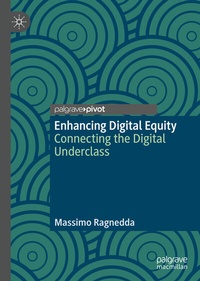
Enhancing Digital Equity
Description

This book highlights how, in principle, digital technologies present an opportunity to reduce social disparities, tackle social exclusion, enhance social and civil rights, and promote equity. However, to achieve these goals, it is necessary to promote digital equity and connect the digital underclass. The book focuses on how the advent of technologies may become a barrier to social mobility and how, by concentrating resources and wealth in few hands, the digital revolution is giving rise to the digital oligarchy, further penalizing the digital underclass. Socially-disadvantaged people, living at the margins of digital society, are penalized both in terms of accessing-using-benefits (three levels of digital divide) but also in understanding-programming-treatment of new digital technologies (three levels of algorithms divide). The advent and implementation of tools that rely on algorithms to make decisions has further penalized specific social categories by normalizing inequalities inthe name of efficiency and rationalization.
Reviews / Votes
"The "digital divide" debate needs a radical update for an age of algorithmic power and intensifying inequality. In this accessible and well-organised text, Massimo Ragnedda provides this and more, enriching our understanding of how inequality works today and what digital equity might mean. Timely and important!" (Nick Couldry, Professor of Media, Communications and Social Theory, London School of Economics and Political Science, UK.
"Division, exclusion and inequality: these issues have long been the focal point for social scientific work. In a changing world, we now need to understand their continuities and reformulations. This sparky and ambitious book takes on this challenge and produces insights that will be of interest to anyone who seeks to genuinely understand how the social world works today." (David Beer, Professor of Sociology, University of York, UK)
More details
Other editions
Additional editions
Person
Massimo Ragnedda is Senior Lecturer at Northumbria University, UK, where he conducts research on the digital divide and social media. He is co-vice chair of the Digital Divide Working Group (IAMCR) and co-convenor of Northumbria Internet and Society Research Group. He has authored twelve books and numerous articles in English, Spanish, Italian, Portuguese and Russian.
Content
1. Theorizing Inequalities.- 2. Old digital inequalities: Digital Divide.- 3. New digital Inequalities: Algorithms divide.- 4. Connecting the digital Underclass.- 5. Conclusions.
