

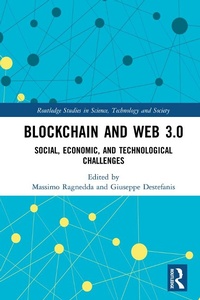
Blockchain and Web 3.0
Social, Economic, and Technological Challenges
1st Edition
Published on 9. July 2019
334 pages
978-0-429-64237-1 (ISBN)
Description

Blockchain is no longer just about bitcoin or cryptocurrencies in general. Instead, it can be seen as a disruptive, revolutionary technology which will have major impacts on multiple aspects of our lives. The revolutionary power of such technology compares with the revolution sparked by the World Wide Web and the Internet in general. Just as the Internet is a means of sharing information, so blockchain technologies can be seen as a way to introduce the next level: sharing value.
Blockchain and Web 3.0 fills the gap in our understanding of blockchain technologies by hosting a discussion of the new technologies in a variety of disciplinary settings. Indeed, this volume explains how such technologies are disruptive and comparatively examines the social, economic, technological and legal consequences of these disruptions. Such a comparative perspective has previously been underemphasized in the debate about blockchain, which has subsequently led to weaknesses in our understanding of decentralized technologies.
Underlining the risks and opportunities offered by the advent of blockchain technologies and the rise of Web 3.0, this book will appeal to researchers and academics interested in fields such as sociology and social policy, cyberculture, new media and privacy and data protection.
Blockchain and Web 3.0 fills the gap in our understanding of blockchain technologies by hosting a discussion of the new technologies in a variety of disciplinary settings. Indeed, this volume explains how such technologies are disruptive and comparatively examines the social, economic, technological and legal consequences of these disruptions. Such a comparative perspective has previously been underemphasized in the debate about blockchain, which has subsequently led to weaknesses in our understanding of decentralized technologies.
Underlining the risks and opportunities offered by the advent of blockchain technologies and the rise of Web 3.0, this book will appeal to researchers and academics interested in fields such as sociology and social policy, cyberculture, new media and privacy and data protection.
More details
Series
Edition
1. Auflage
Language
English
Place of publication
London
United Kingdom
Publishing group
Taylor & Francis Ltd
Target group
College/higher education
Illustrations
25 Tables, black and white; 46 Halftones, black and white
ISBN-13
978-0-429-64237-1 (9780429642371)
Copyright in bibliographic data and cover images is held by Nielsen Book Services Limited or by the publishers or by their respective licensors: all rights reserved.
Schweitzer Classification
Other editions
Additional editions
Massimo Ragnedda | Giuseppe Destefanis
Blockchain and Web 3.0
Social, Economic, and Technological Challenges
Book
03/2021
1st Edition
Routledge
€69.00
Shipment within 15-20 days
Massimo Ragnedda | Giuseppe Destefanis
Blockchain and Web 3.0
Social, Economic, and Technological Challenges
Book
07/2019
1st Edition
Routledge
€207.00
Shipment within 15-20 days
Persons
Massimo Ragnedda is a senior lecturer in mass communication at Northumbria University, Newcastle, UK.
Giuseppe Destefanis is a lecturer in the Department of Computer Science at Brunel University, UK.
Giuseppe Destefanis is a lecturer in the Department of Computer Science at Brunel University, UK.
Content
1. Introduction-Blockchain: a disruptive technology (Massimo Ragnedda and Giuseppe Destefanis)
PART I: Socio-economic aspects and consequences of decentralized technologies
2. The block is hot: A commons-based approach to the development and deployment of blockchains (Sune Sandbeck, A.T. Kingsmith, Julian von Bargen)
3. Can permissionless blockchains be regulated and resolve some of the problems of copyright law? (Guido Noto La Diega and James Stacey)
4. Meetups: Making space for women on the blockchain (Philippa R. Adams, Julie Frizzo-Barker, Betty B. Ackah, Peter A. Chow-White)
5. Drivers of Digital Trust in the Crypto Industry (Scott Freeman, Ivana Beveridge, Jannis Angelis)
6. Lightbulb Concrete (Bronwin Patrickson)
PART II: Blockchain and Digital Media
7. Could blockchain save journalism? An explorative study of blockchain's potential to make journalism a more sustainable business (Walid Al-Saqaf and Malin Picha Edwardsson)
8. The logics of technology decentralization: The case of Distributed Ledger Technologies (Balazs Bodo and Alexandra Giannopoulou)
9. Disruptive Blockworks: Blockchains and networks / acceleration and collision (Matthew Lovett)
10. Blockchained to What (End)? A Socio-material provocation to check distributed futures (Luke Heemsbergen, Alexia Maddox Robbie Fordyce)
11. Blockchain and data market: The case of Wibson from a critical perspective (Guillermina Yansen)
PART III: Technological aspects and consequences of decentralized technologies
12. Applying Smart Contracts in Online Dispute Resolutions on a Large Scale and its Regulatory Implications (Janet Hui Xue and Ralph Holz)
13. SmartAnvil: Open-Source. Tool Suite for Smart Contract Analysis (Stephane Ducasse, Henrique Rocha, Santiago Bragagnolo and Marcus Denker)
14. Managing CRM with Fabric Hyperledger blockchain technology (Dario Puligheddu, Roberto Tonelli and Michele Marchesi)
15. Privacy with Ethereum Smart Contracts (Duarte Teles and Isabel Azevedo)
16. A Hierarchical Structure Model of Success Factors for-Blockchain-based-Crowdfunding (Felix Hartmann, Xiaofeng Wang and Maria Ilaria Lunesu)
PART I: Socio-economic aspects and consequences of decentralized technologies
2. The block is hot: A commons-based approach to the development and deployment of blockchains (Sune Sandbeck, A.T. Kingsmith, Julian von Bargen)
3. Can permissionless blockchains be regulated and resolve some of the problems of copyright law? (Guido Noto La Diega and James Stacey)
4. Meetups: Making space for women on the blockchain (Philippa R. Adams, Julie Frizzo-Barker, Betty B. Ackah, Peter A. Chow-White)
5. Drivers of Digital Trust in the Crypto Industry (Scott Freeman, Ivana Beveridge, Jannis Angelis)
6. Lightbulb Concrete (Bronwin Patrickson)
PART II: Blockchain and Digital Media
7. Could blockchain save journalism? An explorative study of blockchain's potential to make journalism a more sustainable business (Walid Al-Saqaf and Malin Picha Edwardsson)
8. The logics of technology decentralization: The case of Distributed Ledger Technologies (Balazs Bodo and Alexandra Giannopoulou)
9. Disruptive Blockworks: Blockchains and networks / acceleration and collision (Matthew Lovett)
10. Blockchained to What (End)? A Socio-material provocation to check distributed futures (Luke Heemsbergen, Alexia Maddox Robbie Fordyce)
11. Blockchain and data market: The case of Wibson from a critical perspective (Guillermina Yansen)
PART III: Technological aspects and consequences of decentralized technologies
12. Applying Smart Contracts in Online Dispute Resolutions on a Large Scale and its Regulatory Implications (Janet Hui Xue and Ralph Holz)
13. SmartAnvil: Open-Source. Tool Suite for Smart Contract Analysis (Stephane Ducasse, Henrique Rocha, Santiago Bragagnolo and Marcus Denker)
14. Managing CRM with Fabric Hyperledger blockchain technology (Dario Puligheddu, Roberto Tonelli and Michele Marchesi)
15. Privacy with Ethereum Smart Contracts (Duarte Teles and Isabel Azevedo)
16. A Hierarchical Structure Model of Success Factors for-Blockchain-based-Crowdfunding (Felix Hartmann, Xiaofeng Wang and Maria Ilaria Lunesu)
