

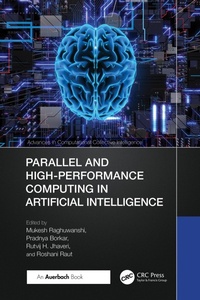
Parallel and High-Performance Computing in Artificial Intelligence
1st Edition
Published on 20. May 2025
340 pages
978-1-040-33270-2 (ISBN)
Description

Parallel and High-Performance Computing in Artificial Intelligence explores high-performance architectures for data-intensive applications as well as efficient analytical strategies to speed up data processing and applications in automation, machine learning, deep learning, healthcare, bioinformatics, natural language processing (NLP), and vision intelligence.
The book's two major themes are high-performance computing (HPC) architecture and techniques and their application in artificial intelligence. Highlights include:
HPC use cases, application programming interfaces (APIs), and applications
Parallelization techniques
HPC for machine learning
Implementation of parallel computing with AI in big data analytics
HPC with AI in healthcare systems
AI in industrial automation
Coverage of HPC architecture and techniques includes multicore architectures, parallel-computing techniques, and APIs, as well as dependence analysis for parallel computing. The book also covers hardware acceleration techniques, including those for GPU acceleration to power big data systems.
As AI is increasingly being integrated into HPC applications, the book explores emerging and practical applications in such domains as healthcare, agriculture, bioinformatics, and industrial automation. It illustrates technologies and methodologies to boost the velocity and scale of AI analysis for fast discovery. Data scientists and researchers can benefit from the book's discussion on AI-based HPC applications that can process higher volumes of data, provide more realistic simulations, and guide more accurate predictions. The book also focuses on deep learning and edge computing methodologies with HPC and presents recent research on methodologies and applications of HPC in AI.
The book's two major themes are high-performance computing (HPC) architecture and techniques and their application in artificial intelligence. Highlights include:
HPC use cases, application programming interfaces (APIs), and applications
Parallelization techniques
HPC for machine learning
Implementation of parallel computing with AI in big data analytics
HPC with AI in healthcare systems
AI in industrial automation
Coverage of HPC architecture and techniques includes multicore architectures, parallel-computing techniques, and APIs, as well as dependence analysis for parallel computing. The book also covers hardware acceleration techniques, including those for GPU acceleration to power big data systems.
As AI is increasingly being integrated into HPC applications, the book explores emerging and practical applications in such domains as healthcare, agriculture, bioinformatics, and industrial automation. It illustrates technologies and methodologies to boost the velocity and scale of AI analysis for fast discovery. Data scientists and researchers can benefit from the book's discussion on AI-based HPC applications that can process higher volumes of data, provide more realistic simulations, and guide more accurate predictions. The book also focuses on deep learning and edge computing methodologies with HPC and presents recent research on methodologies and applications of HPC in AI.
More details
Series
Edition
1. Auflage
Language
English
Place of publication
London
United Kingdom
Publishing group
Taylor & Francis Ltd
Target group
College/higher education
Illustrations
60 Line drawings, black and white; 60 Illustrations, black and white
File size
9,60 MB
ISBN-13
978-1-040-33270-2 (9781040332702)
Copyright in bibliographic data and cover images is held by Nielsen Book Services Limited or by the publishers or by their respective licensors: all rights reserved.
Schweitzer Classification
Other editions
Additional editions
Mukesh Raghuwanshi | Pradnya Borkar | Rutvij H. Jhaveri
Parallel and High-Performance Computing in Artificial Intelligence
Book
05/2025
1st Edition
Auerbach
€244.00
Shipment within 10-20 days
Persons
Dr. M. M. Raghuwanshi is the Dean of Engineering at S.B.Jain Institute of Technology Management and Research, Nagpur, India.
Dr. Pradnya Borkar is an Associate Professor at the Department of Computer Science and Engineering and R&D Cell Incharge, Jhulelal Institute of Technology, Nagpur.
Dr. Rutvij H. Jhaveri is an experienced researcher working in the Department of Computer Science & Engineering, Pandit Deendayal Energy University (PDEU/PDPU), Gandhinagar, India since Dec. 2019.
Dr. Roshani Raut is an as Associate Professor in the Department of Information Technology and Associate Dean International Relations, in Pimpri Chinchwad College of Engineering, Pune, India.
Dr. Pradnya Borkar is an Associate Professor at the Department of Computer Science and Engineering and R&D Cell Incharge, Jhulelal Institute of Technology, Nagpur.
Dr. Rutvij H. Jhaveri is an experienced researcher working in the Department of Computer Science & Engineering, Pandit Deendayal Energy University (PDEU/PDPU), Gandhinagar, India since Dec. 2019.
Dr. Roshani Raut is an as Associate Professor in the Department of Information Technology and Associate Dean International Relations, in Pimpri Chinchwad College of Engineering, Pune, India.
Content
1. Introduction to High Performance Computing Architectures 2. High Performance Computing: Use Cases, API's and Applications 3. Parallelization Techniques 4. High Performance Computing for Machine Learning 5. Implementation of Parallel Computing with Artificial Intelligence in Big Data Analytics 6. D-UNet: Deep Learning Architecture for Colon Polyp Segmentation in Endoscopic Images 7. Early-Stage Plant Disease Detection using YOLOv8 8. Landslide Detection Using Custom Deep Convolutional Neural Network 9. GPU in Big Data: An Acceleration Technique 10. Use of NLP Techniques and High-Performance Computing for Automated Knowledge-based Ontology Construction of Saffron Crop 11. Implementing High-performance Computing with Artificial Intelligence in Healthcare Systems 12. BLMP2CE: Design of a Dual-Bioinspired Low-Complexity Data Mining Engine with Parallel Processing for Automatic Cluster Analysis via Ensemble Learning Operations 13. Deep Learning and Edge Computing with HPC 14. Usage of IoT, High Performance Computing, Machine and Deep Learning in a Human Activity Recognition (HAR) System: Challenges and Opportunities 15. Artificial Intelligence in Industry: An Approach to Automation 16. Usage of IoT, Artificial Intelligence and Machine Learning with HPC: Issues, Challenges, and a Case Study 17. Advancing High-Performance Computing for AI in the Era of Large-Scale Models: A Research Roadmap
