

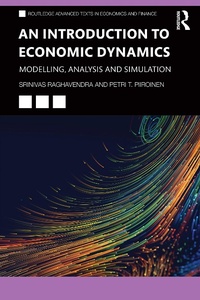
An Introduction to Economic Dynamics
Modelling, Analysis and Simulation
1st Edition
Published on 31. March 2023
256 pages
978-1-000-85098-7 (ISBN)
Description

An Introduction to Economic Dynamics provides a framework for students to appreciate and understand the basic intuition behind economic models and to experiment with those models using simulation techniques in MATLAB (R).
This book goes beyond the often-limited scope of other texts on economic models, which have largely focused on elucidating static equilibrium models. Comparative static analysis inhibits students from asking how the equilibrium position is achieved from an initial out-of-equilibrium position and limits their understanding of the dynamics that underlie such analysis. In this textbook, readers are introduced to ten well-established macroeconomic models - including Keynesian multiplier models, Samuelson's multiplier and Solow's growth model - and guided through the dynamical systems behind each model. Every chapter begins with an overview of the economic problem which the model is designed to help solve followed by an explanation of the mathematics of the model. Solutions are provided using simulation and visualisation techniques in MATLAB (R), which are interwoven organically with the analysis and are introduced in a step-by-step fashion to guide the reader along the way. Appendices provide an introduction to MATLAB (R) along with all the necessary codes.
The book is ideally suited for courses in economic dynamics, macroeconomic modelling and computational economics, as well as for students of finance, mathematics and engineering who are interested in economic models.
This book goes beyond the often-limited scope of other texts on economic models, which have largely focused on elucidating static equilibrium models. Comparative static analysis inhibits students from asking how the equilibrium position is achieved from an initial out-of-equilibrium position and limits their understanding of the dynamics that underlie such analysis. In this textbook, readers are introduced to ten well-established macroeconomic models - including Keynesian multiplier models, Samuelson's multiplier and Solow's growth model - and guided through the dynamical systems behind each model. Every chapter begins with an overview of the economic problem which the model is designed to help solve followed by an explanation of the mathematics of the model. Solutions are provided using simulation and visualisation techniques in MATLAB (R), which are interwoven organically with the analysis and are introduced in a step-by-step fashion to guide the reader along the way. Appendices provide an introduction to MATLAB (R) along with all the necessary codes.
The book is ideally suited for courses in economic dynamics, macroeconomic modelling and computational economics, as well as for students of finance, mathematics and engineering who are interested in economic models.
Reviews / Votes
"This book is a welcome addition to the literature on economic dynamics. Its clear writing style and the emphasis on coding using MATLAB (R) make it a compelling text for introducing undergraduate economics students to stability issues, cycles, and growth. The emphasis on both standard models like the Solow growth model and less standard ones such as the Goodwin growth cycle appeal to a broad spectrum of economists in the profession, and the highly competent authors have put years of experience with the material into a highly accessible textbook. I highly recommend the book to anyone willing to incorporate numerical methods into macroeconomic courses."Daniele Tavani, Associate Professor, Colorado State University
More details
Series
Edition
1. Auflage
Language
English
Place of publication
London
United Kingdom
Publishing group
Taylor & Francis Ltd
Target group
College/higher education
Illustrations
2 Tables, black and white; 50 Line drawings, black and white; 50 Illustrations, black and white
ISBN-13
978-1-000-85098-7 (9781000850987)
Copyright in bibliographic data and cover images is held by Nielsen Book Services Limited or by the publishers or by their respective licensors: all rights reserved.
Schweitzer Classification
Other editions
Additional editions
Srinivas Raghavendra | Petri T. Piiroinen
An Introduction to Economic Dynamics
Modelling, Analysis and Simulation
Book
03/2023
1st Edition
Routledge
€93.40
Shipment within 15-20 days
Srinivas Raghavendra | Petri T. Piiroinen
An Introduction to Economic Dynamics
Modelling, Analysis and Simulation
Book
03/2023
1st Edition
Routledge
€205.30
Shipment within 15-20 days
Persons
Srinivas Raghavendra is an Associate Professor in Economics at the Azim Premji University, Bangalore, India and with the Department of Economics at the University of Galway in Ireland.
Petri T. Piiroinen is an Associate Professor in Nonlinear Mechanics at Chalmers University of Technology, Goeteborg, Sweden.
Petri T. Piiroinen is an Associate Professor in Nonlinear Mechanics at Chalmers University of Technology, Goeteborg, Sweden.
Content
1. Introduction to Economic Dynamics 2. The Cobweb Model 3. Expectation Dynamics in the Cobweb Model 4. Keynesian Multiplier Model 5. The IS/LM Model 6. Debt, Deficit and Stabilization Policy 7. Expectation Dynamics and Hyperinflation 8. The Dornbusch Exchange Rate Overshooting Model 9. The Solow-Swan Growth Model 10. An Endogenous Growth Model 11. Business Cycles I: Samuelson's Multiplier-Accelerator Model 12. Business Cycles II: The Real Business Cycle Model Appendix A. Difference and Differential Equations Appendix B. Matlab Codes
