

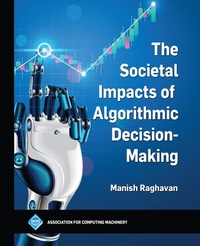
The Societal Impacts of Algorithmic Decision-Making
Description

This book demonstrates the need for and the value of interdisciplinary research in addressing important societal challenges associated with the widespread use of algorithmic decision-making. Algorithms are increasingly being used to make decisions in various domains such as criminal justice, medicine, and employment. While algorithmic tools have the potential to make decision-making more accurate, consistent, and transparent, they pose serious challenges to societal interests. For example, they can perpetuate discrimination, cause representational harm, and deny opportunities.
The Societal Impacts of Algorithmic Decision-Making presents several contributions to the growing body of literature that seeks to respond to these challenges, drawing on techniques and insights from computer science, economics, and law. The author develops tools and frameworks to characterize the impacts of decision-making and incorporates models of behavior to reason about decision-making in complex environments. These technical insights are leveraged to deepen the qualitative understanding of the impacts of algorithms on problem domains including employment and lending.
The social harms of algorithmic decision-making are far from being solved. While easy solutions are not presented here, there are actionable insights for those who seek to deploy algorithms responsibly. The research presented within this book will hopefully contribute to broader efforts to safeguard societal values while still taking advantage of the promise of algorithmic decision-making.
More details
Other editions
Additional editions
Person
Manish Raghavan is the Drew Houston (2005) Career Development Professor at the MIT Sloan School of Management and Department of Electrical Engineering and Computer Science. His research focuses on how algorithms and algorithmic decision-making impact society in a variety of contexts including employment and online media. He is the recipient of the 2021 ACM Doctoral Dissertation Award.
Content
Part I: Theoretical Foundations for Fairness in Algorithmic Decision-Making
1. Inherent Tradeoffs in the Fair Determination of Risk Scores
2. On Fairness and Calibration
3. The Externalities of Exploration and How Data Diversity Helps Exploitation
Part II: Models of Behavior
4. Selection Problems in the Presence of Implicit Bias
5. How Do Classifiers Induce Agents to Behave Strategically?
6. Algorithmic Monoculture and Social Welfare
Part III: Application Domains
7. Mitigating Bias in Algorithmic Hiring: Evaluating Claims and Practices
8. The Hidden Assumptions Behind Counterfactual Explanations and Principal Reasons
Part IV: Conclusion and Future Work
9. Future Directions
