

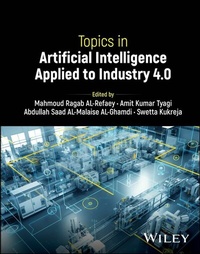
Topics in Artificial Intelligence Applied to Industry 4.0
Description

Forward thinking resource discussing emerging AI and IoT technologies and how they are applied to Industry 4.0
Topics in Artificial Intelligence Applied to Industry 4.0 discusses the design principles, technologies, and applications of emerging AI and IoT solutions on Industry 4.0, explaining how to make improvements in infrastructure through emerging technologies. Providing a clear connection with different technologies such as IoT, Big Data, AR and VR, and Blockchain, this book presents security, privacy, trust, and other issues whilst delving into real-world problems and case studies.
The text takes a highly practical approach, with a clear insight on how readers can increase productivity by drastically shortening the time period between the development of a new product and its delivery to customers in the market by 50%. This book also discusses how to save energy across systems to ensure competitiveness in a global market, and become more responsive in how they produce products and services for their consumers, such as by investing in flexible production lines.
Written by highly qualified authors, Topics in Artificial Intelligence Applied to Industry 4.0 explores sample topics such as:
* Quantum machine learning, neural network implementation, and cloud and data analytics for effective analysis of industrial data
* Computer vision, emerging networking technologies, industrial data spaces, and an industry vision for 2030 in both developing and developed nations
* Novel or improved nature-inspired optimization algorithms in enhancing Industry 5.0 and the connectivity of any components for smart environment
* Future professions in agriculture, medicine, education, fitness, R&D, and transport and communication as a result of new technologies
Aimed at researchers and students in the interdisciplinary fields of Smart Manufacturing and Smart Applications, Topics in Artificial Intelligence Applied to Industry 4.0 provides the perfect overview of technology from the perspective of modern society and operational environment.
More details
Other editions
Additional editions
Persons
Mahmoud Ragab AL-Refaey is a Professor of Data Science with the Information Technology Department, Faculty of Computing and Information Technology (FCIT), King Abdulaziz University (KAU), Jeddah, Saudi Arabia and the Mathematics Department, Faculty of Science, Al-Azhar University, Egypt. He obtained his PhD. from the faculty of Mathematics and Natural Sciences of the Christian-Albrechts-University at Kiel (CAU), Germany.
Amit Kumar Tyagi is an Assistant Professor of Department of Fashion Technology, National Institute of Fashion Technology, New Delhi, India. Previously he has worked as Assistant Professor (Grade-2) and Senior Researcher at the School of Computer Science and Engineering, Vellore Institute of Technology (VIT), Chennai, Tamilnadu, India. He received his PhD. Degree in 2018 from Pondicherry Central University, India.
Abdullah Saad AL-Malaise AL-Ghamdi is a Professor of Information Systems Department, Faculty of Computing and Information Technology (FCIT), King Abdulaziz University (KAU), Jeddah, Saudi Arabia and Information Systems Department, School of Engineering, Computing and Design, Dar Al-Hekma University, Jeddah, Saudi Arabia. He is the Secretary General of the Scientific Council at KAU. He received his PhD. degree in Computer Science, George Washington University, USA.
Swetta Kukreja is Associate Professor in the Computer Science and Engineering, Amity University, Mumbai, India. She has more than 10 years of teaching and research experience.
Content
About the Editors xv
List of Contributors xvii
Preface xxi
Acknowledgment xxiii
1 Introduction to Industry 4.0 and Its Impacts on Society 1
Shrikant Tiwari, Kanchan Naithani, Arun K. Singh, Virendra K. Verma, Ramesh S. Wadawadagi, and Bireshwar D. Mazumdar
1.1 Introduction 1
1.2 The Technological Advancements of the Fourth Industrial Revolution 3
1.3 Impacts on the Economy 5
1.4 Impacts on Society 9
1.5 Ethics and Governance 11
1.6 Future Directions 13
1.7 Conclusion 15
2 Digital Transformation Using Industry 4.0 and Artificial Intelligence 19
M. Keerthika, M. Pragadeesh, M. Santhiya, G. Belshia Jebamalar, and Harish Venu
2.1 Introduction 19
2.2 Industry 4.0 Technologies 20
2.3 AI Features in Industry 4.0 22
2.4 Industry 4.0 and XAI 24
2.5 Industry 4.0 Integration Using an XAI-Based Methodology with AI 24
2.6 Case Studies for Industry 4.0 29
2.7 Challenges of Industry 4.0 31
2.8 Advantages of Intelligent Factory 31
2.9 Discussion and Emerging Trends 32
2.10 Conclusion 33
3 Industry 4.0: Design Principles, Challenges, and Applications 39
K.K. Girish, Sunil Kumar, and Biswajit R. Bhowmik
3.1 Introduction 39
3.2 Organization of Chapter 40
3.3 Industrial Revolutions 40
3.4 Generations of Industrial Revolutions 40
3.5 Transformation to Industry 4.0 43
3.6 Characteristics of Industry 4.0 43
3.7 Technologies Under Industry 4.0 44
3.8 Design Principles of Industry 4.0 53
3.9 Applications of Industry 4.0 57
3.10 Trends in Industry 4.0 58
3.11 Challenges of Industry 4.0 59
3.12 Related Works 61
3.13 Paradigm Shift Toward Industry 5.0 62
3.14 Future Challenges and Research 63
3.15 Conclusion 64
4 Detection from Chest X-Ray Images Based on Modified Deep Learning Approach 69
Jyoti Dabass, Manju Dabass, and Ananda K. Behera
4.1 Introduction 69
4.2 Related Works 70
4.3 Research Methodology 71
4.4 Results and Discussions 80
4.5 Conclusions 89
5 Smart Technologies in Manufacturing Industries: A Useful Perspective 93
V.M. Gobinath, A. Kathirvel, S.K. Rajesh Kanna, and K. Annamalai
5.1 Introduction 93
5.2 Literature Review 95
5.3 Materials and Methods 95
5.4 Discussion 104
5.5 Conclusion 105
6 Blockchain Technology for Industry 4.0 107
Rajiv Kumar Berwer, Sanjeev Indora, Dinesh Kumar Atal, and Vivek Yadav
6.1 Introduction 107
6.2 Key Concepts of Blockchain 110
6.3 Blockchain in Data Privacy and Security 114
6.4 Cybersecurity in the Era of Industry 4.0 116
6.5 Supply Chain Management and Traceability 117
6.6 Blockchain-Enabled Smart Manufacturing 118
6.7 Overcoming Challenges in Blockchain Implementation 119
6.8 Real-World Applications of Blockchain in Industry 4.0 119
6.9 Future Trends 120
6.10 Conclusion 120
7 Unifying Technologies in Industry 4.0: Harnessing the Synergy of Internet of Things, Big Data, Augmented Reality/ Virtual Reality, and Blockchain Technologies 127
K. Logeswaran, S. Savitha, P. Suresh, K.R. Prasanna Kumar, M. Gunasekar, R. Rajadevi, M.K. Dharani, and A.S. Jayasurya
7.1 Introduction to Industry 4.0 127
7.2 Internet of Things 134
7.3 Big Data 136
7.4 Augmented Reality and Virtual Reality 138
7.5 Blockchain 140
7.6 Convergence of IoT, Big Data, AR/VR, and Blockchain in Industry 4.0 142
7.7 Conclusion 145
8 Industry 4.0 in Manufacturing, Communication, Transportation, and Health Care 149
Mani D. Choudhry, Jeevanandham Sivaraj, Sundarrajan Munusamy, Parimala D. Muthusamy, and V. Saravanan
8.1 Introduction 149
8.2 Diversified Applications of Industry 4.0 153
8.3 Conclusion 162
9 Transforming Education Management in the Industry 4.0 Era: Harnessing the Power of Cloud-Based Blockchain 167
Sovers Singh Bisht, Garima Jain, Priyanka Chandani, and Vinod M. Kapse
9.1 Introduction 167
9.2 Revolutionizing Education Through Technology: The Power of Innovation and Connectivity 169
9.3 Blockchain Application in Education with Industry 4.0: Revolutionizing Learning, Credentialing, and Collaboration 172
9.4 Blockchain Solution Providers for Education in the Era of Industry 4.0 174
9.5 Navigating the Challenges: Implementing Blockchain in Education Within the Industry 4.0 Landscape 177
9.6 A Vision for the Future 178
9.7 Conclusion 179
References 179
10 Future Professions in Agriculture, Medicine, Education, Fitness, Research and Development, Transport, and Communication 181
Mohan Singh, Manoj Joshi, Kapil D. Tyagi, and Vaibhav B. Tyagi
10.1 Introduction 181
10.2 Literature Review 182
10.3 AI Impact on Future Professions 186
10.4 Role Model of AI in Industry 4.0 187
10.5 AI in Agriculture 187
10.6 AI in Medicine 189
10.7 Role of AI in Challenges of Medicine 190
10.8 AI in Education 191
10.9 AI in Fitness 194
10.10 AI in R&D 196
10.11 AI in Transport 197
10.12 AI Market Growth in Future Profession 200
10.13 Conclusion 201
11 Cybersecurity Issues and Challenges in Quantum Computing 203
R. Rahul, S. Geetha, Soniya Priyatharsini, K. Mehata, Ts. Sundaresan Perumal, N. Ethiraj, and S. Sendilvelan
11.1 Introduction 203
11.2 Cybersecurity Issues and Challenges in Quantum Computer 206
11.3 General Solutions 217
11.4 Conclusion 219
12 Security, Privacy, Trust, and Other Issues in Industries 4.0 223
Ambeshwar Kumar, Manikandan Ramachandran, M. Manjula, Monika Agarwal, Pooja, and Utku Köse
12.1 Introduction 223
12.2 Security Fog Computing 226
12.3 IoT Challenges 228
12.4 Security Threats and Solutions of Industrial Internet of Things 232
12.5 Conclusion 236
13 Designing a Quantum Computer to Gear up Artificial Intelligence for Industry 4.0 239
K. Pradheep Kumar, Neha Sharma, and Juergen Seitz
13.1 Introduction 239
13.2 Literature Survey 240
13.3 Proposed Work 241
13.4 Simulation Results 250
13.5 Conclusion and Future Work 254
14 Opportunities in Neural Networks for Industry 4.0 257
Rodrigo de Paula Monteiro, José P.G. de Oliveira, Sérgio C. Oliveira, and Carmelo J.A.B. Filho
14.1 Introduction: Why Is Machine Learning Interesting to Industry 4.0? 257
14.2 Machine Learning 257
14.3 Challenges in Industry 4.0 That Can Benefit from Using Machine Learning 259
14.4 Some Cases of Success Deploying ML in Industry 4.0 262
14.5 Conclusions and Final Remarks 267
15 A Smarter Way to Collect and Store Data: AI and OCR Solutions for Industry 4.0 Systems 271
Ajay R. Nair, Varun D. Tripathy, R. Lalitha Priya, Manigandan Kashimani, Guru Akaash N. Janthalur, Nusrat J. Ansari, and Igor Jurcic
15.1 Introduction 271
15.2 Background 271
15.3 Architecture of Wireless Extraction of Display Panel 273
15.4 ESP32 Cam Module 275
15.5 Wireless LAN Network Setup 277
15.6 Optical Character Recognition for Text Detection and Text Recognition 278
15.7 Working of the Model 282
15.8 Application GUI 284
15.9 Conclusion 287
References 287
Index 289
List of Contributors
Monika Agarwal
Computer Science and Engineering
Dayananda Sagar University
Bengaluru, Karnataka, India
Abdullah Saad AL-Malaise AL-Ghamdi
Information Systems Department, Faculty of Computing and Information Technology (FCIT)
King Abdulaziz University (KAU)
Jeddah, Saudi Arabia
Information Systems Department
School of Engineering, Computing and Design
Dar Al-Hekma University
Jeddah, Saudi Arabia
K. Annamalai
VIT University
Chennai, Tamil Nadu, India
Nusrat J. Ansari
Computer Science Department
Vivekanand Education Society's Institute of Technology
Mumbai, Maharashtra, India
Dinesh Kumar Atal
Department of Biomedical Engineering
Deenbandhu Chhotu Ram University of Science and Technology
Sonipat, Haryana, India
Ananda K. Behera
Artificial Intelligence and Machine Learning Programme
Liverpool John Moores University
Liverpool, UK
Rajiv Kumar Berwer
Department of Computer Science and Engineering
Deenbandhu Chhotu Ram University of Science and Technology
Sonipat, Haryana, India
Biswajit R. Bhowmik
BRICS Laboratory
Department of Computer Science and Engineering National Institute of Technology Karnataka
Mangalore, Karnataka, India
Sovers Singh Bisht
Noida Institute of Engineering and Technology
Greater Noida, Uttar Pradesh, India
Priyanka Chandani
Noida Institute of Engineering and Technology
Greater Noida, Uttar Pradesh, India
Mani D. Choudhry
Department of Information Technology
KGiSL Institute of Technology
Coimbatore, Tamil Nadu, India
Jyoti Dabass
DBT Centre of Excellence Biopharmaceutical Technology, IIT
New Delhi, India
Manju Dabass
EECE Department
The Northcap University
Gurugram, Haryana, India
José P.G. de Oliveira
Polytechnic School of Pernambuco
University of Pernambuco
Recife, Pernambuco, Brazil
M.K. Dharani
Department of AI
Kongu Engineering College
Erode, Tamil Nadu, India
N. Ethiraj
Dr. M.G.R. Educational and Research Institute
Chennai, Tamil Nadu, India
Carmelo J.A.B. Filho
Polytechnic School of Pernambuco
University of Pernambuco
Recife, Pernambuco, Brazil
S. Geetha
Dr. M.G.R. Educational and Research Institute
Chennai, Tamil Nadu, India
K.K. Girish
BRICS Laboratory
Department of Computer Science and Engineering National Institute of Technology Karnataka
Mangalore, Karnataka, India
V.M. Gobinath
Rajalakshmi Institute of Technology
Chennai, Tamil Nadu, India
M. Gunasekar
Department of Information Technology
Kongu Engineering College
Erode, Tamil Nadu, India
Sanjeev Indora
Department of Computer Science and Engineering
Deenbandhu Chhotu Ram University of Science and Technology
Sonipat, Haryana, India
Garima Jain
Noida Institute of Engineering and Technology
Greater Noida, Uttar Pradesh, India
Guru Akaash N. Janthalur
Computer Science Department
Vivekanand Education Society's Institute of Technology
Mumbai, Maharashtra, India
A.S. Jayasurya
Department of Electrical and Electronics
Universiti Teknologi Petronas
Perak, Malaysia
G. Belshia Jebamalar
Department of Computer Science and Engineering
S.A. Engineering College
Chennai, Tamil Nadu, India
Manoj Joshi
Department of ECE
JSS Academy of Technical Education
Noida, Uttar Pradesh, India
Igor Jurcic
Telecommunications and Informatics Department
HT ERONET
Mostar, Bosnia and Herzegovina
S.K. Rajesh Kanna
Rajalakshmi Institute of Technology
Chennai, Tamil Nadu, India
Vinod M. Kapse
Noida Institute of Engineering and Technology
Greater Noida, Uttar Pradesh, India
Manigandan Kashimani
Computer Science Department
Vivekanand Education Society's Institute of Technology
Mumbai, Maharashtra, India
A. Kathirvel
Panimalar Engineering College
Chennai, Tamil Nadu, India
M. Keerthika
Department of Computer Science and Engineering
Rajalakshmi Engineering College
Chennai, Tamil Nadu, India
Utku Köse
Computer Engineering
Suleyman Demirel University
Kaskelen, Kazakhstan
Swetta Kukreja
Department of Computer Science and Engineering
Amity University
Mumbai, Maharashtra, India
Ambeshwar Kumar
Computer Science and Engineering
GITAM University
Visakhapatnam, Andhra Pradesh, India
K. Pradheep Kumar
Department of CSIS
BITS Pilani
Pilani, Rajasthan, India
K.R. Prasanna Kumar
Department of Information Technology
Kongu Engineering College
Erode, Tamil Nadu, India
Sunil Kumar
BRICS Laboratory
Department of Computer Science and Engineering National Institute of Technology Karnataka
Mangalore, Karnataka, India
R. Lalitha Priya
Computer Science Department
Vivekanand Education Society's Institute of Technology
Mumbai, Maharashtra, India
K. Logeswaran
Department of AI
Kongu Engineering College
Erode, Tamil Nadu, India
M. Manjula
Computer Science and Engineering
Dayananda Sagar University
Bengaluru, Karnataka, India
Bireshwar D. Mazumdar
Department of Computer Science and Engineering
Faculty of Engineering and Technology
United University Prayagraj
Allahabad, Uttar Pradesh, India
K. Mehata
Dr. M.G.R. Educational and Research Institute
Chennai, Tamil Nadu, India
Rodrigo de Paula Monteiro
Polytechnic School of Pernambuco
University of Pernambuco
Recife, Pernambuco, Brazil
Sundarrajan Munusamy
Department of Networking and Communications
SRM Institute of Science & Technology
Chennai, Tamil Nadu, India
Parimala D. Muthusamy
Department of Electronics and Communication Engineering
Velalar College of Engineering and Technology
Erode, Tamil Nadu, India
Ajay R. Nair
Computer Science Department
Vivekanand Education Society's Institute of Technology
Mumbai, Maharashtra, India
Kanchan Naithani
School of Computing Science and Engineering
Galgotias University
Greater Noida, Uttar Pradesh, India
Sérgio C. Oliveira
Polytechnic School of Pernambuco
University of Pernambuco
Recife, Pernambuco, Brazil
Ts. Sundaresan Perumal
Universiti Sains Islam Malaysia
Bandar Baru Nilai
Negeri Sembilan, Malaysia
Pooja
Computer Science and Engineering
Dayananda Sagar University
Bengaluru, Karnataka, India
M. Pragadeesh
Department of Information Technology
Rajalakshmi Engineering College
Chennai, Tamil Nadu, India
Soniya Priyatharsini
Dr. M.G.R. Educational and Research Institute
Chennai, Tamil Nadu, India
Mahmoud Ragab AL-Refaey
Information Technology Department, Faculty of Computing and Information Technology (FCIT)
King Abdulaziz University (KAU)
Jeddah, Saudi Arabia
Mathematics Department
Faculty of Science
Al-Azhar University
Naseir City, Cairo, Egypt
R. Rahul
Dr. M.G.R. Educational and Research Institute
Chennai, Tamil Nadu, India
R. Rajadevi
Department of AI
Kongu Engineering College
Erode, Tamil Nadu, India
Manikandan Ramachandran
School of Computing
SASTRA Deemed University
Thanjavur, Tamil Nadu, India
M. Santhiya
Department of Computer Science and Engineering
Rajalakshmi Engineering College
Chennai, Tamil Nadu, India
V. Saravanan
Department of Computer Science
College of Engineering and Technology
Dambi Dollo University
Dambi Dollo, Oromia Region, Ethiopia
S. Savitha
Department of CSE
K.S.R. College of Engineering
Tiruchengode, Tamil Nadu, India
Juergen Seitz
Duale Hochschule Baden-Württemberg
Wirtschaftsinformatik, Heidenheim, Germany
S. Sendilvelan
Dr. M.G.R. Educational and Research Institute
Chennai, Tamil Nadu, India
Neha Sharma
Tata Consultancy Services
Pune, Maharashtra, India
Arun K. Singh
Department of Computer Science & Engineering
Greater Noida Institute of Technology
Greater Noida, Uttar Pradesh, India
Mohan Singh
Department of ECE
G.L. Bajaj Institute of Technology and Management
Greater Noida, Uttar Pradesh, India
Jeevanandham Sivaraj
Department of Information Technology
Sri Ramakrishna Engineering College
Coimbatore, Tamil Nadu, India
P. Suresh
Department of Database Systems
School of Computer Science and Engineering
Vellore Institute of...
