

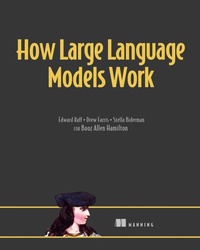
How Large Language Models Work
Published on 22. July 2025
200 pages
978-1-63835-760-5 (ISBN)
Description

Learn how large language models like GPT and Gemini work under the hood in plain English.
How Large Language Models Work translates years of expert research on Large Language Models into a readable, focused introduction to working with these amazing systems. It explains clearly how LLMs function, introduces the optimization techniques to fine-tune them, and shows how to create pipelines and processes to ensure your AI applications are efficient and error-free.
In How Large Language Models Work you will learn how to:
• Test and evaluate LLMs
• Use human feedback, supervised fine-tuning, and Retrieval Augmented Generation (RAG)
• Reducing the risk of bad outputs, high-stakes errors, and automation bias
• Human-computer interaction systems
• Combine LLMs with traditional ML
How Large Language Models Work is authored by top machine learning researchers at Booz Allen Hamilton, including researcher Stella Biderman, Director of AI/ML Research Drew Farris, and Director of Emerging AI Edward Raff. They lay out how LLM and GPT technology works in plain language that's accessible and engaging for all.
About the Technology
Large Language Models put the "I" in "AI." By connecting words, concepts, and patterns from billions of documents, LLMs are able to generate the human-like responses we've come to expect from tools like ChatGPT, Claude, and Deep-Seek. In this informative and entertaining book, the world's best machine learning researchers from Booz Allen Hamilton explore foundational concepts of LLMs, their opportunities and limitations, and the best practices for incorporating AI into your organizations and applications.
About the Book
How Large Language Models Work takes you inside an LLM, showing step-by-step how a natural language prompt becomes a clear, readable text completion. Written in plain language, you'll learn how LLMs are created, why they make errors, and how you can design reliable AI solutions. Along the way, you'll learn how LLMs "think," how to design LLM-powered applications like agents and Q&A systems, and how to navigate the ethical, legal, and security issues.
What's Inside
• Customize LLMs for specific applications
• Reduce the risk of bad outputs and bias
• Dispel myths about LLMs
• Go beyond language processing
About the Readers
No knowledge of ML or AI systems is required.
About the Author
Edward Raff, Drew Farris and Stella Biderman are the Director of Emerging AI, Director of AI/ML Research, and machine learning researcher at Booz Allen Hamilton.
Table of Contents
1 Big picture: What are LLMs?
2 Tokenizers: How large language models see the world
3 Transformers: How inputs become outputs
4 How LLMs learn
5 How do we constrain the behavior of LLMs?
6 Beyond natural language processing
7 Misconceptions, limits, and eminent abilities of LLMs
8 Designing solutions with large language models
9 Ethics of building and using LLMs
How Large Language Models Work translates years of expert research on Large Language Models into a readable, focused introduction to working with these amazing systems. It explains clearly how LLMs function, introduces the optimization techniques to fine-tune them, and shows how to create pipelines and processes to ensure your AI applications are efficient and error-free.
In How Large Language Models Work you will learn how to:
• Test and evaluate LLMs
• Use human feedback, supervised fine-tuning, and Retrieval Augmented Generation (RAG)
• Reducing the risk of bad outputs, high-stakes errors, and automation bias
• Human-computer interaction systems
• Combine LLMs with traditional ML
How Large Language Models Work is authored by top machine learning researchers at Booz Allen Hamilton, including researcher Stella Biderman, Director of AI/ML Research Drew Farris, and Director of Emerging AI Edward Raff. They lay out how LLM and GPT technology works in plain language that's accessible and engaging for all.
About the Technology
Large Language Models put the "I" in "AI." By connecting words, concepts, and patterns from billions of documents, LLMs are able to generate the human-like responses we've come to expect from tools like ChatGPT, Claude, and Deep-Seek. In this informative and entertaining book, the world's best machine learning researchers from Booz Allen Hamilton explore foundational concepts of LLMs, their opportunities and limitations, and the best practices for incorporating AI into your organizations and applications.
About the Book
How Large Language Models Work takes you inside an LLM, showing step-by-step how a natural language prompt becomes a clear, readable text completion. Written in plain language, you'll learn how LLMs are created, why they make errors, and how you can design reliable AI solutions. Along the way, you'll learn how LLMs "think," how to design LLM-powered applications like agents and Q&A systems, and how to navigate the ethical, legal, and security issues.
What's Inside
• Customize LLMs for specific applications
• Reduce the risk of bad outputs and bias
• Dispel myths about LLMs
• Go beyond language processing
About the Readers
No knowledge of ML or AI systems is required.
About the Author
Edward Raff, Drew Farris and Stella Biderman are the Director of Emerging AI, Director of AI/ML Research, and machine learning researcher at Booz Allen Hamilton.
Table of Contents
1 Big picture: What are LLMs?
2 Tokenizers: How large language models see the world
3 Transformers: How inputs become outputs
4 How LLMs learn
5 How do we constrain the behavior of LLMs?
6 Beyond natural language processing
7 Misconceptions, limits, and eminent abilities of LLMs
8 Designing solutions with large language models
9 Ethics of building and using LLMs
More details
Other editions
Additional editions
Edward Raff | Drew Farris | Stella Biderman
How Large Language Models Work
Book
07/2025
Manning Publications
€57.00
Shipment within 3-4 weeks
Persons
Edward Raff is a Director of Emerging AI at Booz Allen Hamilton, where he leads the machine learning research team. He has worked in healthcare, natural language processing, computer vision, and cyber security, among fundamental AI/ML research. The author of Inside Deep Learning, Dr. Raff has over 100 published research articles at the top artificial intelligence conferences. He is the author of the Java Statistical Analysis Tool library, a Senior Member of the Association for the Advancement of Artificial Intelligence, and twice chaired the Conference on Applied Machine Learning and Information Technology and the AI for Cyber Security workshop. Dr. Raff's work has been deployed and used by anti-virus companies all over the world.
Drew Farris is a professional software developer and technology consultant whose interests focus on large scale analytics, distributed computing and machine learning. Previously, he worked at TextWise where he implemented a wide variety of text exploration, management and retrieval applications combining natural language processing, classification and visualization techniques. He has contributed to a number of open source projects including Apache Mahout, Lucene and Solr, and holds a master's degree in Information Resource Management from Syracuse University's iSchool and a B.F.A in Computer Graphics.
Stella Biderman is a machine learning researcher at Booz Allen Hamilton and the executive director of the non-profit research center EleutherAI. She is a leading advocate for open source artificial intelligence and has trained many of the world's most powerful open source artificial intelligence algorithms. She has a master's degree in computer science from the Georgia Institute of Technology and degrees in Mathematics and Philosophy from the University of Chicago.
Drew Farris is a professional software developer and technology consultant whose interests focus on large scale analytics, distributed computing and machine learning. Previously, he worked at TextWise where he implemented a wide variety of text exploration, management and retrieval applications combining natural language processing, classification and visualization techniques. He has contributed to a number of open source projects including Apache Mahout, Lucene and Solr, and holds a master's degree in Information Resource Management from Syracuse University's iSchool and a B.F.A in Computer Graphics.
Stella Biderman is a machine learning researcher at Booz Allen Hamilton and the executive director of the non-profit research center EleutherAI. She is a leading advocate for open source artificial intelligence and has trained many of the world's most powerful open source artificial intelligence algorithms. She has a master's degree in computer science from the Georgia Institute of Technology and degrees in Mathematics and Philosophy from the University of Chicago.
