

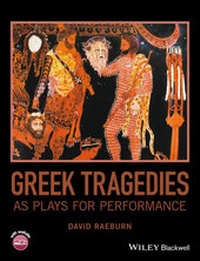
Greek Tragedies as Plays for Performance
Description

More details
Other editions
Additional editions
Person
Content
1
Introduction
Greek tragedy was an art form initiated in ancient Athens towards the end of the sixth century BC and developed during the fifth century BC. Although tragedies continued to be acted and composed during the fourth century and later, all that survives to us in more or less complete, as opposed to fragmentary, form consists of 33 plays, said to date from 472 to 406 BC and traditionally attributed to Aeschylus, Sophocles and Euripides.1
These plays have been studied and valued in later times for a variety of reasons. Most of them survived in the first place because they were selected in late antiquity or the Middle Ages as 'set books" in schools for the purpose of teaching the grammar and syntax of the ancient Greek language. Although there were occasional performances from the Renaissance onwards, they were primarily regarded as materials for pedagogic purposes or textual criticism until the early twentieth century, when interest in them as major works of drama became established among a wider public. In due course this inspired a plethora of new translations or original plays based on them. Scholars have explored their stagecraft as well as their literary qualities. Much recent work has examined the plays as socio-historic documents which help to illuminate the period in which they were composed on general issues such as group identity, gender and class. Finally, the last century has seen an unprecedented rise of public interest in those ancient texts as plays for performance on stage by professional or amateur actors.
The aim of this book is to focus on four tragedies of Aeschylus, three of Sophocles and three of Euripides, exploring each play on its own in terms of its original status as a theatrical artefact. I try to show how these ten texts "work" as drama and, more specifically, how the three great poets used the characteristic form of the Greek tragic genre to create dramatic sequences that would engage and hold their audiences' attention and stir their emotions in the theater, while at the same time encouraging them to reflect on matters of profound importance. This introductory chapter attempts to define the ancient poet's task in terms of this form, the social context in which the plays were composed to be presented, and the human and other resources that were available at the time. All these factors dictated their composition and are important to their consideration as works of art.
Greek Tragedy as a Genre
"Greek tragedy is a hybrid form, and the different parts of the drama are differentiated in form and style" (Rutherford 2012, 29). All our surviving plays follow a standard pattern, a sequence of discrete sections akin to the "movements" of a classical symphony or the "numbers" of an eighteenth century oratorio and in modern music theater. Put as its simplest, these movements alternate between spoken "episodes" (scenes) for one to three solo actors and "odes" (songs) performed by a chorus. The normal meter for the former is the iambic trimeter, while the latter are delivered in a variety of so-called lyric meters. Variations on this pattern are mentioned later but it is enough at this point to note the hybrid character of Greek tragedy and the particular challenge that it presented to the ancient dramatist in creating a continuity in unfolding his story on stage to his audience in a compelling and satisfying way. To understand how these plays "work" as drama, we need to analyse the "structure of feeling," the controlled sequence of emotional responses implicit in this basic alternation of movements for chorus and solo actors and to observe how these two disparate elements are united in the individual texts.
This peculiar form calls for some explanation. Here we have European drama in its infancy and we need to ask how it came about. Unfortunately, the detailed evidence for the origins of Greek tragedy is difficult and obscure; we can never be entirely sure how or when it began, and this book is not the place to argue a problematic issue.2 Tragedies were certainly being performed at Athens by the end of the sixth century and we have the firm date of 472 BC for our first surviving example of the genre, Aeschylus' Persae. An answer to the question, "How did Greek tragedy take the hybrid form that it did?" may be more easily sought if we briefly examine the performance genres which existed in Greece earlier in the sixth century.
The ancestor of the tragic chorus is surely to be found in the so-called genre of "choral lyric," that is the performance of cult poetry sung and danced by a choir to the accompaniment of the lyre or other musical instrument. These performances were originally "sacral," religious acts offered in honour of gods or heroes in the hope of blessings for the local community. Examples would include the "paean" performed in honour of Apollo, or the "dithyramb" which was associated particularly with Dionysus, the god of wine and (later) of the dramatic festivals at Athens. Subsequently, choral lyric could be essentially secular, as in the epinikion, a hymn celebrating the victory of an athlete in one of the great inter-state festivals like the Olympics, an art perfected in the fifth century by the poet Pindar. The whole genre evidently goes back to the seventh century and was mainly developed in the southern part of Greece, the Peloponnese, not so much in Athens itself, though an Attic vase dated to 560-50 BC3 offers evidence for pre-dramatic performances by a chorus of satyrs, who were always associated with the worship of Dionysus. It is significant that the choral songs of Attic tragedy adopt certain features of the Doric dialect which was spoken in some cities of the Peloponnese.
The other performance art from which Greek tragedy fairly obviously derives was the public recitation of epic verse by professionals known as "rhapsodes." By 514 at the latest, and very possibly earlier, competitions in the recitation of Homeric verse were held in Athens at the Great Panathenaea, the quadrennial festival in honour of the city's patron goddess Athena, alongside contests in athletic and equestrian events. The Iliad and Odyssey themselves derive from a tradition of oral recitation in a preliterate culture and make perfect performance poetry in their combination of third-person narrative and speeches, often quite long, that are put into the mouths of the various characters. Epic poetry would doubtless have demanded the kind of projection of voice and personality that was associated with acting or any form of public speaking; it must also have included an element of impersonation in the delivery of the speeches. The rhapsodic contests can thus be seen as leading naturally into tragedy, in which a story was presented by masked actors individually impersonating a variety of characters, with the narrative element covered by more nondescript "messengers," through whom the audience could learn, by ear, of such events in the story as could not convincingly be enacted before their eyes.
If tragedy starts with a chorus and a messenger, it is not difficult to regard the tragic contests at Athens as entailing a marriage between two pre-existing art forms, choral lyric and epic recitation. These contests were an important feature of the City Dionysia, the annual festival in honour of Dionysus, which may have been inaugurated in its earliest form by the tyrant Pisistratus in about 534 - though scholars debate the dating of the various additions which led to the festival as it became in the Periclean age, during the second half of the fifth century, when the art of tragedy had grown to maturity. There was a tradition in ancient times that credited a certain Thespis with the idea of introducing a solo actor (himself), perhaps by detaching the leader of a lyric chorus and getting him to deliver long speeches in response to questions put to him by the chorus. This would fit the Greek word for an actor, hypocrites, usually understood as meaning "answerer." Thespis is also supposed to have disguised himself, a crucial innovation which leads to drama as we understand it, and to have worn stylized makeup or a linen mask.
For all these uncertainties, when it comes to our first surviving tragedy, the Persae of Aeschylus, we find a sequence of long movements for the Chorus of Persian Elders, punctuated by other movements, including a central Messenger scene, which involve one or two solo actors who make their entrances and exits at various points in the drama. That the chorus was initially thought of as the primary element is suggested by the term epeisodion, meaning "insertion," which was later used as the formal description of the intervening scenes for solo actors and gives us our own word "episode."
The Social Context
Before we can fully understand how the individual plays work as drama, it is important to consider the various external factors which will have shaped the poet's composition. First of all is the social context in which the plays were first performed at Athens.
Tragedies during the fifth century were designed for presentation at the City Dionysia, the festival of Dionysus at Athens, which was held over five or six days in late March when the seas were navigable and the city full of visitors after the...
