

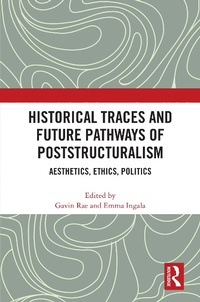
Historical Traces and Future Pathways of Poststructuralism
Aesthetics, Ethics, Politics
1st Edition
Published on 11. November 2020
290 pages
978-1-000-22261-6 (ISBN)
Description

This volume brings together an international array of scholars to reconsider the meaning and place of poststructuralism historically and demonstrate some of the ways in which it continues to be relevant, especially for debates in aesthetics, ethics, and politics.
The book's chapters focus on the works of Butler, Deleuze, Derrida, Foucault, Irigaray, Kristeva, Lacan, and Lyotard-in combination with those of Agamben, Luhman, Nancy, and Nietzsche-and examine issues including biopolitics, culture, embodiment, epistemology, history, music, temporality, political resistance, psychoanalysis, revolt, and the visual arts. The contributors use poststructuralism as a hermeneutical strategy that rejects the traditional affirmation of unity, totality, transparency, and representation to instead focus on the foundational importance of open-ended becoming, difference, the unknowable, and expression. This approach allows for a more expansive definition of poststructuralism and helps demonstrate how it has contributed to debates across philosophy and other disciplines.
Historical Traces and Future Pathways of Poststructuralism will be of particular interest to researchers in philosophy, politics, political theory, critical theory, aesthetics, feminist theory, cultural studies, intellectual history, psychoanalysis, and sociology.
The book's chapters focus on the works of Butler, Deleuze, Derrida, Foucault, Irigaray, Kristeva, Lacan, and Lyotard-in combination with those of Agamben, Luhman, Nancy, and Nietzsche-and examine issues including biopolitics, culture, embodiment, epistemology, history, music, temporality, political resistance, psychoanalysis, revolt, and the visual arts. The contributors use poststructuralism as a hermeneutical strategy that rejects the traditional affirmation of unity, totality, transparency, and representation to instead focus on the foundational importance of open-ended becoming, difference, the unknowable, and expression. This approach allows for a more expansive definition of poststructuralism and helps demonstrate how it has contributed to debates across philosophy and other disciplines.
Historical Traces and Future Pathways of Poststructuralism will be of particular interest to researchers in philosophy, politics, political theory, critical theory, aesthetics, feminist theory, cultural studies, intellectual history, psychoanalysis, and sociology.
More details
Edition
1. Auflage
Language
English
Place of publication
London
United Kingdom
Publishing group
Taylor & Francis Ltd
Target group
College/higher education
Product notice
Reflowable
ISBN-13
978-1-000-22261-6 (9781000222616)
Copyright in bibliographic data and cover images is held by Nielsen Book Services Limited or by the publishers or by their respective licensors: all rights reserved.
Schweitzer Classification
Other editions
Additional editions
Gavin Rae | Emma Ingala
Historical Traces and Future Pathways of Poststructuralism
Aesthetics, Ethics, Politics
Book
01/2023
1st Edition
Routledge
€63.60
Shipment within 15-20 days
Gavin Rae | Emma Ingala
Historical Traces and Future Pathways of Poststructuralism
Aesthetics, Ethics, Politics
Book
11/2020
1st Edition
Routledge
€205.90
Shipment within 15-20 days
Persons
Gavin Rae is Senior Research Professor at the Universidad Complutense de Madrid, Spain. He is the author of six monographs, the most recent of which are Poststructuralist Agency (2020); Critiquing Sovereign Violence (2019); and Evil in the Western Philosophical Tradition (2019), published by Edinburgh University Press; and the co-editor (with Emma Ingala) of The Meanings of Violence: From Critical Theory to Biopolitics and Subjectivity and the Political: Contemporary Perspectives, published by Routledge.
Emma Ingala is Senior Lecturer in the Department of Logic and Theoretical Philosophy at the Universidad Complutense de Madrid (UCM), Spain. She specializes in poststructuralist thought, political anthropology, feminism, and psychoanalysis, and is the co-editor (with Gavin Rae) of The Meanings of Violence: From Critical Theory to Biopolitics and Subjectivity and the Political: Contemporary Perspectives, both published by Routledge.
Emma Ingala is Senior Lecturer in the Department of Logic and Theoretical Philosophy at the Universidad Complutense de Madrid (UCM), Spain. She specializes in poststructuralist thought, political anthropology, feminism, and psychoanalysis, and is the co-editor (with Gavin Rae) of The Meanings of Violence: From Critical Theory to Biopolitics and Subjectivity and the Political: Contemporary Perspectives, both published by Routledge.
Content
Introduction
Gavin Rae and Emma Ingala
Part I: Historical Traces
1. Nietzsche and the Emergence of Poststructuralism
Alan D. Schrift
2. Poststructuralism in America: From Epistemological Relativism to Post-Truth?
Kevin Kennedy
3. From Choirboy to Funeral Orator: Foucault's Complicated Relationship to Structuralism
Guilel Treiber
4. Haunted by Derrida: Reading Benjamin's 'Critique of Violence' and Derrida's 'Force of Law' in Constellation
James R. Martel
Part II: Future Pathways: Aesthetics
5. A Poststructuralism for the Visual Arts
Ashley Woodward
6. What Moves Music?: Poststructuralism, Pulsion, and Musical Ontology
Michael David Szekely
Part III: Ethical Openings
7. Not Just a Body: Lacan on Corporeality
Emma Ingala
8. The Ethics and Politics of Temporality: Judith Butler, Embodiment, and Narrativity
Rosine Kelz
Part IV: Political Apertures
9. Re-thinking Poststructuralism with Deleuze and Luhmann: Autopoiesis, Immanence, Politics
Hannah Richter
10. Kristeva's Wager on the Future of Revolt
S. K. Keltner
11. Strategies of Political Resistance: Agamben and Irigaray
Gavin Rae
Gavin Rae and Emma Ingala
Part I: Historical Traces
1. Nietzsche and the Emergence of Poststructuralism
Alan D. Schrift
2. Poststructuralism in America: From Epistemological Relativism to Post-Truth?
Kevin Kennedy
3. From Choirboy to Funeral Orator: Foucault's Complicated Relationship to Structuralism
Guilel Treiber
4. Haunted by Derrida: Reading Benjamin's 'Critique of Violence' and Derrida's 'Force of Law' in Constellation
James R. Martel
Part II: Future Pathways: Aesthetics
5. A Poststructuralism for the Visual Arts
Ashley Woodward
6. What Moves Music?: Poststructuralism, Pulsion, and Musical Ontology
Michael David Szekely
Part III: Ethical Openings
7. Not Just a Body: Lacan on Corporeality
Emma Ingala
8. The Ethics and Politics of Temporality: Judith Butler, Embodiment, and Narrativity
Rosine Kelz
Part IV: Political Apertures
9. Re-thinking Poststructuralism with Deleuze and Luhmann: Autopoiesis, Immanence, Politics
Hannah Richter
10. Kristeva's Wager on the Future of Revolt
S. K. Keltner
11. Strategies of Political Resistance: Agamben and Irigaray
Gavin Rae
