

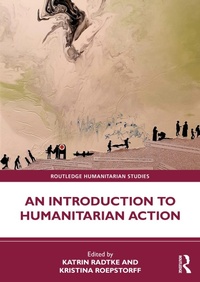
An Introduction to Humanitarian Action
Published on 18. March 2025
388 pages
978-1-000-87718-2 (ISBN)
Description

This important new textbook provides a concise and practice-oriented introduction to the workings of the humanitarian sector and the key contemporary debates surrounding it.
The number of people around the world in need of humanitarian action and protection is at its highest figure in decades; yet at the same time, the humanitarian system is facing numerous problems and undergoing fundamental reforms. This book invites us to tackle these challenges head on, addressing the increasing complexity of humanitarian crises and the implications for humanitarian principles and standards as well as the management of humanitarian projects. Expansive in scope, the book covers:
The sector's historical foundations and the need to decolonise
The main types of crises and sectors of humanitarian response
State and non-state actors and institutions
The key rules, norms, and project management approaches
Key trends and challenges, including access, innovation, and anticipation
The book also covers important debates on localisation, inclusive programming, and the decolonisation of the humanitarian system. This exciting new textbook will be an important read for students looking for a comprehensive introduction, as well as for practitioners wanting to stimulate critical thinking and enhance their practical skills.
The number of people around the world in need of humanitarian action and protection is at its highest figure in decades; yet at the same time, the humanitarian system is facing numerous problems and undergoing fundamental reforms. This book invites us to tackle these challenges head on, addressing the increasing complexity of humanitarian crises and the implications for humanitarian principles and standards as well as the management of humanitarian projects. Expansive in scope, the book covers:
The sector's historical foundations and the need to decolonise
The main types of crises and sectors of humanitarian response
State and non-state actors and institutions
The key rules, norms, and project management approaches
Key trends and challenges, including access, innovation, and anticipation
The book also covers important debates on localisation, inclusive programming, and the decolonisation of the humanitarian system. This exciting new textbook will be an important read for students looking for a comprehensive introduction, as well as for practitioners wanting to stimulate critical thinking and enhance their practical skills.
More details
Series
Language
English
Place of publication
London
United Kingdom
Publishing group
Taylor & Francis Ltd
Target group
College/higher education
Illustrations
14 Tables, black and white; 19 Line drawings, black and white; 2 Halftones, black and white; 21 Illustrations, black and white
File size
3,38 MB
ISBN-13
978-1-000-87718-2 (9781000877182)
Copyright in bibliographic data and cover images is held by Nielsen Book Services Limited or by the publishers or by their respective licensors: all rights reserved.
Schweitzer Classification
Other editions
Additional editions
Katrin Radtke | Kristina Roepstorff
An Introduction to Humanitarian Action
Book
03/2025
1st Edition
Routledge
€207.40
Shipment within 10-20 days
Katrin Radtke | Kristina Roepstorff
An Introduction to Humanitarian Action
Book
03/2025
1st Edition
Routledge
€64.30
Shipment within 10-20 days
Persons
Katrin Radtke is a senior research associate and lecturer at the Institute for Law of Peace and Armed Conflict at Ruhr University Bochum, Germany. She is Academic Director of the academy for humanitarian action (aha) and Academic Coordinator of the Network on Humanitarian Action (NOHA) Joint Master's Programme in Bochum. She obtained her doctorate in political science from the Humboldt University Berlin and holds an MA in political sciences from the New School University New York. Her research focuses on disaster risk assessment and localisation of humanitarian action. Before joining the Ruhr University Bochum she spent several years working for the NGO Welthungerhilfe in the field of humanitarian action.
Kristina Roepstorff is Associate Professor of International Relations at the Otto-von-Guericke University Magdeburg and Senior Researcher at the Peace Research Institute Oslo (PRIO). She has been teaching on the European NOHA Master Programme in International Humanitarian Action since 2008 and as an associate faculty member at the School of Humanitarian Studies, Royal Roads University, Canada, since 2015. Kristina obtained her Habilitation in political science from the University of Magdeburg (2023) and her doctorate in political science from Bremen University (2009). With her research on humanitarian action, peacebuilding, and forced migration, she seeks to bridge academic research and teaching with policy and practice.
Kristina Roepstorff is Associate Professor of International Relations at the Otto-von-Guericke University Magdeburg and Senior Researcher at the Peace Research Institute Oslo (PRIO). She has been teaching on the European NOHA Master Programme in International Humanitarian Action since 2008 and as an associate faculty member at the School of Humanitarian Studies, Royal Roads University, Canada, since 2015. Kristina obtained her Habilitation in political science from the University of Magdeburg (2023) and her doctorate in political science from Bremen University (2009). With her research on humanitarian action, peacebuilding, and forced migration, she seeks to bridge academic research and teaching with policy and practice.
Content
PART 1 Introduction 1 Humanitarian action in a changing world; Zoom in: Interactions between local and international response; 2 Decolonising humanitarian action; PART 2 Humanitarian response 3 Humanitarian crises; 4 Actors and institutions; Zoom in: Communities as first responders; 5 Rules and norms of humanitarian action; 6 Modalities and sectors; Zoom in: Humanitarianism across the globe; 7 Humanitarian management; Zoom in: Different models of humanitarian action; PART 3 Trends and challenges 8 Humanitarian access; 9 Diversity and inclusion in humanitarian action; 10 Nexus thinking: linking humanitarian action with development, peace, and beyond; 11 Humanitarian innovation: past, present, and future of a movement for change; 12 Anticipatory humanitarian action
