

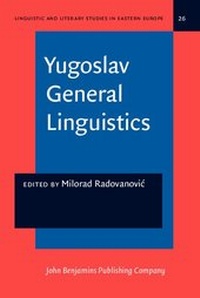
Yugoslav General Linguistics
1st Edition
Published on 1. January 1989
VIII, 381 pages
978-90-272-7843-2 (ISBN)
Description

This volume is the first anthology of readings in Yugoslav general linguistics in English. It contains twenty contributions by outstanding Yugoslav scholars in such areas as comparative typology and contact linguistics, sociolinguistics (including such topics as bilingualism, multilingualism, diglossia, language planning, language policy, translation theory, etc.), psycholinguistics, structural/generative linguistics (phonology, morphology, syntax, and semantics), text linguistics, pragmatics, linguistic semiotics, and the philosophy of language science. The collection should appeal to linguists of all persuasions and specializations.
More details
Other editions
Additional editions
Milorad Radovanovic
Yugoslav General Linguistics
Book
01/1989
John Benjamins Publishing Co
€188.68
Shipment within 10-15 days
Content
- YUGOSLAV GENERAL LINGUISTICS
- Editorial page
- Title page
- Copyright page
- Table of Contents
- List of contributors
- Editor's introduction
- References
- Some remarks on distinctive features: especially in Standard Serbo-Croatian
- Notes
- References
- Generative structuralism
- 1. Introduction
- 2. Terminology
- 3. Continuities
- 3.1 Historical development
- 3.2 Socio-psychological heritage
- 3.3 Methodological similarities
- 3.4 Programmatic links
- 3.5 Logical sequence
- 3.6 Conceptual fit
- 3.7 Epistemological status of structures
- 4. Conclusion
- References
- Some contributions to the theory of contact linguistics
- References
- Psychological studies of bilingualism in Vojvodina
- 1. Introduction
- 2. The study of bilingualism from the standpoint of developmental psychology
- 3. The study of bilingualism from the standpoint of experimental psycholinguistics
- 4. The study of bilingualism relevant to educational psychology and applied psychoHnguistics
- Note
- References
- On referentially used nouns and the upgrading/downgrading of their identificatory force
- Notes
- References
- Structureand typology of dialectal differentiation
- Notes
- Prosodic possibilities in phonology and morphology
- Notes
- References
- Translation and backtranslation
- References
- Language change in an urban setting
- Phonology
- Morphology
- Syntax
- Prosody
- Notes
- References
- Some aspects of prescriptivism in Serbo-Croatian
- The two principles
- Sources of normative advice
- Notes
- References
- Linguistic variety and relationship of languages
- Notes
- References
- Language contacts in multilingual Vojvodina
- A European case of language contacts
- Vojvodina and the Yugoslav model of multilingualism
- Patterns of language use
- Notes
- References
- Modern Icelandic vowel quantity revisited
- Introduction
- Acknowledgement
- References
- Language in space and space in language
- Notes
- References
- Between sign and act
- References
- Linguistic theory and sociolinguistics in Yugoslavia
- 1. Linguistic theory: sociolinguistics
- 2. (Socio)linguistics in Yugoslavia
- 2.1 Standardization, language planning, and language policy
- 2.2 The stratification of language
- 2.3 Languages in contact, bilingualism, multilingualism, and diglossia
- 2.4 Verbal interactions
- 2.5 Applied sociolinguistics
- References
- Language planning: theory and application
- 1. Subject, approach and goal
- 2. Terminology
- 2.1 Linguistic terminology
- 2.2 Sociological terminology
- 3. Ideology of standardization
- 4. From 'is' to 'ought to be'
- 5. Legitimacy principles and normative principles
- 5. Principles of norm implementation
- Notes
- References
- Psycholinguistics: research directions
- The state of Yugoslav linguistics and psychology today
- Definition of psycholinguistics
- The subject and the theoretical scopes of Yugoslav psycholinguistics
- Methods
- Developmental psycholinguistics
- Experimental psycholinguistics
- Applied psycholinguistics
- Instead of a conclusion
- Notes
- References
- On linguistic autonomy
- Notes
- References
- Language contact, language system and language code
- The movement of the Indo-European Perfect
- The Balkan Reporting Modality
- The Macedonian dual standard
- Notes
- References
