

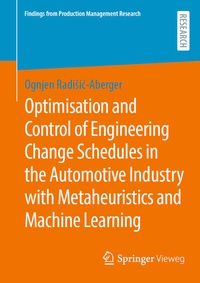
Optimisation and Control of Engineering Change Schedules in the Automotive Industry with Metaheuristics and Machine Learning
Description

Adaptation and change are imperative for products and companies to remain competitive. Managing these changes, however, is increasingly difficult and requires thorough planning and management. Especially in complex production systems, the efficient handling of these engineering changes becomes a competitive edge. This book embarks upon the task to manage the increasingly difficult optimisation and control of engineering changes through artificial intelligence. Based on a knowledge base gained from a systematic literature review, it is shown how AI methods can be applied to resolve challenges faced in production environments. Based on metaheuristic algorithms, optimal EC effectivity dates are determined, which are then validated and controlled by machine learning based business process monitoring. These advances provide significant support for change coordinators and material planners by reducing administrative effort end ensuring complexity control.
More details
Other editions
Additional editions
Person
Ognjen Radisic-Aberger works in production planning. His academic research focuses on AI approaches to optimise production processes and production management.
Content
1. Introduction.- 2. Theoretical Background.- 3. Publication I: AI-Artifacts in Engineering Change Management - A Systematic Literature Review.- 4. Publication II: Deciding on When to Change - A Benchmark of Metaheuristic Algorithms for Timing Engineering Changes.- 5. Publication III: Predicting Schedule Adherence of Engineering Changes - A case study on effectivity date adherence prediction using machine learning.- 6. Publication IV: Evaluating Early Predictive Performance of Machine Learning Approaches for Engineering Change Schedule - A Case Study Using Predictive Process Monitoring Techniques.- 7. Critical Reflection and Future Perspective.- 8. Summary.
