

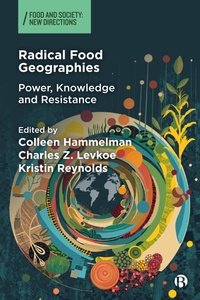
Radical Food Geographies
Power, Knowledge and Resistance
Bristol University Press
1st Edition
Published on 20. August 2024
294 pages
978-1-5292-3343-8 (ISBN)
Description

This collection presents critical and action-oriented approaches to addressing food systems inequities across places, spaces, and scales. With case studies from around the globe, Radical Food Geographies explores interconnections between power structures and the social and ecological dynamics that bring food from the land and water to our plates. Through themes of scale, spatial imaginaries, and human and more-than-human relationships, the authors explore ongoing efforts to co-construct more equitable and sustainable food systems for all.
Advancing a radical food geographies praxis, the book reveals multiple forms of resistance and resurgence, and offers examples of co-creating food systems transformation through scholarship, action, and geography.
Advancing a radical food geographies praxis, the book reveals multiple forms of resistance and resurgence, and offers examples of co-creating food systems transformation through scholarship, action, and geography.
Reviews / Votes
'This is an extremely impressive collection of works that fulfils its goals of showing how theoretically founded collaboration, analysis, praxis, and action bringing together academic researchers and activists can support resistance to injustices within the food system and the creation of new ones.' The AAG Review of Books'Radical Food Geographies is a stellar example of what it means to put food at the center of world building. From the initial development of the concept of radical food geographies in 2019 to the publication of this book, Hammelman, Levkoe, Reynolds and all the contributors demonstrate the value of slow, deep, collaborative work. This collection shows us that is the work that leads us toward the just, equitable (food) futures we deserve.' Ashante M. Reese, University of Texas at Austin 'The myths about food, unsurprisingly, serve to reinforce the very forces and interests that profit from the desire to address the "crises" conjured by those myths. For example, there is the myth about the urgency to accelerate agricultural production because... global hunger. And the one about hunger befalling the... less fortunate. Although these, and related myths are touched upon in this anthology, the primary reason to read this book is not just to understand, but to take effective action, through addressing root causes of global food system dysfunctions. The authors communicate in different ways, from different sources of authority, but all converge on this insight: economic power, transformed into political power, creates perverse disparities that must be seen and countered by social power. Yes, that is a food topic. Read this timely tome to fathom, and act upon, the abundant global evidence.' Ricardo J. Salvador, Advisor, Union of Concerned Scientists 'Radical Food Geographies makes a major contribution to understanding resistance to, and action against the injustices of the food system, showing how theory and action can be articulated through praxis. The volume demonstrates this notably through the engagement of authors from diverse disciplinary, professional and geographical backgrounds working beyond Eurocentric and anglophone epistemological dominance in a process of co-creation and collaboration.' Coline Perrin, Institut National de Recherche pour l'Agriculture, l'Alimentation, l'Environnement (INRAE), UMR Innovation
'Radical Food Geographies offers a powerful framework to analyse the systemic forces shaping food experiences around the world while simultaneously providing inspiration for resisting and transforming these oppressive structures through collaborative scholarship and activism.' Pascale Joassart-Marcelli, San Diego State University
'This book is especially suitable to geographers and critical food scholars as inspiration to engage more deeply with the people they study, and seek out ways that their research
can help to advance food justice and food sovereignty.' Agriculture and Human Values
More details
Series
Edition
First Edition
Language
English
Place of publication
Bristol
United Kingdom
Target group
Professional and scholarly
Edition type
Abridged edition
Product notice
Reflowable
Illustrations
16 s/w Abbildungen, 3 s/w Tabellen
3 Tables, black and white; 17 Illustrations, black and white
File size
3,24 MB
ISBN-13
978-1-5292-3343-8 (9781529233438)
Copyright in bibliographic data and cover images is held by Nielsen Book Services Limited or by the publishers or by their respective licensors: all rights reserved.
Schweitzer Classification
Other editions
Additional editions
Colleen Hammelman | Charles Z Levkoe | Kristin Reynolds
Radical Food Geographies
Power, Knowledge and Resistance
Book
approx. 02/2027
1st Edition
Bristol University Press
€46.00
Not yet published
Radical Food Geographies
Power, Knowledge and Resistance
Book
08/2024
1st Edition
Bristol University Press
€112.50
Shipment within 3-4 weeks
Persons
Colleen Hammelman is Associate Professor in the Department of Geography and Earth Sciences at the University of North Carolina at Charlotte. She is also the Director of the Charlotte Action Research Project (CHARP). Her community-engaged research and teaching focus on social justice concerns, particularly among migrant communities, in urban food systems across the Americas. She is author of Growing Greener Cities: A Political Ecology Analysis of Urban Agriculture in the Americas.
Charles Z. Levkoe is the Canada Research Chair in Equitable and Sustainable Food Systems, a Member of the College of New Scholars, Artists and Scientists of the Royal Society of Canada, and Professor in the Department of Health Sciences at Lakehead University. His community engaged research uses a food systems lens to better understand the importance of, and connections between social justice, ecological regeneration, regional economies and active democratic engagement.
Kristin Reynolds is Associate Professor and Chair of Food Studies and Director of the Food and Social Justice Action Research Lab at The New School in New York City, NY. She is also an Associated Researcher at the European School of Political and Economic Sciences in Lille, France, and Affiliated Faculty at Yale Center for Environmental Justice. Her scholarship and activism center on racial and economic equity in the global food system using critical participatory/action research approaches. She is co-author of Beyond the Kale: Urban Agriculture and Social Justice Activism in New York City.
Charles Z. Levkoe is the Canada Research Chair in Equitable and Sustainable Food Systems, a Member of the College of New Scholars, Artists and Scientists of the Royal Society of Canada, and Professor in the Department of Health Sciences at Lakehead University. His community engaged research uses a food systems lens to better understand the importance of, and connections between social justice, ecological regeneration, regional economies and active democratic engagement.
Kristin Reynolds is Associate Professor and Chair of Food Studies and Director of the Food and Social Justice Action Research Lab at The New School in New York City, NY. She is also an Associated Researcher at the European School of Political and Economic Sciences in Lille, France, and Affiliated Faculty at Yale Center for Environmental Justice. Her scholarship and activism center on racial and economic equity in the global food system using critical participatory/action research approaches. She is co-author of Beyond the Kale: Urban Agriculture and Social Justice Activism in New York City.
Content
Foreword - M. Jahi Chappell
Introduction - Kristin Reynolds, Charles Z. Levkoe, Colleen Hammelman
1. Growing a Radical Food Geographies Praxis - Charles Z. Levkoe, Colleen Hammelman, Kristin Reynolds
Part 1: Scale
2. Fostering Racial Justice via Values-Based Food Procurement in the Good Food Buffalo Coalition - Jessica L. Gilbert-Overland
3. With Pots and Pens to Parliament: Understanding and Responding to Crises through a Critical Feminist Lens in Cape Town South Africa - Sanelisiwe Nyaba, Caroline Peters, Jane Battersby, Nicole Paganini
4. Radical Food Intersections: Pandemic Shocks, Gentrification Mutation, Essential Labour and the Evolution of Struggle - Joshua Sbicca and Alison Hope Alkon
5. Racialised Migrant Labour in Organic Agriculture in Canada: Blind Spots and Barriers to Justice - Susanna Klassen
Part 2: Spatial Imaginaries
6. Radical and Intersectional Food Systems in the Context of Multiple Crises: The Case of Ollas Comunes in Chile - Francisco Garcia, Cristina Bonilla, Paula Novack, Fernando Toro
7. Radical Legal Geographies of the Food Desert Spatial Imaginary - Erica Zurawski and Alanna K. Higgins
8. Consuming Chinatown: Gentrifying through Taste and Design - Lynn Huynh
9. Developing Black Urban Agrarianism - Brittany D. Jones
Part 3: Human and More-than-Human Relations
10. Beyond "Good Intentions": Developing Meaningful Indigenous-Settler Partnerships to Advance Indigenous Food Sovereignty - Rosie Kerr, Charles Z. Levkoe, Larry McDermott, Jessica McLaughlin, Julie Price, Glenn Checkley, Alex Boulet, Erika Bockstael, Sarah Craig, Amanda Froese
11. Reshaping Collective Dreams for a Just Food Future through Research and Activism in Western Avadh, India- Sudha Nagavarapu, Surbala Vaish, Om Prakash, Kamal Kishore, Richa Singh, Richa Kumar and Sangtin Kisan Mazdoor Sangathan (SKMS)
12. Food-Making in the Sisterhoods of Bourj Albarajenah Refugee Camp: Towards Radical Food Geographies of Displacement - Yafa El Masri
13. The Possibilities of Geopoetics for Growing Radical Food Geographies and Rooting Responsibilities on Indigenous Lands - Christine Anonuevo, Sarah de Leeuw, Katya Korol, Monika Krzywania
14. Radical Food Geographies Un/Settlings: The Weaponization of Food and Its Discontents in Occupied Palestine and the Ch'orti' Maya East - Danya Nadar and Jennifer Casolo
15. Epilogue - Colleen Hammelman, Kristin Reynolds, Charles Z. Levkoe
Introduction - Kristin Reynolds, Charles Z. Levkoe, Colleen Hammelman
1. Growing a Radical Food Geographies Praxis - Charles Z. Levkoe, Colleen Hammelman, Kristin Reynolds
Part 1: Scale
2. Fostering Racial Justice via Values-Based Food Procurement in the Good Food Buffalo Coalition - Jessica L. Gilbert-Overland
3. With Pots and Pens to Parliament: Understanding and Responding to Crises through a Critical Feminist Lens in Cape Town South Africa - Sanelisiwe Nyaba, Caroline Peters, Jane Battersby, Nicole Paganini
4. Radical Food Intersections: Pandemic Shocks, Gentrification Mutation, Essential Labour and the Evolution of Struggle - Joshua Sbicca and Alison Hope Alkon
5. Racialised Migrant Labour in Organic Agriculture in Canada: Blind Spots and Barriers to Justice - Susanna Klassen
Part 2: Spatial Imaginaries
6. Radical and Intersectional Food Systems in the Context of Multiple Crises: The Case of Ollas Comunes in Chile - Francisco Garcia, Cristina Bonilla, Paula Novack, Fernando Toro
7. Radical Legal Geographies of the Food Desert Spatial Imaginary - Erica Zurawski and Alanna K. Higgins
8. Consuming Chinatown: Gentrifying through Taste and Design - Lynn Huynh
9. Developing Black Urban Agrarianism - Brittany D. Jones
Part 3: Human and More-than-Human Relations
10. Beyond "Good Intentions": Developing Meaningful Indigenous-Settler Partnerships to Advance Indigenous Food Sovereignty - Rosie Kerr, Charles Z. Levkoe, Larry McDermott, Jessica McLaughlin, Julie Price, Glenn Checkley, Alex Boulet, Erika Bockstael, Sarah Craig, Amanda Froese
11. Reshaping Collective Dreams for a Just Food Future through Research and Activism in Western Avadh, India- Sudha Nagavarapu, Surbala Vaish, Om Prakash, Kamal Kishore, Richa Singh, Richa Kumar and Sangtin Kisan Mazdoor Sangathan (SKMS)
12. Food-Making in the Sisterhoods of Bourj Albarajenah Refugee Camp: Towards Radical Food Geographies of Displacement - Yafa El Masri
13. The Possibilities of Geopoetics for Growing Radical Food Geographies and Rooting Responsibilities on Indigenous Lands - Christine Anonuevo, Sarah de Leeuw, Katya Korol, Monika Krzywania
14. Radical Food Geographies Un/Settlings: The Weaponization of Food and Its Discontents in Occupied Palestine and the Ch'orti' Maya East - Danya Nadar and Jennifer Casolo
15. Epilogue - Colleen Hammelman, Kristin Reynolds, Charles Z. Levkoe
