

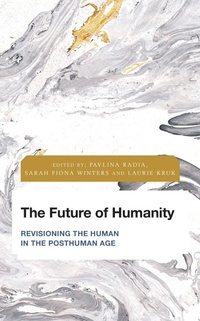
The Future of Humanity
Revisioning the Human in the Posthuman Age
1st Edition
Published on 12. August 2019
246 pages
978-1-78660-957-1 (ISBN)
Description

What is the future of humanity? What does it mean to be 'human' in the posthuman age? What responsibility does humankind have towards others and their environments? How are the stories that humans tell themselves implicated in the very power asymmetries and eco-political challenges that they bemoan? Taking a cross-disciplinary approach to the posthuman age, the essays in this collection speak to the multifaceted geographies and counter-geographies of humanity, probing into the possible futures we face as planetary species. Some of these include: ecological issues generated by centuries of neglecting our environment(s); power asymmetries stemming from economic and cultural globalization; violence and its affective politics informed by cultural, ethnic, and racial genocides; religious disputes; social inequities produced by consumerism; gender normativity; and the increasing impact of digital and AI (artificial intelligence) technology on the human body, as well as historical, socio-political, not to mention ethical relations.
Reviews / Votes
Reframing the humanist subject as a complex temporal material and a differential ecology of affects, this exciting interdisciplinary collection enables multiple entry points to new thinking in support of posthuman futures. The essays explore shared incursions of biology and technology to redefine what it means to be human in the twenty-first century and articulate non-anthropocentric perspectives with planetary implications. This groundbreaking collection of interdisciplinary meditations on the posthuman condition reminds us that we all have a stake in the shape of the digital future. The essays offer captivating and occasionally unsettling glimpses of an emerging reality that will challenge settled assumptions about the very nature of human existence, and compel us to consider our place in a new order. Why read this book? Because it dares to ask questions that are precise, substantial and necessary, when thinking about what's coming next. The future analyzed here is not mere speculation based on personal conjectures, but it manifests in the ramifications of causes and effects well rooted in the history of humankind. The future, in this sense, does not come from nowhere: it is already here.More details
Series
Edition
1. Auflage
Language
English
Place of publication
London
United Kingdom
Illustrations
5 b/w illustrations;5 b/w photos;
ISBN-13
978-1-78660-957-1 (9781786609571)
Copyright in bibliographic data and cover images is held by Nielsen Book Services Limited or by the publishers or by their respective licensors: all rights reserved.
Schweitzer Classification
Other editions
Additional editions
Pavlina Radia | Sarah Fiona Winters | Laurie Kruk
The Future of Humanity
Revisioning the Human in the Posthuman Age
Book
08/2019
Rowman & Littlefield International
€170.70
Shipment within 3-4 weeks
Persons
Pavlina Radia is Dean of the Faculty of Arts and Science and Professor in English Studies at Nipissing University, Canada. She is also Director of the Centre for Interdisciplinary Collaboration in the Arts and Sciences at Nipissing University. She is the author of Nomadic Modernisms and Diasporic Journeys of Djuna Barnes and Jane Bowles: "Two Very Serious Ladies" (2016) and Ecstatic Consumption: The Spectacle of Global Dystopia in Contemporary American Literature (2016). She is also a co-editor of Food and Appetites: The Hunger Artist and the Arts with Ann McCulloch (2012).
Sarah Fiona Winters is Associate Professor in English Studies at Nipissing University, Canada. Her research focuses on the representations of evil in post-war children's fantasy and on the relationship of fandom studies to digital pedagogies. She has published articles on C. S. Lewis, Philip Pullman, J. K. Rowling, Suzanne Collins, and Margaret Mahy.
Laurie Kruk is Professor of English Studies at Nipissing University, Canada. She has published The Voice Is the Story: Conversations with Canadian Writers of Short Fiction (2003) and Double-Voicing the Canadian Short Story (2016). She has also published three collections of poetry: Theories of the World (1992), Loving the Alien (2006), and My Mother Did Not Tell Stories (2012).
Sarah Fiona Winters is Associate Professor in English Studies at Nipissing University, Canada. Her research focuses on the representations of evil in post-war children's fantasy and on the relationship of fandom studies to digital pedagogies. She has published articles on C. S. Lewis, Philip Pullman, J. K. Rowling, Suzanne Collins, and Margaret Mahy.
Laurie Kruk is Professor of English Studies at Nipissing University, Canada. She has published The Voice Is the Story: Conversations with Canadian Writers of Short Fiction (2003) and Double-Voicing the Canadian Short Story (2016). She has also published three collections of poetry: Theories of the World (1992), Loving the Alien (2006), and My Mother Did Not Tell Stories (2012).
Content
Introduction: Reflections on the (Post)Human Future, Pavlina Radia
Part I: Humanity, Big History, and Politics of Progress, Sarah Winters
Chapter One: Humanity Has a Choice: Our Common Future from a Big History Perspective, Fred Spier
Chapter Two: Investing in Disaster: Technical Progress and the Taboo of Diminishing Returns, David Witzling
Chapter Three: Gender, Religions and the SDGs: A Reflection on Empowering Buddhist Nuns, Manuel Litalien
Part II: Genocidal Fractures: The Eternal Return of the Past, Laurie Kruk
Chapter Four: The Pilgrimage to Auschwitz: Making Meaning in Late in Modernity, Gillian McCann
Chapter Five: From Gas Chambers to 9/11: The Future of Postmemory and Contemporary America's Commodity Grief Culture, Pavlina Radia
Chapter Six: Art, Trauma, and History: A Survivor's Story, Aaron Weiss
Part III: Doctrines Revisited: Rewriting the Margins, Sarah Winters
Chapter Seven: The Shock Doctrine in Apocalyptic Fiction, Christine Bolus-Reichert
Chapter Eight: Guy Vanderhaeghe and the Fu
Part I: Humanity, Big History, and Politics of Progress, Sarah Winters
Chapter One: Humanity Has a Choice: Our Common Future from a Big History Perspective, Fred Spier
Chapter Two: Investing in Disaster: Technical Progress and the Taboo of Diminishing Returns, David Witzling
Chapter Three: Gender, Religions and the SDGs: A Reflection on Empowering Buddhist Nuns, Manuel Litalien
Part II: Genocidal Fractures: The Eternal Return of the Past, Laurie Kruk
Chapter Four: The Pilgrimage to Auschwitz: Making Meaning in Late in Modernity, Gillian McCann
Chapter Five: From Gas Chambers to 9/11: The Future of Postmemory and Contemporary America's Commodity Grief Culture, Pavlina Radia
Chapter Six: Art, Trauma, and History: A Survivor's Story, Aaron Weiss
Part III: Doctrines Revisited: Rewriting the Margins, Sarah Winters
Chapter Seven: The Shock Doctrine in Apocalyptic Fiction, Christine Bolus-Reichert
Chapter Eight: Guy Vanderhaeghe and the Fu
