

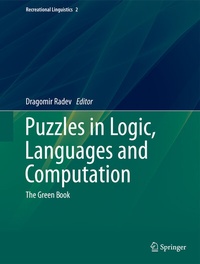
Puzzles in Logic, Languages and Computation
Description

This is the second volume of a unique collection that brings together the best English-language problems created for students competing in the Computational Linguistics Olympiad. These problems are representative of the diverse areas presented in the competition and designed with three principles in mind:
· To challenge the student analytically, without requiring any explicit knowledge or experience in linguistics or computer science;
· To expose the student to the different kinds of reasoning required when encountering a new phenomenon in a language, both as a theoretical topic and as an applied problem;
· To foster the natural curiosity students have about the workings of their own language, as well as to introduce them to the beauty and structure of other languages;
· To learn about the models and techniques used by computers to understand human language.
Aside from being a fun intellectual challenge, the Olympiad mimics the skills used by researchers and scholars in the field of computational linguistics.
In an increasingly global economy where businesses operate across borders and languages, having a strong pool of computational linguists is a competitive advantage, and an important component to both security and growth in the 21st century.
This collection of problems is a wonderful general introduction to the field of linguistics through the analytic problem solving technique.
" A fantastic collection of problems for anyone who is curious about how human language works! These books take serious scientific questions and present them in a fun, accessible way. Readers exercise their logical thinking capabilities while learning about a wide range of human languages, linguistic phenomena, and computational models. " - Kevin Knight, USC Information Sciences Institute
Reviews / Votes
From the reviews:
"This collection of problems is intended to appeal to several audiences: students at all levels who are interested in languages, teachers who present courses in linguistics or computer science, and anyone with a general interest in language. . No computer science or linguistics experience is necessary for enjoying this book or for solving the problems. . Anyone who enjoys puzzles or language will probably find this book appealing." (Andrew R. Huber, Computing Reviews, January, 2014)
More details
Other editions
Additional editions
Persons
Dragomir Radev is the program chair of the North American Computational Linguistics Olympiad (NACLO). He has been the head coach of the US teams at the International Linguistics Olympiad (IOL) since 2007. He holds a PhD from Columbia University and is currently a Professor of Computer Science and Engineering, Information, and Linguistics at the University of Michigan and an Adjunct Professor of Computer Science at Columbia University. He also serves as the secretary of the Association for Computational Linguistics (ACL) and is an Association for Computing Machinery (ACM) Distinguished Scientist.
