

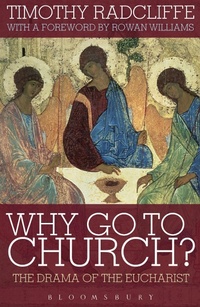
Why Go to Church?
The Drama of the Eucharist
1st Edition
Published on 12. April 2008
224 pages
978-1-4411-5620-4 (ISBN)
Description

This important Lent title examines what it means to celebrate the Eucharist, and in turn reminds us of our capacity for love, hope and faith. With a foreword by former Archbishop of Canterbury Rowan Williams.
The Eucharist, writes Cardinal Timothy Radcliffe, is a three-part drama, forming us in faith, hope and love. In this book he examines what it means to celebrate the Eucharist. Other people experience it as boring and pointless. Listening to the readings, the homily and the creed all take us through the crises and challenges of faith. From the offertory through to the end of the Eucharistic prayer we are caught up in the hope that was Christ's, faced with Good Friday. From the Our Father until we are sent on our way, especially in receiving communion, we are formed as people who are capable of love.
The Eucharist, writes Cardinal Timothy Radcliffe, is a three-part drama, forming us in faith, hope and love. In this book he examines what it means to celebrate the Eucharist. Other people experience it as boring and pointless. Listening to the readings, the homily and the creed all take us through the crises and challenges of faith. From the offertory through to the end of the Eucharistic prayer we are caught up in the hope that was Christ's, faced with Good Friday. From the Our Father until we are sent on our way, especially in receiving communion, we are formed as people who are capable of love.
Reviews / Votes
A Tablet Book of the Year 2008 A rich but digestible helping of Christian thought. * The Times * A beautiful and often piercing meditation on the meaning of the Mass for human living ... Throughout the book, Radcliffe lightens and enriches his writing with insights drawn from remarkably wide and eclectic reading. * The Tablet * This is one of the finest expositions of the meaning of the eucharist that I have read. This is no dry textbook: Radcliffe fills his pages with stories of people who have crossed his path all over the world. * Church Times * [Radcliffe] has the rare gift of showing the familiar and obvious and boringly churchy to be all-important and exciting. * The Oldie * This book offers the reader so much more than a treatise on why they should get out of bed on a Sunday to go to Church: Radcliffe calls us to recognise the Eucharist as 'The unobserved drama [which] is in the core of our humanity'... I found that after reading this book, the Mass was much more accessible to me ... I found his confidence reassuring and his use of day-to-day examples helpful. He successful shows us that we are 'at home' with God and that the drama of the Eucharist is played out in order to draw us more closely into relationship with God. Radcliffe's book is not a polemic on why we should attend Church, nor is it an exercise in apologetics for aspects of Eucharistic experience: it manages to speak respectfully of the frustrations, confusion and hope experienced by many people who attend Church... It is certainly a book I will share with others, return to and continue to explore... this book has given me the tools to re-examine where I fit in. * Thinking Faith * This is an important and innovative treatment of the celebration of the symbolic sacrificial meal at the center of Christian Worship. Radcliffe provides an accessible but profoundly devout treatment of the experience of Eucharistic worship. With a foreword by Rowan Williams. Recommended for most collections. * Library Journal * Radcliffe's book is on the drama of the Eucharist in three acts - faith, hope, and charity - each preparing for the next. Using the words and stories of the Scriptures, with examples from history and culture, Radcliffe walks readers through the Eucharist: the word of God, the homily, the creed, the prayers, the peace, the offertory, the Eucharistic prayers, the bread and wine, the sending out...Why do we go to Church? To express our faith in God, to be part of the community of hope and together to be sent out to be witness of God's love. * EpiscopalLife * Shows the reader how relevant the Eucharist is to their everyday experience, and in doing so raises these experiences to holiness ... Radcliffe should consider it a triumph that this book reaches beyond the pulpit and speaks to the reader throughout the Eucharistic celebration. It is certainly a book I will share with others, return to and continue to explore. * Thinking Faith * Radcliffe writes as a believer, for believers....Why Go to Church? Is a mix of Eucharistic theology, commentary and spiritual reflection stimulated by the various parts of the Mass. Overall, it is more than an extended meditation than a theological treatise. It shows the subtle art of a seasoned preacher who knows how to invite his audience into the happenings of grace by telling a story, reciting a poem, relating an experience or making a point with humor or a well-chosen quote...Radcliffe's meditation on the Eucharist can be inspiring reading for preachers and teachers. * America: The National Catholic Weekly * Why Go To Church? should be required reading for anyone who has ever felt the urge not to attend a Sunday Eucharist or who has ever confessed inattentiveness, ambivalence, or boredom with the Mass. This insightful and pastorally sound book will reintroduce the reader to the fundamental value and joy of actively participating in the daily or weekly gathering of God's people.... This helpful commentary, filled with touching stories and real life occurrences, will certainly bring new insights and renewed enthusiasm for our most traditional form of prayer.... This title is recommended for parish libraries and personal reflection. * Catholic Library World * The engagingly expressed thesis of the book is that the Eucharist is a drama in three acts, linked to faith, hope and charity (love)..."[Going to church] is not merely a big subject, it is the central point of Christianity. * Daily Telegraph * It is accessible, fresh in approach and thought-provoking. Offering a refreshingly new way of comprehending the structure, flow and inner dynamism of the Eucharistic Liturgy, this book is a must for those who would incline to propose a Christian Spirituality which is devoid of any communal aspect. It is also essential reading for those who struggle to understand the relevance or necessity of common prayer, liturgy and ritual. It will prove inspirational for those who seek to deepen their understanding of the Eucharistic Celebration. * Face The Nation * This is a fine book, especially to be recommended to the intelligent avarage reader. * The Pastoral Review * In the face of our 'spiritual but not religious' and institution-wary culture, Timothy Radcliffe, the English Dominican, explains why going to church is so much more than participating in an archaic tradition. In this book, Radcliffe explores how the Eucharist recreates the drama of human existence, which unfolds slowly throughout our life....he is careful to separate our faith from our society's emphasis on individualism and consumerism...Radcliffe uses popular culture and spiritual writings to try to reconnect us with our core, our intimate relationship with God through the Eucharist and through the community of believers. This is why we go to church. * US Catholic * Radcliffe packs each paragraph with so much information that you have to read the book slowly to take everything in. But this is not a complex tome, nor is it a trivial self-help book on personal spirituality. Radcliffe uses popular culture and spiritual writings to try to reconnect us with God through the Eucharist and through the community of believers. This is why we go to church. * US Catholic *More details
Edition
1. Auflage
Language
English
Place of publication
New York
United States
Target group
Professional and scholarly
ISBN-13
978-1-4411-5620-4 (9781441156204)
Copyright in bibliographic data and cover images is held by Nielsen Book Services Limited or by the publishers or by their respective licensors: all rights reserved.
Schweitzer Classification
Other editions
Additional editions
Book
12/2008
Continuum International Publishing Group Ltd.
€22.50
Shipment within 15-20 days
Person
Cardinal Timothy Radcliffe is a former Master of the Dominican Order. Educated at Oxford and Paris, he joined the Dominicans in 1965, and taught scripture at Blackfriars, Oxford, for many years. His bestselling books published by Bloomsbury include What is the Point of Being a Christian?, Alive in God and I Call You Friends. He was elevated to the rank of Cardinal by Pope Francis in December 2024.
Content
Foreword by The Archbishop of Canterbury
Introduction
The Confession of Sins
The Glory of God
The Holiness of God
The Breaking of the Body
Lamb of God
Thanksgiving
Introduction
The Confession of Sins
The Glory of God
The Holiness of God
The Breaking of the Body
Lamb of God
Thanksgiving
