

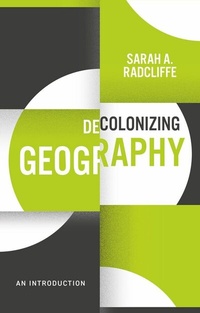
Decolonizing Geography
Description

The first book of its kind, Decolonizing Geography offers an indispensable introductory guide to the origins, current state and implications of the decolonial project in geography.
Sarah A. Radcliffe recounts the influence of colonialism on the discipline of geography and introduces key decolonial ideas, explaining why they matter and how they change geography's understanding of people, environments and nature. She explores the international origins of decolonial ideas, through to current Indigenous thinking, coloniality-modernity, Black geographies and decolonial feminisms of colour. Throughout, she presents an original synthesis of wide-ranging literatures and offers a systematic decolonizing approach to space, place, nature, global-local relations, the Anthropocene and much more.
Decolonizing Geography is an essential resource for students and instructors aiming to broaden their understanding of the nature, origins and purpose of a geographical education.
Sarah A. Radcliffe is Professor of Latin American Geography at the University of Cambridge.
More details
Other editions
Additional editions
Person
Content
Preface
List of Tables, Textboxes and Figures
Chapter 1 Why decolonize geography?
Chapter 2 Postcolonialism and Decoloniality
Chapter 3 Decolonizing Geographies
Chapter 4 Decolonizing Geographical Concepts
Chapter 5 Decolonizing Geography's Curriculum
Chapter 6 Decolonizing geographical research practice
Glossary
Bibliography
Index
Foreword: Decolonizing in a North-South Dialogue
Rogério Haesbaert
Decolonizing Geography is a book about action and doing, as all geography books should be; it is essential to look at space through the actions of different actors-subjects, human and more-than-human, in their multiple relations to time and space. Living, indeed, means transforming space and transforming ourselves through space, since it constitutes us in the first place as bodies (or body-territories, as we have learned from Indigenous peoples and Latin American feminists). Consistent with decolonial approaches, our aim should be not only to treat every theoretical approach analytically, but to treat categories of analysis also in dialogue with categories of practice - that is, ultimately deriving from common sense and struggles 'from below'. Additionally, these categories are normative in pointing to a new geographic horizon for the future.
In making a decolonizing geography, Sarah Radcliffe has engaged openly in dialogue with what sometimes, in a simplified way, we see as 'the South', as if a well-defined geography was delineated between a North and a South - the North always positioned 'on the top' of the map or compass. Making geography is always about understanding and practising one fundamental characteristic of space in motion, namely its ability to change one's perspective and thereby discover other worlds. Thus, practising space - doing geography - means, above all, seeking to look at the world from the point of view of Others. The book does this masterfully, based on Radcliffe's longstanding and generous life's work alongside peoples and cultures often labelled 'peripheral' (such as Kichwa peoples in Ecuador), and her teaching and learning with them. Indigenous peoples show us today how relative the categories of North, South, centre and periphery are. To decolonize is precisely to have the ability to understand/recognize the Other's gaze and transform ourselves with it, changing our perspective and 'classificatory' vision. Today, indeed, peripheral, Southern and colonized groups bring fundamental lessons that many central or Northern geographers, in their anthropocentric and dominating/classifying zeal, ignored or despised for a long time.
Taking up points emphasized by the author, I would like to focus on the critiques of decolonial approaches, which defenders of this way of sentipensar and acting constantly face. A Spanish and Portuguese term used by Latin American decolonial thinkers, sentipensar is a neologism that breaks the binary of feeling ('sentir' to feel) and thinking ('pensar' to think). In her book, Sarah Radcliffe warns us not to romanticize pre-colonial societies. These societies were already very complex and differentiated; for instance, some pre-Colombian states such as the Aztecs and Incas practised forms of colonialism with the ambition of dominating and imposing ideologies (albeit far from present-day capitalism's extent and intensity). On the other hand, we must always be attentive to the risk of oversimplifying decolonial critiques of 'modernity', which, despite all its processes of domination, was also the cradle of autonomous thought. The philosopher Cornelius Castoriadis, for instance, says that modernity is based on a constant dispute between two social projects, one heteronomic (domination/subordination) and the other autonomous-liberatory, with the triumph of the former. Likewise, not all ('modern') European thought is Eurocentric, defending the imposition of a modern-Euro-colonial 'one-world world' universalism. In the Latin American case, the situation is even more complex, as North America imposes itself through colonizing power, starting with the name: 'American' designates a resident of the United States as well as an inhabitant of the entire continent, aspects that reflect the Monroe Doctrine (1823) and its ambiguous motto 'America for [North] Americans'. For this reason, Indigenous peoples in the continent decolonize America by re-naming it Abya Yala ('living earth').
Another dilemma of decolonial thinking is the risk of overemphasizing oppressions of race-ethnicity and gender and downplaying their intersectionality with class domination. Treating all these dimensions as mutually constitutive and contextualizing them geo-historically, however, is no easy task. The designation modernity-coloniality has always been closely linked to capitalism, as for the colonization process, as this book reminds us, can never be dissociated from the expansive impetus of capitalist accumulation and consumption, as exemplified by Latin America's current subjection to the extractive economic model. Thus, the concept of coloniality can never be dissociated from a critical reading of the capitalist world system as a whole.
Sarah Radcliffe also points out that decolonial thinking and attitudes are not new, and link back to the work of several geographers who were concerned with a critical reading 'from below' based on specific spaces and subalternized groups. They established more egalitarian relationships, with the purpose of making geography across North and South. 'Collaborative and Southern geographies have existed for decades, even if they were not always labelled decolonial', says the author. Achieving this more egalitarian North-South relationship is difficult, however, due to the coloniality of language. From my perspective looking from the South, language appears crucial, and northern intellectuals may not appreciate the importance of mastering a foreign language to carry out a decolonization process, fleeing from the (often implicit) belief that what is 'recognized' or what is 'better' is already (or will soon be) published in the hegemonic language of English. During my time as a post-doctoral researcher at the Open University, I was surprised during a seminar when Doreen Massey introduced me and pointed out that English was my fourth language. Only later did I realize the importance of this, as few geography professors spoke a second language, let alone more, whereas in Brazilian universities managing two foreign languages is a necessary condition to pursue a doctorate. Arguably the 'universalizing' character of English today, especially via the internet, significantly accelerates and facilitates communication, but every self-respecting decolonial study necessarily needs a greater involvement with multiple languages, in order to appreciate the worldviews and geographies of subalternized groups.
Among the lessons to be learnt in a 'North-South' dialogue with Latin America is 'anthropophagy' (as the Brazilian writer Oswald de Andrade discussed in his 1928 'Manifesto Antropofágico') - to receive the Other and somehow 'swallow' it and make something else of it. This Latin American hybridity or 'transculturation' (a term from the Cuban essayist Fernando Ortiz) took place in large part, of course, under the violence of colonization. But much hybridity arises from the longstanding societies and politics of original peoples who, even when forcibly transformed, bring forward decolonial proposals such as the one that opens this book, namely to build 'a world where many worlds fit' (un mundo donde quepan muchos mundos, to quote the Zapatista movement). Transculturation thus allows the delineation and building of what Radcliffe calls 'decolonial pluri-geo-graphies'. Having more than one world means accommodating non-hierarchical, diverse, worlds (a pluriverse) and overcoming divisions such as between First, Second and Third worlds.
In addition to the geographical concepts discussed in Chapter 4 there is the concept of region (or regionalization processes), which carries strong Eurocentric overtones, as in the world's division into continents. By contrast, in Brazil, Josué de Castro brings a pioneering approach for a 'regionalization from below' (by identifying the regionalizing of Brazil's starving populations), focusing directly on subalternized groups. Mariátegui, the Peruvian Marxist thinker, in turn, speaks of a 'new regionalism' in Peru, centred around Indigenous peoples and land issues. The concept of territory similarly can be decolonized further. The concept of territory in Latin America informs critical geographical accounts because of the term's use in struggles 'not only for land but also for territory', as Indigenous peoples say. As Radcliffe points out, unlike Anglophone geographies' functional and 'technological' definition of territory, here territory is understood as a defensive and affirmative space of life, struggling for existence or, as Carlos Walter Porto-Gonçalves expresses it, a r-existencia (resisting in order to exist). Always in movement, territory must be seen in the multiplicity of its manifestations and overlaps, in short, as a multi- or trans-territoriality - as Guaraní peoples on the border between Paraguay, Bolivia, Brazil and Argentina claim. This existential 'life-territory' is evident also in Arturo Escobar's discussion of Afro-descendant peoples in Colombia's Pacific region. These geographies alert us to the practical and political relevance of our concepts. As...
