

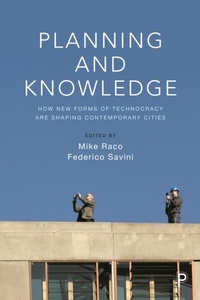
Planning and Knowledge
How New Forms of Technocracy Are Shaping Contemporary Cities
1st Edition
Published on 10. July 2019
336 pages
978-1-4473-4525-1 (ISBN)
Description

This book uses an international perspective and draws on a wide range of new conceptual and empirical material to examine the sources of conflict and cooperation within the different landscapes of knowledge that are driving contemporary urban change. Based on the premise that historically established systems of regulation and control are being subject to unprecedented pressures, scholars critically reflect on the changing role of planning and governance in sustainable urban development, looking at how a shift in power relations between expert and local cultures in western planning processes has blurred the traditional boundaries between public, private and voluntary sectors.
More details
Other editions
Additional editions
Mike Raco | Federico Savini
Planning and Knowledge
How New Forms of Technocracy Are Shaping Contemporary Cities
Book
07/2019
1st Edition
Policy Press
€88.10
Shipment within 15-20 days
Planning and Knowledge
How New Forms of Technocracy Are Shaping Contemporary Cities
E-Book
07/2019
1st Edition
Policy Press
€47.99
Available for download
Mike Raco | Federico Savini
Planning and knowledge
How new forms of technocracy are shaping contemporary cities
Book
06/2019
Policy Press
€54.65
Shipment within 15-20 days
Persons
Editor
Bartlett School of Planning, University College London
Centre for Urban Studies, University of Amsterdam
Contributions
Maynooth University
Rob Kitchin is a Professor in the Maynooth University Social Sciences Institute, Ireland. He is author/editor of a number of books about technology and society and is a recipient of the Royal Irish Academy's Gold Medal for the Social Sciences.
Rob Kitchin is a Professor in the Maynooth University Social Sciences Institute, Ireland. He is author/editor of a number of books about technology and society and is a recipient of the Royal Irish Academy's Gold Medal for the Social Sciences.
School of Planning, Oxford Planning Research Centre, Oxford Brookes University
Dr Sue Brownill is Reader in Urban Policy and Governance at Oxford Brookes University. Her research focuses on public participation and spatial equity in planning and regeneration, affordable housing and community planning and localism.
Dr Sue Brownill is Reader in Urban Policy and Governance at Oxford Brookes University. Her research focuses on public participation and spatial equity in planning and regeneration, affordable housing and community planning and localism.
University of Reading
Gavin Parker is Professor of Planning Studies at the University of Reading. Professor Parker maintains a strong interest in citizenship, participation and governance in land, planning and development. Recent research has centred on neighbourhood planning in England.
Gavin Parker is Professor of Planning Studies at the University of Reading. Professor Parker maintains a strong interest in citizenship, participation and governance in land, planning and development. Recent research has centred on neighbourhood planning in England.
Amsterdam University of Applied Sciences
Stan Majoor is Professor of Urban Management at the Amsterdam University of Applied Sciences.
Stan Majoor is Professor of Urban Management at the Amsterdam University of Applied Sciences.
Department of Planning and Landscape, University of Manchester
Content
Part I: Conceptual framings of technocracy
The rise of a new urban technocracy ~ Federico Savini and Mike Raco
Planning, knowledge and technocracy in historical perspective ~ Michael Hebbert
Part II: Public planning and bureaucracies in contemporary urban development politics
Dealing with tensions: the expertise of boundary spanners in facilitating community initiatives ~ Ward Rauws and Martine de Jong
Plurality of expert knowledge: public planners' experience with urban contractulism in Amsterdam ~ Tuna Tasan-Kok & Martijn van den Hurk
Local government in the face of crisis: changing public management of urban projects in Amsterdam ~ Thijs Koolmees and Stan Majoor
Captured by bureaucracy: street-level professionals mediating past, present and future knowledge ~ Nanke Verloo
Part III: Corporate knowledge and the land and property development sector
Anticipatory knowledge: how development consultants see the future ~ Rachel Weber
Towards an 'information technocracy': discourses of London's post-referendum real estate markets ~ Nicola Livingstone
Finance as technocratic agent in urban development ~ Sabine Dörry
Planning professionalism in the face of technocracy: ethics, values and practices ~ Susannah Gunn
Part IV: private consultants and the delivery of public policy
Professional lobbying in urban planning: depoliticization or REpoliticization? ~ Aino Hirvola and Raine Mäntysalo
Advocates, advisors and scrutineers: the technocracies of private sector planning in England ~ Gavin Parker, Emma Street and Matthew Wargent
Localism and the reconfiguration of planning's publics in the landscapes of technocrac ~ Sue Brownill
The politics of new urban professions: the case of urban development engineers ~ Jonathan Metzger and Sherif Zakhour
Part V: New constellations of actors and the management and governance of contemporary cities
Smart cities, algorithmic technocracy and new urban technocrats ~ Rob Kitchin, Claudio Coletta, Leighton Evans, Liam Heaphy and Darach Mac Donncha
Planning by numbers: affordable housing and viability in England ~ Antonya Layard
Transnational design and local implications for planning: project flights and landings ~ Davide Ponzini
Researching the best-practice: academic knowledge production, planning and the post-politicisation of environmental politics ~ Samuel Mössner and Catarina Gomes de Matos
Conclusions: The technocratic logics of contemporary planning ~ Federico Savini and Mike Raco
The rise of a new urban technocracy ~ Federico Savini and Mike Raco
Planning, knowledge and technocracy in historical perspective ~ Michael Hebbert
Part II: Public planning and bureaucracies in contemporary urban development politics
Dealing with tensions: the expertise of boundary spanners in facilitating community initiatives ~ Ward Rauws and Martine de Jong
Plurality of expert knowledge: public planners' experience with urban contractulism in Amsterdam ~ Tuna Tasan-Kok & Martijn van den Hurk
Local government in the face of crisis: changing public management of urban projects in Amsterdam ~ Thijs Koolmees and Stan Majoor
Captured by bureaucracy: street-level professionals mediating past, present and future knowledge ~ Nanke Verloo
Part III: Corporate knowledge and the land and property development sector
Anticipatory knowledge: how development consultants see the future ~ Rachel Weber
Towards an 'information technocracy': discourses of London's post-referendum real estate markets ~ Nicola Livingstone
Finance as technocratic agent in urban development ~ Sabine Dörry
Planning professionalism in the face of technocracy: ethics, values and practices ~ Susannah Gunn
Part IV: private consultants and the delivery of public policy
Professional lobbying in urban planning: depoliticization or REpoliticization? ~ Aino Hirvola and Raine Mäntysalo
Advocates, advisors and scrutineers: the technocracies of private sector planning in England ~ Gavin Parker, Emma Street and Matthew Wargent
Localism and the reconfiguration of planning's publics in the landscapes of technocrac ~ Sue Brownill
The politics of new urban professions: the case of urban development engineers ~ Jonathan Metzger and Sherif Zakhour
Part V: New constellations of actors and the management and governance of contemporary cities
Smart cities, algorithmic technocracy and new urban technocrats ~ Rob Kitchin, Claudio Coletta, Leighton Evans, Liam Heaphy and Darach Mac Donncha
Planning by numbers: affordable housing and viability in England ~ Antonya Layard
Transnational design and local implications for planning: project flights and landings ~ Davide Ponzini
Researching the best-practice: academic knowledge production, planning and the post-politicisation of environmental politics ~ Samuel Mössner and Catarina Gomes de Matos
Conclusions: The technocratic logics of contemporary planning ~ Federico Savini and Mike Raco
