

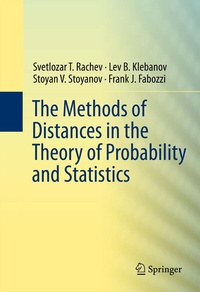
The Methods of Distances in the Theory of Probability and Statistics
Description

Reviews / Votes
From the book reviews:
"This textbook gives a comprehensive overview of the method of metric distances and its applications in probability theory. . The text is mainly self-contained and should be accessible for readers with basic knowledge in probability theory. The exposition is well structured and covers an impressive range of topics around the central theme of probability metrics." (Hilmar Mai, zbMATH, Vol. 1280, 2014)
"The reviewed book is divided into five parts. . The target audience is graduate students in the areas of functional analysis, geometry, mathematical programming, probability, statistics, stochastic analytics, and measure theory. The book can also be used for students in probability and statistics. The theory of probability metrics presented here can be applied to engineering, physics, chemistry, information theory, economics, and finance. Specialists from the aforementioned areas might find the book useful." (Adriana Horníková, Technometrics, Vol. 55 (4), November, 2013)
More details
Other editions
Additional editions
Persons
Content
Main directions in the theory of probability metrics.- Probability distances and probability metrics: Definitions.- Primary, simple and compound probability distances, and minimal and maximal distances and norms.- A structural classification of probability distances.-Monge-Kantorovich mass transference problem, minimal distances and minimal norms.- Quantitative relationships between minimal distances and minimal norms.- K-Minimal metrics.- Relations between minimal and maximal distances.- Moment problems related to the theory of probability metrics: Relations between compound and primary distances.- Moment distances.- Uniformity in weak and vague convergence.- Glivenko-Cantelli theorem and Bernstein-Kantorovich invariance principle.- Stability of queueing systems.-Optimal quality usage.- Ideal metrics with respect to summation scheme for i.i.d. random variables.- Ideal metrics and rate of convergence in the CLT for random motions.- Applications of ideal metrics for sums of i.i.d. random variables to the problems of stability and approximation in risk theory.- How close are the individual and collective models in risk theory?- Ideal metric with respect to maxima scheme of i.i.d. random elements.- Ideal metrics and stability of characterizations of probability distributions.- Positive and negative de nite kernels and their properties.- Negative definite kernels and metrics: Recovering measures from potential.- Statistical estimates obtained by the minimal distances method.-Some statistical tests based on N-distances.- Distances defined by zonoids.- N-distance tests of uniformity on the hypersphere.-
