

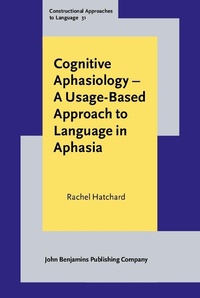
Cognitive Aphasiology - A Usage-Based Approach to Language in Aphasia
1st Edition
Published on 11. October 2021
331 pages
978-90-272-5969-1 (ISBN)
Description

Aphasia is the most common acquired language disorder in adults, resulting from brain damage, usually stroke. This book firstly explains how aphasia research and clinical practice remain heavily influenced by rule-based, generative theory, and summarizes key shortcomings with this approach. Crucially, it demonstrates how an alternative -- the constructivist, usage-based approach -- can provide a more plausible theoretical perspective for characterizing language in aphasia. After detailing rigorous transcription and segmentation methods, it presents constructivist, usage-based analyses of spontaneous speech from people with various aphasia 'types', challenging a clear-cut distinction between lexis and grammar, emphasizing the need to consider whole-form storage and frequency effects beyond single words, and indicating that individuals fall along a continuum of spoken language capability rather than differing categorically by aphasia 'type'. It provides original insight into aphasia -- with wide-reaching implications for clinical practice --, while equally highlighting how the study of aphasia is important for the development of Cognitive Linguistics.
More details
Other editions
Additional editions
Book
10/2021
John Benjamins Publishing Co
€123.30
Shipment within 10-15 days
Content
- Intro
- Cognitive Aphasiology - A Usage-Based Approach to Language in Aphasia
- Editorial page
- Title page
- Copyright page
- Dedication page
- Table of Contents
- List of tables
- List of figures
- List of common abbreviations
- Acknowledgements
- 1. Introduction
- 2. Aphasia and the rule-based approach
- 2.1 An introduction to aphasia
- 2.2 The rule-based, generative approach
- 2.3 Some general challenges to the rule-based approach
- 2.4 Rule-based theory and its challenges in aphasiology and clinical practice
- 2.5 Chapter summary
- 3. The constructivist, usage-based approach and its potential in aphasiology
- 3.1 Introduction
- 3.2 Overview of the constructivist, usage-based approach
- 3.2.1 Constructions and the syntax-lexicon continuum
- 3.2.2 Language acquisition
- 3.2.3 Language storage: The adult 'end-state'
- 3.2.4 Utterance formulation
- 3.2.5 Summary of the constructivist, usage-based approach
- 3.3 Towards a constructivist, usage-based approach to aphasia
- 3.3.1 Boye et al.'s (2018) usage-based view of agrammatic aphasia
- 3.3.2 Work focused on frequency effects in aphasia from a usage-based perspective
- 3.4 Aims of the current monograph
- 3.5 Chapter summary
- 4. Method of data collection
- 4.1 Introduction
- 4.2 Participants
- 4.3 Data collection
- 4.3.1 Data collection from the recruited participants
- 4.3.2 Narrative elicitation from PATSy Database participants and neurotypical speakers
- 4.4 Transcription
- 4.5 Data extraction and analysis
- 5. Developing a reliable transcription method
- 5.1 Introduction
- 5.2 Method
- 5.2.1 Participants
- 5.2.2 Development and application of the protocol
- 5.2.3 Reliability testing
- 5.3 Results
- 5.3.1 Reliability levels
- 5.3.2 Points of disagreement on each aspect
- 5.4 General discussion
- 5.4.1 Summary of findings and implications
- 5.5 Conclusion
- 6. Speech segmentation (extraction of strings for analysis)
- 6.1 Introduction
- 6.2 Development of first protocol
- 6.2.1 Units based on structure of interaction
- 6.2.2 Units based on functional/pragmatic criteria
- 6.2.3 Units based on syntactic criteria
- 6.2.4 Units based on prosodic criteria
- 6.2.5 Procedures incorporating mixed criteria to segment speech by PWA
- 6.2.6 The first developed protocol
- 6.3 Reliability testing of first protocol
- 6.3.1 Method
- 6.3.2 Results
- 6.3.3 Discussion
- 6.4 Development of second protocol
- 6.5 First reliability testing of second protocol
- 6.5.1 Method
- Anchor 108
- 6.5.3 Discussion of results and further development of second protocol
- 6.6 Second reliability testing of second protocol
- 6.6.1 Method
- 6.6.2 Results
- 6.7 General discussion
- 6.8 Conclusion
- 7. Quantitative and qualitative analyses of verbs
- 7.1 Introduction to analyses
- 7.1.1 Verbs and sentence production in aphasia
- 7.1.2 Predictions
- 7.2 Method
- 7.2.1 Participants
- 7.2.2 Data extraction
- 7.2.3 Data analysis
- 7.3 Results
- 7.3.1 Number of verb tokens
- 7.3.2 Lemma diversity
- 7.3.3 Frequency of lemmas in spoken English
- 7.3.4 Qualitative analysis of lemmas and productivity
- 7.3.4.1 KP
- 7.3.4.2 TH
- 7.3.4.3 DB (pilot case)
- 7.3.4.4 ST
- 7.3.4.5 HB
- 7.3.4.6 MH
- 7.4 Discussion
- 7.4.1 Discussion of findings
- 7.4.2 Implications for theory and clinical practice
- 7.4.3 Limitations and methodological considerations
- 7.5 Conclusion
- 8. Quantitative analyses of strings
- 8.1 Introduction
- 8.2 Method
- 8.2.1 Data
- 8.2.2 Data analysis
- 8.3 Results
- 8.3.1 String length
- 8.3.2 String complexity
- 8.3.3 String well-formedness
- 8.3.4 Relationship between string well-formedness and frequency
- 8.4 Discussion
- 8.4.1 Discussion of findings
- 8.4.2 Implications for theory and clinical practice
- 8.4.3 Limitations and methodological considerations
- 8.5 Conclusion
- 9. Qualitative analyses of strings
- 9.1 Introduction
- 9.2 Method
- 9.2.1 Data
- 9.2.2 Analysis
- 9.2.2.1 Qualitative analysis of constructions and productivity
- 9.2.2.2 Potential frequency effects
- 9.2.2.3 Features rendering strings 'unacceptable'
- 9.3 Results
- 9.3.1 Qualitative analysis of strings: constructions and productivity levels
- 9.3.1.1 KP
- 9.3.1.2 TH
- 9.3.1.3 DB
- 9.3.1.4 ST
- 9.3.1.5 HB
- 9.3.1.6 MH
- 9.3.1.7 Summary of sentence types, clause patterns and tenses used by the six PWA
- 9.3.2 Features rendering strings 'unacceptable'
- 9.4 Discussion
- 9.4.1 Discussion of main findings
- 9.4.1.1 Constructions and productivity levels
- 9.4.1.2 Potential frequency effects
- 9.4.1.3 Features rendering strings 'unacceptable'
- 9.4.1.4 Other noteworthy observations from constructional analyses
- 9.4.2 Implications for theory and clinical practice
- 9.4.3 Limitations and methodological considerations
- 9.5 Conclusion
- 10. Overall discussion of findings, implications and limitations
- 10.1 Summary of main findings
- 10.2 Theoretical and clinical implications
- 10.2.1 Implications for linguistic theory
- 10.2.2 Implications for aphasiology and clinical practice
- 10.3 Limitations and methodological considerations
- 10.4 Conclusion
- 11. What next for Cognitive Aphasiology?
- References
- Appendix I. Language profiles of case study participants
- Appendix II. Protocol for counting words in a speech sample
- Appendix III. Transcription protocol
- Appendix IV. First segmentation protocol
- Appendix V. Second segmentation protocol (string extraction)
- Appendix VI. Protocol for extraction and classification of verbs
- Appendix VII. All verb tokens produced by HB
- Appendix VIII. All verb tokens produced by MH
- Appendix IX. All strings and subordinate clauses produced by HB
- Appendix X. All strings and subordinate clauses produced by MH
- Index
