

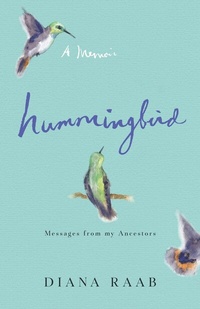
Hummingbird
Description

Explore the depths of love and loss across three generations of women Hummingbird is a spiritual memoir about the connection between three generations of women--the author, her mother and her beloved maternal grandmother whose wisdoms taught the author how to exist in the world by following her intuition and listening to her heart. Follow Diana on a journey of more than five decades as an author, nurse, research psychologist, teacher, cancer survivor, and more. With insightful prompts, the reader is also invited to explore their own ancestral connections. "...Raab offers poignant and thoughtful insights to help us heal intergenerational trauma. Raab rightly reminds us that our ancestors live on in us and we are invited to call on them anytime we need help..." -- SONIA CHOQUETTE, New York Times bestselling author, The Answer is Simple and Ask Your Guides "Diana Raab knows the terrain of the human heart... she invites readers to reflect upon their own life's journeys and to use writing and journaling to navigate a pathway for healing..." -- TERRA TREVOR, author of We Who Walk the Seven Ways "Hummingbird is not only a poignant spiritual memoir, it is an invitation. Raab is accessible and authentic... She opens hearts and deftly offers insightful prompts, sweetly encouraging the reader's collaboration." -- MARILYN KAPP, author of Love is Greater Than Pain "With disarming honesty, Raab slows down our jittery minds to share the intimacies of experiencing trauma and healing self-care in a way that they feel as normal as sleeping and eating... A safety net for the reader to explore their own path to hope." -- TRISTINE RAINER, author of Your Life as Story, and The New Diary
All prices
More details
Other editions
Additional editions
Content
- frontcover.pdf
- 9781615997640_txt
- backcover
2
My Grandmother, My Guide
There is always one moment in childhood when the door opens and lets the future in.
~ Graham Greene
When I was a child, I was often alone and found solace in reading and writing. I loved true stories about real people doing important things. My favorite book was a biography of Florence Nightingale. I loved reading about all the wonderful things she did as the founder of modern nursing. She inspired the healer in me and, eventually, my early career as a registered nurse. Her example gave me a sense of life's infinite possibilities even when my own life seemed narrow and lonely.
Still, my childhood was not always gloomy. My parents, Edward and Eva; my maternal grandparents, Regina and Sam; and I lived in the suburbs of New York City and were often influenced by its cultural sensibilities. From an early age, I was told that I looked like Elizabeth Taylor, but only in adolescence did I understand that it was my sultry green eyes inherited from my father, combined with my dark eyebrows and thick, dark-brown hair inherited from my mother, that bore the resemblance. I had the innate ability to capture people's attention even before I learned to speak. I've continued to have this ability throughout my life, and even though I've never taken advantage of it, I've subconsciously felt blessed.
My bedroom was on the second floor of our pink-shingled, suburban home. My bed had a blue-and-green paisley quilted bedspread with a big, brown cork bulletin board above it featuring photos and poems. Through the window overlooking the backyard, I'd sometimes stare out at the birds to see if they were sending messages. There were all sorts of birds-blue jays, robins, sparrows, and hummingbirds-hovering near the red flowers that Mother had planted and maintained with her green thumb, which unfortunately I did not inherit. As an adult I have been extremely talented in killing the hardiest of house plants.
I lived in that same house until I left for college. I looked out that same bedroom window when, as a teenager, I was having my first LSD trip, which I did in response to my grandfather's death. I remember feeling as if I were having an out-of-body experience and speaking to Grandpa and other loved ones who'd moved into the next realm. That was more than fifty years ago.
Propped up on my childhood bed sat my family of dolls. I cared for them every day, pretending to change, wash, and feed them. My favorite doll was called Tiny Tears, which was a popular doll in the 1950s. She had the magical ability to shed tears from two small holes on either side of the bridge of her nose. This was made possible by feeding her water with a small baby bottle and then pressing her stomach. I tried so hard to make her happy; I couldn't bear to see those tears come from her eyes, which, to me, signaled that she was sad.
For several years when I was young, my maternal grandparents lived with my parents and me, their bedroom being right beside mine. My grandmother, Regina Reinharz Klein, was my primary caretaker and a huge inspiration. It was she who taught me to type, and I wrote my first short story on the Remington typewriter perched on her vanity. My creativity was set free on that typewriter as I traveled to imaginary places in my mind. Sometimes I read my stories aloud to my dolls.
Caretaking came as naturally to me as it did to my grandmother. She not only taught me how to type and appreciate books, she also taught me how to love and follow my heart and my instincts. Then, when I was ten years old, she died by suicide.
It is often the case that we tend to appreciate people more after they die. They also seem to come more alive when they're gone. Children tend to take experiences more in stride than adults. I didn't grieve openly as my mother did. I grieved quietly in the privacy of my room, with my dolls and my journal. At that tender age, it was impossible fully to understand the permanence of death, but I did understand the deep ache in my heart.
It was then and there that I learned how to console myself through writing. Whenever I wrote, I felt better; I realized how healing it was. Soon afterward, I yearned to share my passion with other neighborhood children, so I organized after-school journaling classes in my backyard. These were also children of hardworking people who didn't have much time for parenting. Many of their young voices remained unheard. Thus, my lessons provided a container for their feelings. As it turned out, they found a lot to write about.
Armed with a stack of black-and-white marbled composition notebooks, pens, and packs of stickers from the local Woolworths, I encouraged the children to decorate and personalize their journals. I told them their journal was their best friend. I suggested they write about their family or whatever concerned them. On some afternoons, especially near the full moon when many of us tend to be more emotional, they wrote nonstop for so long that I had to remind them it was time to go home for dinner. During those days with the neighborhood children, I intuited that storytelling and teaching were my life's calling. It was something I sensed in my heart.
I believe I inherited this deep sense of intuition from my grandmother. In fact, I have often made predications that came true. For the most part, the more we open our spiritual channel, the more things happen.
Years later as an adult, when visiting the spiritual community of Cassadaga near Orlando, Florida, where I lived at the time, I met with an older psychic. My hope was that she could access the additional information I wanted about my grandmother. I shared a black-and-white photo of Grandma in which she was posing with her coifed, short light hair, dark eyebrows, and pencil-thin lips with unexposed teeth. She had high cheekbones highlighted with blush. Her eyes seemed like vortexes of information and pierced right through me.
The rather tall, well-dressed, blonde psychic, also with deep eyes, held the photo and gave it an intense stare. She then looked up at me and stared deep into my own eyes and said, "You know, she's a seer." Her comment stopped me in my tracks. It was as if something I already knew was just confirmed. When someone acknowledges what we already believe, the knowledge somehow becomes even more powerful. Strangely, during my adolescence and early adulthood, I didn't really think much about my grandmother. She was just an ancestor who passed away. I was busy growing up and doing the things teenagers did. Then I got married and began raising three wonderful children of my own.
My life was busy as a writer and mother, fitting in writing between homemaking and chauffeuring my children to and from school and after-school activities. I always wanted to be home for them after school; I never wanted them to be a latchkey child as I had been. At that time, I was lucky enough to have a home office where I could shut the door and do some writing if the kids were busy.
Then, at the age of forty-seven, when everything was going well in my life, there was a huge shift. My teenagers had just finished summer camp, and I was getting them ready to start a new school year. My gynecologist called to say that I had an abnormal mammogram. His shocking phone call divulged that I had ductal carcinoma in situ (DCIS), a precursor of breast cancer, in my right breast.
There was no history of cancer in my family. Even so, the diagnosis made me wonder if that had been why my grandmother took her life. I began to feel her intense presence. I believe that I subconsciously called her back because I craved her nurturing and love, something my mother was never capable of providing. In fact, when I phoned my mother to say that I had breast cancer, she responded, "Oh no, I better go get my mammogram!" While it was painful to hear her react in this way, I wasn't surprised because she'd always been self-involved and lacked empathy for me or anyone else.
After my subsequent surgery and recovery, I began to examine and research my grandmother's life at a much deeper level. The cancer diagnosis had made me realize the fragility of life. I spent many hours journaling unfulfilled dreams and realized that I had always wanted to attend graduate school. A few times a year I received Poets & Writers magazine, and as I flipped through one, an advertisement captivated my attention. It was for a low-residency MFA degree in writing that offered distance-learning education with a brief on-campus program for weekends or weeks each year. It seemed perfect for someone like me who wanted to minimize my time away from my family. After some discussion with my husband, I applied to and was accepted into the charter class at Spalding University in Louisville, Kentucky. When the time came to do a thesis, which was essentially a writing project, I decided to write the story of Grandma's life interwoven with mine. Based on our relationship for the first ten years of my life, it turned into a memoir entitled Regina's Closet: Finding My Grandmother's Secret Journal. My hope in writing the book was to bring her closer to me and also to keep her memory alive.
While researching and writing Regina's Closet, I needed help getting more answers about Grandma's life and death. She had had a very small family, and, by the time I was doing the research, many of her relatives had passed away. I met with another psychic who suggested I try to channel with her. She told me to set a time each day to...
