

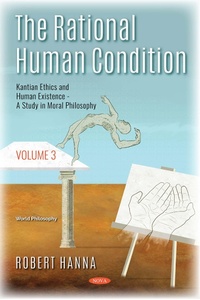
Rational Human Condition. Volume 3: Kantian Ethics and Human Existence: A Study in Moral Philosophy
Published on 28. December 2018
337 pages
978-1-5361-4522-9 (ISBN)
Description

Robert Hanna's The Rational Human Condition is a five-volume book series, including:Volume 1. Preface and General Introduction, Supplementary Essays, and General BibliographyVolume 2. Deep Freedom and Real Persons: A Study in MetaphysicsVolume 3. Kantian Ethics and Human Existence: A Study in Moral PhilosophyVolume 4. Kant, Agnosticism, and Anarchism: A Theological-Political TreatiseVolume 5. Cognition, Content, and the A Priori: A Study in the Philosophy of Mind and KnowledgeThe fifth volume in the series, Cognition, Content, and the A Priori, was published by Oxford University Press in 2015. So, with the present publication of the first four volumes in the series by Nova Science in 2019, all five volumes of The Rational Human Condition are now available in hard-copy and as e-books. All five books share a common aim, which is to work out a true general theory of human rationality in a thoroughly nonideal natural and social world. This philosophical enterprise is what Hanna calls rational anthropology. In the eleventh and most famous of his Theses on Feuerbach, Marx wrote that "e;philosophers have only interpreted the world in different ways; the point is to change it."e; Hanna completely agrees with Marx that the ultimate aim of philosophy is to change the world, not merely interpret it. So, Marx and Hanna are both philosophical liberationists: that is, they both believe that philosophy should have radical political implications. But, beyond Marx, Hanna also thinks that the primary aim of philosophy (understood as rational anthropology) and its practices of synoptic reflection, writing, teaching, and public conversation is to change lives for the better-and ultimately, for the sake of the highest good. Then, and only then, can the human race act upon the world in the right way. The four volumes of The Rational Human Condition will therefore appeal not only to philosophers, but also to any other philosophically-minded person interested in the intellectual and practical adventure of synoptic, reflective thinking about the nature of our rational, but still ineluctably "e;human, all-too-human"e; lives.
More details
Other editions
Additional editions
Robert Hanna
The Rational Human Condition
Volume 3 - Kantian Ethics and Human Existence - A Study in Moral Philosophy
Book
12/2018
Nova Science Publishers Inc
€363.07
Shipment within 15-20 days
Content
- Intro
- Contents
- Preface
- A Note on References
- Chapter 1
- Introduction: Existential Kantian Ethics and the Nature of Morality
- 1.1. Existential Kantian Ethics
- 1.2. Ethics, Morality, and Existential Kantian Ethics
- 1.3. Existential Kantian Ethics versus Moral Relativism, Moral Skepticism, and Moral Particularism
- 1.4. Existential Kantian Ethics versus Egoism and Act Consequentialism
- 1.5. "The World of the Happy": Existential Kantian Ethics versus Ethical Naturalism
- 1.5.1. The First Naturalistic Fallacy as Failed Logical Supervenience
- 1.5.2. The Second Naturalistic Fallacy as Failed Nomological Supervenience
- 1.5.3. Three Possible Objections, and Six Replies
- 1.6. Why, Deep in Your Heart, You are an Existential Kantian Ethicist
- Chapter 2
- Living with Contradictions: Nonideal Kantian Ethical Theory
- 2.1. How Nonideal Can A World Be?
- 2.2. The Skinny Logic and the Fat Semantics of Moral Principles in Existential Kantian Ethics
- 2.3. How to Solve the Universalizability and Rigorism Problems
- 2.4. How to Solve the Problem of Moral Dilemmas
- 2.5. Policy of Truth: The Murderer-at-the-Door Revisited
- Conclusion
- Chapter 3
- Neo-Persons and Non-Persons: The Morality of Abortion and Infanticide
- 3.1. Introduction
- 3.2. The Problem of Abortion and Infanticide, and the Neo-Person Thesis
- 3.3. The Neo-Person Thesis, Neo-Persons, and Non-Persons
- 3.4. A Five-Step Argument for the Neo-Person Thesis
- 3.4.1. Step 1
- 3.4.2. Step 2
- 3.4.3. Step 3
- 3.4.4. Step 4
- 3.4.5. Step 5
- 3.5. A Critique of the Standard Approaches
- 3.5.1. Against the Low Bar of Personhood Approach
- 3.5.2. Against the Weak Potentiality Approach
- 3.5.3. Against the High Bar of Personhood Approach
- 3.5.4. Against the Right-to-Refuse-Life-Support Approach
- 3.6. Three Objections and Three Replies
- 3.6.1. Objection 1: Every Substantive Moral Appeal to Potentiality is Rationally Inadmissible.
- 3.6.1.1. Two Replies to Objection 1
- 3.6.2. Objection 2: The Concept PERSON is an Ambiguous, Incomplete, and Vague Concept
- 3.6.2.1. Two Replies to Objection 2
- 3.6.3. Objection 3: The Neo-Person Thesis Fails to Proceed Fundamentally Via the Right-to-Life
- 3.6.3.1. Two Replies to Objection 3
- Conclusion
- Chapter 4
- What Is It Like to Be a Bat in Pain? The Morality of Our Treatment of Non-Human Animals
- 4.1. Introduction
- 4.2. Real Persons and Different Species
- 4.3. Pain and Suffering
- 4.4. Moral Comparison
- 4.4.1. The Mental-Mental Gap
- 4.4.2. Multiple Realization, Structure-Restricted Correlation, and Schematization
- 4.4.3. An Argument for the Moral Comparison Thesis
- 4.5. Kindness to Animals Revisited: Harming without Torture or Cruelty
- 4.6. Kindness to All Living Beings: Associate Membership in The Realm of Ends
- Conclusion
- Chapter 5
- Trolleys, Bridges, Human Missiles, and Ponds: The Morality of Saving Lives
- 5.1. Introduction
- 5.2. Runaway Trolleys and Bridges: The Trolley Problem
- 5.3. Human Missiles and More Bridges: The Self-Defense Problem
- 5.4. Ponds, Vintage Sedans, and Envelopes: The Famine Relief Problem
- Conclusion
- Chapter 6
- Rage against the Dying of the Light: The Morality of One's Own Death
- 6.1. Introduction
- 6.2. The Ambiguity of "Death"
- 6.3. Why Deaths Is Not Lived Through
- 6.4. The Incoherence and Impossibility of Personal Immortality
- 6.4.1. Williams on the Tedium of Immortality
- 6.4.2. Fischer on How Immortality Could Be a Good Thing
- 6.4.3. Some Worries About Williams's Account and Fischer's Account Alike
- 6.5. Deaths is Neither a Bad Thing Nor a Good Thing for the One Who Dies-Yet Deathp Can Be Either a Good Thing or a Bad Thing for the One Who Dies
- 6.5.1. Nagel On the Nature of Death
- 6.5.2. Suits Against the "Deprivation" Account of the Badness of Death
- 6.5.3. Some Critical Worries About Nagel's Account and Suits's Account Alike
- 6.6. Untimely Deathsp and Why We Should Rage Against the Dying of the Light
- 6.7. The Morality of Euthanasia
- 6.8. The Morality of Self-Sacrifice
- 6.9. The Morality of Suicide
- 6.10. The Morality of One's Own Accidental Deathp
- 6.11. The Morality of One's Own Natural Deathp
- Conclusion
- General Bibliography for The Rational Human Condition, Volumes 1-4
- References
- Endnotes
- About the Author
- Index
- Blank Page
- Blank Page
