

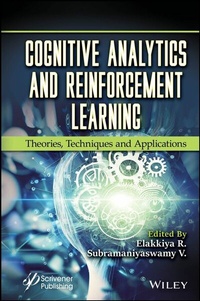
Cognitive Analytics and Reinforcement Learning
Description

The combination of cognitive analytics and reinforcement learning is a transformational force in the field of modern technological breakthroughs, reshaping the decision-making, problem-solving, and innovation landscape; this book offers an examination of the profound overlap between these two fields and illuminates its significant consequences for business, academia, and research.
Cognitive analytics and reinforcement learning are pivotal branches of artificial intelligence. They have garnered increased attention in the research field and industry domain on how humans perceive, interpret, and respond to information. Cognitive science allows us to understand data, mimic human cognitive processes, and make informed decisions to identify patterns and adapt to dynamic situations. The process enhances the capabilities of various applications.
Readers will uncover the latest advancements in AI and machine learning, gaining valuable insights into how these technologies are revolutionizing various industries, including transforming healthcare by enabling smarter diagnosis and treatment decisions, enhancing the efficiency of smart cities through dynamic decision control, optimizing debt collection strategies, predicting optimal moves in complex scenarios like chess, and much more. With a focus on bridging the gap between theory and practice, this book serves as an invaluable resource for researchers and industry professionals seeking to leverage cognitive analytics and reinforcement learning to drive innovation and solve complex problems.
The book's real strength lies in bridging the gap between theoretical knowledge and practical implementation. It offers a rich tapestry of use cases and examples. Whether you are a student looking to gain a deeper understanding of these cutting-edge technologies, an AI practitioner seeking innovative solutions for your projects, or an industry leader interested in the strategic applications of AI, this book offers a treasure trove of insights and knowledge to help you navigate the complex and exciting world of cognitive analytics and reinforcement learning.
Audience
The book caters to a diverse audience that spans academic researchers, AI practitioners, data scientists, industry leaders, tech enthusiasts, and educators who associate with artificial intelligence, data analytics, and cognitive sciences.
More details
Other editions
Additional editions
Persons
Elakkiya R., PhD, is an assistant professor in the Department of Computer Science at the Birla Institute of Technology & Science in Dubai, UAE. She received a Ph.D. in 2018 and did her doctoral research in sign language recognition. Her research focuses on addressing trending issues in computer science, mathematics, and engineering. Along with publishing two books, 50 research articles, and three patents, she is an editor of the Information Engineering and Applied Computing journal. She received the Young Achiever Award in 2019.
Subramaniyaswamy V., PhD, is a professor at the School of Computing at SASTRA Deemed University in Tamilnadu, India. He received a Ph.D. from Anna University in 2013. His research areas include cognitive computing, reinforced learning, recommender systems, artificial intelligence, and the Internet of Things. He has published more than 200 research papers and book chapters in international journals and books.
Content
Preface xiii
Part I: Cognitive Analytics in Continual Learning 1
1 Cognitive Analytics in Continual Learning: A New Frontier in Machine Learning Research 3
Renuga Devi T., Muthukumar K., Sujatha M. and Ezhilarasie R.
1.1 Introduction 4
1.2 Evolution of Data Analytics 5
1.3 Conceptual View of Cognitive Systems 7
1.4 Elements of Cognitive Systems 7
1.5 Features, Scope, and Characteristics of Cognitive System 9
1.6 Cognitive System Design Principles 12
1.7 Backbone of Cognitive System Learning/Building Process 13
1.8 Cognitive Systems vs. AI 17
1.9 Use Cases 18
1.10 Conclusion 25
2 Cognitive Computing System-Based Dynamic Decision Control for Smart City Using Reinforcement Learning Model 29
Sasikumar A., Logesh Ravi, Malathi Devarajan, Hossam Kotb and Subramaniyaswamy V.
2.1 Introduction 30
2.2 Smart City Applications 32
2.3 Related Work 36
2.4 Proposed Cognitive Computing RL Model 39
2.5 Simulation Results 45
2.6 Conclusion 47
3 Deep Recommender System for Optimizing Debt Collection Using Reinforcement Learning 51
Keerthana S., Elakkiya R. and Santhi B.
3.1 Introduction 52
3.2 Terminologies in RL 54
3.3 Different Forms of RL 57
3.4 Related Works 59
3.5 Proposed Methodology 62
3.6 Result Analysis 66
3.7 Conclusion 68
Part II: Computational Intelligence of Reinforcement Learning 73
4 Predicting Optimal Moves in Chess Board Using Artificial Intelligence 75
Thangaramya K., Logeswari G., Sudhakaran G., Aadharsh R., Bhuvaneshwar S., Dheepakraaj R. and Parasu Sunny
4.1 Introduction 76
4.2 Literature Survey 83
4.3 Proposed System 88
4.4 Results and Discussion 95
4.5 Conclusion 98
5 Virtual Makeup Try-On System Using Cognitive Learning 103
Divija Sanapala and J. Angel Arul Jothi
5.1 Introduction 104
5.2 Related Works 105
5.3 Proposed Method 111
5.4 Experimental Results and Analysis 118
5.5 Conclusion 119
6 Reinforcement Learning for Demand Forecasting and Customized Services 123
Sini Raj Pulari, T. S. Murugesh, Shriram K. Vasudevan and Akshay Bhuvaneswari Ramakrishnan
6.1 Introduction 124
6.2 RL Fundamentals 125
6.3 Demand Forecasting and Customized Services 130
6.4 eMart: Forecasting of a Real-World Scenario 131
6.5 Conclusion and Future Works 133
7 COVID-19 Detection through CT Scan Image Analysis: A Transfer Learning Approach with Ensemble Technique 135
P. Padmakumari, S. Vidivelli and P. Shanthi
7.1 Introduction 136
7.2 Literature Survey 137
7.3 Methodology 140
7.4 Results and Discussion 144
7.5 Conclusion 148
8 Paddy Leaf Classification Using Computational Intelligence 151
S. Vidivelli, P. Padmakumari and P. Shanthi
8.1 Introduction 151
8.2 Literature Review 153
8.3 Methodology 155
8.4 Results and Discussion 160
8.5 Conclusion 163
9 An Artificial Intelligent Methodology to Classify Knee Joint Disorder Using Machine Learning and Image Processing Techniques 167
M. Sharmila Begum, A. V. M. B. Aruna, A. Balajee and R. Murugan
9.1 Introduction 168
9.2 Literature Survey 169
9.3 Proposed Methodology 171
9.4 Experimental Results 182
9.5 Conclusion 185
Part III: Advancements in Cognitive Computing: Practical Implementations 189
10 Fuzzy-Based Efficient Resource Allocation and Schedulingin a Computational Distributed Environment 191
Suguna M., Logesh R. and Om Kumar C. U.
10.1 Introduction 192
10.2 Proposed System 193
10.3 Experimental Results 196
10.4 Conclusion 201
11 A Lightweight CNN Architecture for Prediction of Plant Diseases 203
Sasikumar A., Logesh Ravi, Malathi Devarajan, Selvalakshmi A. and Subramaniyaswamy V.
11.1 Introduction 204
11.2 Precision Agriculture 206
11.3 Related Work 211
11.4 Proposed Architecture for Prediction of Plant Diseases 214
11.5 Experimental Results and Discussion 217
11.6 Conclusion 219
12 Investigation of Feature Fusioned Dictionary Learning Model for Accurate Brain Tumor Classification 223
P. Saravanan, V. Indragandhi, R. Elakkiya and V. Subramaniyaswamy
12.1 Introduction 224
12.2 Literature Review 227
12.3 Proposed Feature Fusioned Dictionary Learning Model 229
12.4 Experimental Results and Discussion 232
12.5 Conclusion and Future Work 235
13 Cognitive Analytics-Based Diagnostic Solutions in Healthcare Infrastructure 239
Akshay Bhuvaneswari Ramakrishnan, T. S. Murugesh, Sini Raj Pulari and Shriram K. Vasudevan
13.1 Introduction 240
13.2 Cognitive Computing in Action 241
13.3 Increasing the Capabilities of Smart Cities Using Cognitive Computing 243
13.4 Cognitive Solutions Revolutionizing the Healthcare Industry 246
13.5 Application of Cognitive Computing to Smart Healthcare in Seoul, South Korea (Case Study) 249
13.6 Conclusion and Future Work 251
14 Automating ESG Score Rating with Reinforcement Learning for Responsible Investment 253
Mohan Teja G., Logesh Ravi, Malathi Devarajan and Subramaniyaswamy V.
14.1 Introduction 254
14.2 Comparative Study 259
14.3 Literature Survey 263
14.4 Methods 266
14.5 Experimental Results 273
14.6 Discussion 277
14.7 Conclusion 278
15 Reinforcement Learning in Healthcare: Applications and Challenges 283
Tribhangin Dichpally, Yatish Wutla and Sheela Jayachandran
15.1 Introduction 283
15.2 Structure of Reinforcement Learning 285
15.3 Applications 289
15.4 Challenges 310
15.5 Conclusion 312
16 Cognitive Computing in Smart Cities and Healthcare 317
Dave Mahadevprasad V., Ondippili Rudhra and Sanjeev Kumar Singh
16.1 Introduction 318
16.2 Machine Learning Inventions and Its Applications 322
16.3 What is Reinforcement Learning and Cognitive Computing? 326
16.4 Cognitive Computing 327
16.5 Data Expressed by the Healthcare and Smart Cities 331
16.6 Use of Computers to Analyze the Data and Predict the Outcome 332
16.7 Machine Learning Algorithm 332
16.8 How to Perform Machine Learning? 336
16.9 Machine Learning Algorithm 338
16.10 Common Libraries for Machine Learning Projects 340
16.11 Supervised Learning Algorithm 341
16.12 Future of the Healthcare 343
16.13 Development of Model and Its Workflow 346
16.13.1 Types of Evaluation 347
16.14 Future of Smart Cities 347
16.15 Case Study I 349
16.16 Case Study II 352
16.17 Case Study III 355
16.18 Case Study IV 358
16.19 Conclusion 360
References 360
Index 365
1
Cognitive Analytics in Continual Learning: A New Frontier in Machine Learning Research
Renuga Devi T.1, Muthukumar K.2*, Sujatha M.1┼ and Ezhilarasie R.1
1School of Computing, SASTRA Deemed University, Thanjavur, India
2School of Electrical & Electronics Engineering, SASTRA Deemed University, Thanjavur, India
Abstract
The cognitive system that started with automation has now set its benchmark to reach human-centric intelligence. The slow adoption of cognitive systems is most likely due to its meticulous training process. With cognitive computing as its backbone nowadays, any data can be converted into an asset anytime and anywhere. The complexity of data and its abandonment nature demand the coexistence of many technologies to provide deep insights in a domain. A generic artificial intelligence system built on deep learning and natural language processing evolves into a personalized business partner and a life companion that continuously learns. Combining tremendous power, humanity's relationship with technology has undergone incredible shifts. The adaptation and embracement have led to a higher level of intelligence augmentation, mainly in decision support and engagement systems, penetrating its need in various fields, especially in the healthcare industry, business-to-business, industrial marketing, autonomous driving, financial services, manufacturing sectors, and as a human assistant in day-to-day activities. The expensive and complex process of using cognitive systems to get complete resolutions for specific business segments on historical static data and dynamic real-time data should be addressed with Hadoop, Spark, NoSQL, and other technologies that are part of cognitive systems besides NLP, AI, and ML. This chapter begins with an understanding of different analytics and the need of the hour, then gradually penetrates to give insights into cognitive systems, design principles, and key characteristics of the system, dwelling in the backbone of cognitive systems and its different learning approaches with some prominent use cases.
Keywords: Cognitive computing, machine learning algorithms, natural language processing, artificial intelligence, cognitive analytics
1.1 Introduction
The cognitive age is a continuous trend of massive technological development. The driving force behind this trend is the developing field of cognitive technology, which consists of profoundly disruptive systems that interpret unstructured data, reason to generate hypotheses, learn from experience, and organically interact with humans. With this technology, the capacity to generate insight from all types of data will be critical to success in the cognitive age.
Cognitive computing is likely most notable for upending the conventional IT view that a technology's worth reduces with time; because cognitive systems improve as they learn, they actually grow more useful. This trait makes cognitive technology very valuable for business, and many early adopters are capitalizing on the competitive edge it provides. The cognitive era has arrived, not just because technology has matured, but also because the phenomena of big data necessitate it. The goal of cognitive computing is to be able to solve some uncertain real-world issues comparable to those addressed by the human brain [1].
Since its inception in the 1950s, cognitive science has grown at a rapid pace. Furthermore, as a key component of cognitive science, cognitive computing has a significant influence on artificial intelligence and information technology [2]. Computing systems in the past could gather, transport, and store unstructured data, but they could not interpret it. Cognitive computing systems are intended to foster a better "symbiotic relationship" between humans and technology by replicating human reasoning and problem-solving. Cognitive computing simulates the human brain using computerized models. It is accomplished by the combination of the Von Neumann paradigm and neuromorphic computing, which combines analytic, iterative processes with extremely sophisticated logical and reasoning operations in a very short period of time while utilizing very little power.
The excitement around AI equipment has been dubbed a "renaissance of equipment," as vendors race to manufacture space-explicit or exceptional job-at-hand explicit designs that can fundamentally scale and increase computing productivity [3]. Cognitive systems are probabilistic in nature that hold the capability to adapt and sense the unpredictability and complexity of unstructured input. They analyze that information, organize it, and explain what it means, as well as the reasons for their judgments [4]. Cognitive computing refers to technological platforms that combine reasoning, machine learning, natural language processing, vision, voice, and human computer interaction that replicates the human brain operation and aid in decision-making. The progression of cognitive thought evolves from pure descriptivism through past prediction to prescriptiveness, reflecting a journey from understanding to anticipation and active guidance.
1.2 Evolution of Data Analytics
As we go forward, the graph in Figure 1.1 shows us the benefits that each type of analytics provides.
a) Descriptive Analytics
Acquiring and evaluating facts to explain what has happened. The majority of business reports are descriptive in nature, which is capable of providing historical data summary or explaining differences from one another. Insights from past data are provided in detail by descriptive analytics via data aggregation and data mining but fail to explain the reason behind the insights.
Figure 1.1 Benefits of analytics (source: https://swifterm.com/the-difference-between-descriptive-diagnostic-predictive-and-cognitive-analytics/).
b) Diagnostic Analytics
Diagnostic analytics addresses the reason behind the inference and discovers answers to why questions. The data are compared with past data to identify why the particular situation has happened. This method of data evaluation is useful to uncover data anomalies, determine the relationships within the data, and detect patterns and trends in product market analysis. Some of the diagnostic analytics used by various business firms include data discovery, alarms, drill-down, correlation, drill-up, and data mining. In-depth analysis by experienced demand planners provides assistance for better decision choices. Diagnostic analytics is a reactive process; it helps us only to anticipate the possibility of continuation of the current situation even when used with forecasting.
c) Predictive Analytics
Predictive analytics forms a part of business intelligence that uses predictive and descriptive factors of the available data to forecast and identify the possibility of the occurrence of an unknown pattern in the near future. Predictive analytics is a subset of business intelligence that analyzes and predicts the possibility of an unknown future result using descriptive and predictive factors from the past. It combines analytical techniques, data mining strategies, predictive models, and forecasting methods to assess the possibility of risk and linkages in the current data to perform future predictions. At this point, you are more interested in why something happened than in what happened. It offers proactive market responses.
d) Prescriptive Analytics
Prescriptive analytics combines descriptive, predictive, and diagnostic analysis to create the possibility to make things happen. Beginning with descriptive analysis, which informed us about what has happened, the next stage was to do a diagnostic about why it happened and the next was predictive analysis to predict when it would happen. As a consequence, prescriptive analysis uses business principles and mathematical models on the data to infer future decisions/actions from the current data. Business firms can implement prescriptive analytics in day-to-day transactions only when analytics-driven culture is followed for the entire organization. Larger firms such as Amazon and McDonald's employ prescriptive analytics to increase revenue and customer experience by increasing their demand planning.
e) Cognitive Analytics
A software that takes all data and analytics and also learns on its own without explicit human direction is cognitive analytics. To achieve this self-learning, cognitive analytics combines advanced technologies like Natural Language Processing (NLP), artificial intelligence algorithms, machine learning and deep learning, semantics, data mining, and emotional intelligence [5]. Using these techniques, the cognitive application would become smarter and repair itself.
Figure 1.2 Conceptual view of cognitive computing [6].
1.3 Conceptual View of Cognitive Systems
Internal components of the cognitive analytics engine are depicted in Figure 1.2 by the large rectangle. To represent and reason with information, many knowledge representation structures are required. A variety of machine learning methods and inference engines are also required. Domain cognitive models encapsulate domain-specific cognitive processes to facilitate cognitive style problem solving. The learning and adaptation component increases system performance by learning from prior encounters with users. In contrast to all...
