

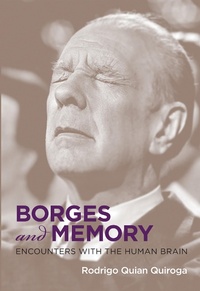
Borges and Memory
Description

Imagine the astonishment felt by neuroscientist Rodrigo Quian Quiroga when he found a fantastically precise interpretation of his research findings in a story written by the great Argentinian fabulist Jorge Luis Borges fifty years earlier. Quian Quiroga studies the workings of the brain—in particular how memory works—one of the most complex and elusive mysteries of science. He and his fellow neuroscientists have at their disposal sophisticated imaging equipment and access to information not available just twenty years ago. And yet Borges seemed to have imagined the gist of Quian Quiroga's discoveries decades before he made them.
The title character of Borges's "Funes the Memorious" remembers everything in excruciatingly particular detail but is unable to grasp abstract ideas. Quian Quiroga found neurons in the human brain that respond to abstract concepts but ignore particular details, and, spurred by the way Borges imagined the consequences of remembering every detail but being incapable of abstraction, he began a search for the origins of Funes. Borges's widow, María Kodama, gave him access to her husband's personal library, and Borges's books led Quian Quiroga to reread earlier thinkers in philosophy and psychology. He found that just as Borges had perhaps dreamed the results of Quian Quiroga's discoveries, other thinkers—William James, Gustav Spiller, John Stuart Mill—had perhaps also dreamed a story like "Funes."
With Borges and Memory, Quian Quiroga has given us a fascinating and accessible story about the workings of the brain that the great creator of Funes would appreciate.
More details
Other editions
Additional editions
Persons
Content
INTRODUCTION 1
1 FUNES AND OTHER CASES OF EXTRAORDINARY
MEMORY 9
2 THE LIBRARY OF BABEL 23
3 THE MAN WHO COULD NOT FORGET 37
4 LIVING IN THE PAST 51
5 SUBTLETIES OF MEMORY 65
6 WHERE DO MEMORIES RESIDE? 77
7 PRODIGIOUS MINDS 101
8 THE DELICATE BALANCE BETWEEN REMEMBERING AND
FORGETTING 117
9 PERCEPTION AND MEMORY 131
10 NEUROPHYSIOLOGY OF VISION 145
11 THE JENNIFER ANISTON NEURON 159
12 KEYS TO THOUGHT 181
Acknowledgments 203
Index 207
