

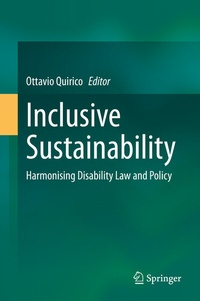
Inclusive Sustainability
Description

In light of the third-generation concept of 'inclusive sustainability', the volume explores the architecture of global disability governance and its degree of harmonisation. The book integrates socio-cultural, economic, political and legal analyses from an international and comparative perspective. The first part of the volume outlines a tripartite systematisation of disability rights for States and non-state persons. In light of essential economic considerations, the second part explores the relationship between disability and specific fundamental rights and regimes, particularly the rights to life, health, education, work and participation. The third part takes an institutional approach and focuses on the way in which the UN and regional organisations regulate disability (rectius, different ability).
More details
Other editions
Additional editions
Person
Dr Ottavio Quirico is an Associate Professor in the School of Law at the University of New England and the Centre for European Studies of the Australian National University, and a Fernand Braudel Senior Fellow in the Law Department of the European University Institute. He has held positions in universities worldwide and acted as a consultant to the United Nations.
Content
Abbreviations.- Introduction.- Part I: Tripartite Disability Rights: A Theory.- Chapter 1. States, International Organisations, Other Sovereign Entities and the Architecture of Disability Rights: A Tripartite Approach? (Ottavio Quirico).- Chapter 2. Non-State Persons and Disability Rights and Duties (Timothy Fadgen).- Part II: Evolving Regulatory Areas.- Chapter 3. Right to Life v. Right to Health? Disability and Selective Abortion (Ottavio Quirico, Katarzyna Kwapisz Williams, John Morss and Xiang Gao).- Chapter 4. The Right to Inclusive Education for Persons with Disabilities: A Comparative Analysis of State Progress (Jane Kotzmann, Emily Griffith and John Morss).- Chapter 5. Economics and Disability Rights: Inclusive Sustainability (Ottavio Quirico and Ciprian Radavoi).- Chapter 6. Right to Work of Persons with Disabilities: The Public-Private Interface (Kip Werren and Guy Charlton).- Chapter 7. Towards a Decentralised Model of Participation for People with Disabilities? TheCase of Human Rights Cities (Camilla Ioli).- Part III: Universal and Regional Approaches.- Chapter 8. Mapping the UN Disability Rights System: A Two-Tier Pathway to Universalism (Ottavio Quirico).- Chapter 9. European Legal Systems and Disability Rights (Anne McNaughton).- Chapter 10. The Need for a Comprehensive Overhaul of Disability Rights in the African Union (Emmanuel Guematcha).- Chapter 11. Disability Rights in the Asia-Pacific Region: A Fragmented Approach (Otto Henfling and Lana Leslie).- Chapter 12. The Asymmetries of Disability Rights Protection in the Inter-American System (Ottavio Quirico and Pablo Jiménez Lobeira).- Conclusion.- Index.
