

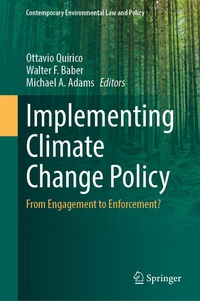
Implementing Climate Change Policy
Description

Over a time lapse of only about 170 years, the trajectory of greenhouse gas (GHG) in the atmosphere has exceeded the 1.5°C security level established in the Paris Agreement. States and international organisations have thus far addressed global warming primarily by means of policy-making and law-making-that is, from the standpoint of 'primary' rules, but convergence is still limited. Climate science indeed warns that the timely achievement of carbon neutrality by 2050 currently necessitates drastic cuts in GHG emissions on a yearly basis. Can therefore a progressive implementation of 'secondary' norms, that is, sanctions and ensuing enforcement procedures, meaningfully contribute to fostering a fast transition to a low-carbon economy based on renewables and, possibly, nuclear energy and further innovative technologies, including corresponding adaptation measures? 'Hard' and 'soft' mechanisms, both 'public' and 'private' in nature, whereby enforceable sanctions integrate goal setting, pledges and a variety of behavioural incentives, disclose a fragmented 'enforcement deficit', which compels case-by-case decentralised solutions, whereby the threshold is by now set at a 2°C temperature increase above pre-industrial levels, with fast-approaching tipping points.
More details
Other editions
Additional editions
Persons
Ottavio Quirico holds a Ph.D. in Law and a Master in International Relations from the University of Social Sciences of Toulouse. He is a professor and researcher at Perugia University for Foreigners, University of New England, ANU Centre for European Studies and European University Institute. He has been, inter alia, a Marie Curie Fellow at Université Panthéon-Assas, has acted as a consultant to the United Nations, and has taught and published extensively on international law and EU law and politics and climate change.
Walter F. Baber holds a Ph.D. in Political Science from the University of North Carolina and a Juris Doctorate from the University of San Diego. He is a professor in the Environmental Sciences and Policy Program at the Graduate Center for Public Policy and Administration at California State University, Long Beach. He is, inter alia, a member of the Lead Faculty Group of the Earth System Governance Project and has an extensive background in international environmental research and teaching.
Michael A. Adams hold degrees in economics and law from University College London. He is a Professor of Corporate Law and Governance at the University of New England, Law School. He specialises in international corporate governance, financial services, information governance, consumer protection (greenwash) and legal technology, and has taught and published extensively in these areas.
Content
Climate change emission reductions to limit warming.- Governing through rules goals and pledges the evolution of behavioural mechanisms in the climate regime.- Climate change mitigation and adaptation an obligation of means or result a jurisdictional approach.- The big problem with the big actor.- Defining and enforcing net zero carbon governance for a corporation operating in the agricultural sector in italy through consumer protection.- Enforcement of international sustainability in climate policies via private law: A comparative case study in greenwash laws.- Private actors and climate policy the problem of slapp lawsuits.- Enforcing climate judgments.- Enforcing climate obligations in failed states with special reference to the sahel region.- Beyond sovereignty enforcing climate obligations in the antarctic space.- Enforcing climate obligations through international organisations the eu and investment.- From climate diplomacy to enforcement in eu trade agreements.- Justifying climate enforcement mechanisms in eu trade and investment agreements as international countermeasures.- International tribunals contributing to enforcing climate change obligations through advisory functions.
