

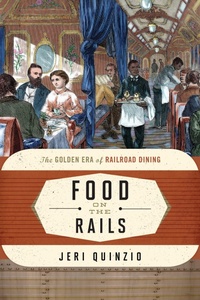
Food on the Rails
The Golden Era of Railroad Dining
1st Edition
Published on 10. October 2014
194 pages
978-1-4422-2733-0 (ISBN)
Description

In roughly one hundred years - from the 1870s to the 1970s - dining on trains began, soared to great heights, and then fell to earth.
The founders of the first railroad companies cared more about hauling freight than feeding passengers. The only food available on trains in the mid-nineteenth century was whatever passengers brought aboard in their lunch baskets or managed to pick up at a brief station stop. It was hardly fine dining.
Seeing the business possibilities in offering long-distance passengers comforts such as beds, toilets, and meals, George Pullman and other pioneering railroaders like Georges Nagelmackers of Orient Express fame, transformed rail travel. Fine dining and wines became the norm for elite railroad travelers by the turn of the twentieth century. The foods served on railroads - from consommé to turbot to soufflé, always accompanied by champagne - equaled that of the finest restaurants, hotels, and steamships.
After World War II, as airline travel and automobiles became the preferred modes of travel, elegance gave way to economy. Canned and frozen foods, self-service, and quick meals and snacks became the norm. By the 1970s, the golden era of railroad dining had come grinding to a halt.
Food on the Rails traces the rise and fall of food on the rails from its rocky start to its glory days to its sad demise. Looking at the foods, the service, the rail station restaurants, the menus, they dining accommodations and more, Jeri Quinzio brings to life the history of cuisine and dining in railroad cars from the early days through today.
The founders of the first railroad companies cared more about hauling freight than feeding passengers. The only food available on trains in the mid-nineteenth century was whatever passengers brought aboard in their lunch baskets or managed to pick up at a brief station stop. It was hardly fine dining.
Seeing the business possibilities in offering long-distance passengers comforts such as beds, toilets, and meals, George Pullman and other pioneering railroaders like Georges Nagelmackers of Orient Express fame, transformed rail travel. Fine dining and wines became the norm for elite railroad travelers by the turn of the twentieth century. The foods served on railroads - from consommé to turbot to soufflé, always accompanied by champagne - equaled that of the finest restaurants, hotels, and steamships.
After World War II, as airline travel and automobiles became the preferred modes of travel, elegance gave way to economy. Canned and frozen foods, self-service, and quick meals and snacks became the norm. By the 1970s, the golden era of railroad dining had come grinding to a halt.
Food on the Rails traces the rise and fall of food on the rails from its rocky start to its glory days to its sad demise. Looking at the foods, the service, the rail station restaurants, the menus, they dining accommodations and more, Jeri Quinzio brings to life the history of cuisine and dining in railroad cars from the early days through today.
More details
Series
Edition
1. Auflage
Language
English
Place of publication
New York
United States
Publishing group
Bloomsbury Publishing Plc
Illustrations
37 b/w photos
ISBN-13
978-1-4422-2733-0 (9781442227330)
Copyright in bibliographic data and cover images is held by Nielsen Book Services Limited or by the publishers or by their respective licensors: all rights reserved.
Schweitzer Classification
Other editions
Additional editions
Book
10/2014
Rowman & Littlefield Publishers
€62.50
Shipment within 10-20 days
Person
Jeri Quinzio is a freelance writer specializing in food history. She is the author of Pudding: A Global History and Of Sugar and Snow: A History of Ice Cream Making, which won the 2010 International Association of Culinary Professionals (IACP) Culinary History award. A contributor to books including The Oxford Encyclopedia of American Food and Drink and Culinary Biographies, she has written for magazines ranging from The Ladies' Home Journal to Gastronomica.
Content
Foreword
Acknowledgments
Introduction
Chapter One: Dining Before the Dining Car
Chapter Two: The Dining Car Debuts
Chapter Three: Fine Dining on European Railroads
Chapter Four: Transporting Restaurants
Chapter Five: Streamlined Dining
Chapter Six: The Golden-and Not So Golden-Era
Chapter Seven: Endings and Beginnings
Afterword: Take the Train
Notes
Bibliography
Index
About the Author
Acknowledgments
Introduction
Chapter One: Dining Before the Dining Car
Chapter Two: The Dining Car Debuts
Chapter Three: Fine Dining on European Railroads
Chapter Four: Transporting Restaurants
Chapter Five: Streamlined Dining
Chapter Six: The Golden-and Not So Golden-Era
Chapter Seven: Endings and Beginnings
Afterword: Take the Train
Notes
Bibliography
Index
About the Author
