

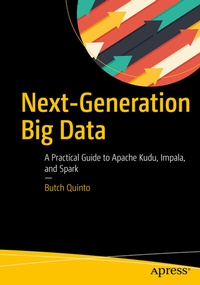
Next-Generation Big Data
Description

Utilize this practical and easy-to-follow guide to modernize traditional enterprise data warehouse and business intelligence environments with next-generation big data technologies.
Next-Generation Big Data
takes a holistic approach, covering the most important aspects of modern enterprise big data. The book covers not only the main technology stack but also the next-generation tools and applications used for big data warehousing, data warehouse optimization, real-time and batch data ingestion and processing, real-time data visualization, big data governance, data wrangling, big data cloud deployments, and distributed in-memory big data computing. Finally, the book has an extensive and detailed coverage of big data case studies from Navistar, Cerner, British Telecom, Shopzilla, Thomson Reuters, and Mastercard.
What You'll Learn
-
Install Apache Kudu, Impala, and Spark to modernize enterprise data warehouse and business intelligence environments, complete with real-world, easy-to-follow examples, and practical advice
-
Integrate HBase, Solr, Oracle, SQL Server, MySQL, Flume, Kafka, HDFS, and Amazon S3 with Apache Kudu, Impala, and Spark
-
Use StreamSets, Talend, Pentaho, and CDAP for real-time and batch data ingestion and processing
-
Utilize Trifacta, Alteryx, and Datameer for data wrangling and interactive data processing
-
Turbocharge Spark with Alluxio, a distributed in-memory storage platform
-
Deploy big data in the cloud using Cloudera Director
-
Perform real-time data visualization and time series analysis using Zoomdata, Apache Kudu, Impala, and Spark
-
Understand enterprise big data topics such as big data governance, metadata management, data lineage, impact analysis, and policy enforcement, and how to use Cloudera Navigator to perform common data governance tasks
-
Implement big data use cases such as big data warehousing, data warehouse optimization, Internet of Things, real-time data ingestion and analytics, complex event processing, and scalable predictive modeling
- Study real-world big data case studies from innovative companies, including Navistar, Cerner, British Telecom, Shopzilla, Thomson Reuters, and Mastercard
BI and big data warehouse professionals interested in gaining practical and real-world insight into next-generation big data processing and analytics using Apache Kudu, Impala, and Spark; and those who want to learn more about other advanced enterprise topics
Reviews / Votes
"The book assumes familiarity with basic data analytics methods and tools, especially Hadoop, and presents high-level introductions to emerging technologies. It thus serves as a helpful guide for data analytics professionals seeking to keep pace with this dynamic and quickly advancing field." (Harry J. Foxwell, Computing Reviews, April 10, 2019)More details
Other editions
Additional editions
Person
Butch has more than 20 years of experience in various technical and leadership roles in several industries including banking and finance, telecommunications, government, utilities, transportation, e-commerce, retail, technology, manufacturing, and bioinformatics. Butch is a recognized thought leader and a frequent speaker at conferences and events. He is a contributor to the Apache Spark and Apache Kudu open source projects, founder of the Cloudera Melbourne User Group, and Deloitte's Director of Alliance for Cloudera.
Content
Chapter 1: Next-Generation Big Data.- Chapter 2: Introduction to Kudu.- Chapter 3: Introduction to Impala.- Chapter 4: High Performance Data Analysis with Impala and Kudu.- Chapter 5: Introduction to Spark.- Chapter 6: High-Performance Data Processing with Spark and Kudu.- Chapter 7: Batch and Real-Time Data Ingestion and Processing.- Chapter 8: Big Data Warehousing.- Chapter 9: Big Data Visualization and Data Wrangling.- Chapter 10: Distributed In-Memory Big Data Computing.- Chapter 11: Big Data Governance and Management.- Chapter 12: Big Data in the Cloud.- Chapter 13: Big Data Case Studies.-
