

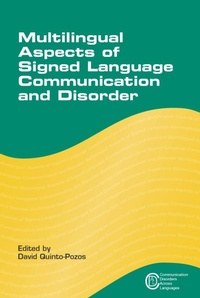
Multilingual Aspects of Signed Language Communication and Disorder
Published on 10. February 2014
288 pages
978-1-78309-132-4 (ISBN)
Description

Inquiry into signed languages has added to what is known about structural variation and language, language learning, and cognitive processing of language. However, comparatively little research has focused on communication disorders in signed language users. For some deaf children, atypicality is viewed as a phase that they will outgrow, and this results in late identification of linguistic or cognitive deficits that might have been addressed earlier. This volume takes a step towards describing different types of atypicality in language communicated in the signed modality such as linguistic impairment caused by deficits in visual processing, difficulties with motor movements, and neurological decline. Chapters within the book also consider communication differences in hearing children acquiring signed and spoken languages.
Reviews / Votes
This book brings together an impressive group of contributors to present pioneering research on signed language and the manifestation of communication disorders in a visual-motor modality. Readers will undoubtedly appreciate the emphasis on bilingual considerations and the innovative recommendations for improving identification and future needs for treatment research. * Pamela A. Hadley, University of Illinois at Urbana-Champaign, USA * This valuable volume provides a rich resource of tools and state-of-the-art methods for investigating signed language communication disorders across the life span. Each chapter fills a critical gap in our knowledge of communication differences and disorders in the visual-manual modality. Moreover, the findings presented in this book have significant implications for theories of language disorders that have been developed solely from spoken language data. * Karen Emmorey, San Diego State University, USA *More details
Series
Language
English
Place of publication
Bristol
United Kingdom
Publishing group
Channel View Publications Ltd
Target group
Professional and scholarly
ISBN-13
978-1-78309-132-4 (9781783091324)
Copyright in bibliographic data and cover images is held by Nielsen Book Services Limited or by the publishers or by their respective licensors: all rights reserved.
Schweitzer Classification
Other editions
Additional editions
David Quinto-Pozos
Multilingual Aspects of Signed Language Communication and Disorder
Book
02/2014
Multilingual Matters
€56.20
Shipment within 10-20 days
Person
David Quinto-Pozos is an Assistant Professor in the Department of Linguistics, University of Texas at Austin, USA. His research focuses on signed language, communication disorder, language acquisition and the interaction between language and gesture in the signed modality.
Content
David Quinto-Pozos: Preface
Laurence Leonard: Foreword
1. David Quinto-Pozos: Introduction: Considering Communication Disorders and Differences in the Signed Language Modality
Part 1: Developmental Language Disorders in the Signed Modality
2. Rosalind Herman, Katherine Rowley, Chloe Marshall, Kathryn Mason, Joanna Atkinson, Bencie Woll & Gary Morgan: Profiling SLI in Deaf Children who are Sign Language Users
3. David Quinto-Pozos, Jenny Singleton, Peter Hauser, & Susan Levine: A Case-Study Approach to Investigating Developmental Signed Language Disorders
4. Aaron Shield & Richard P. Meier: The Acquisition of Sign Language by Deaf Children with Autism Spectrum Disorder
5. Wolfgang Mann & Tobias Haug: Mapping Out Guidelines for the Development and Use of Sign Language Assessments - some Critical Issues, Comments, and Suggestions
Part 2: Fluency Disorders, Neurogenics and Acquired Communication Disorders
6. Geoffrey Whitebread: A Review of Stuttering in Signed Languages
7. Martha Tyrone: Sign Dysarthria: A Speech Disorder in Signed Language
8. Patricia Spanjer, Marielle Fieret & Anne Baker: The Influence of Dementia on Language in a Signing Population
Part 3: Hearing Children from Signing Households
9. Anne E. Baker and Beppie van den Bogaerde: KODAs: A Special Form of Bilingualism
10. Deborah Chen Pichler, James Lee and Diane Lillo-Martin: Language Development in ASL-English Bimodal Bilinguals
Laurence Leonard: Foreword
1. David Quinto-Pozos: Introduction: Considering Communication Disorders and Differences in the Signed Language Modality
Part 1: Developmental Language Disorders in the Signed Modality
2. Rosalind Herman, Katherine Rowley, Chloe Marshall, Kathryn Mason, Joanna Atkinson, Bencie Woll & Gary Morgan: Profiling SLI in Deaf Children who are Sign Language Users
3. David Quinto-Pozos, Jenny Singleton, Peter Hauser, & Susan Levine: A Case-Study Approach to Investigating Developmental Signed Language Disorders
4. Aaron Shield & Richard P. Meier: The Acquisition of Sign Language by Deaf Children with Autism Spectrum Disorder
5. Wolfgang Mann & Tobias Haug: Mapping Out Guidelines for the Development and Use of Sign Language Assessments - some Critical Issues, Comments, and Suggestions
Part 2: Fluency Disorders, Neurogenics and Acquired Communication Disorders
6. Geoffrey Whitebread: A Review of Stuttering in Signed Languages
7. Martha Tyrone: Sign Dysarthria: A Speech Disorder in Signed Language
8. Patricia Spanjer, Marielle Fieret & Anne Baker: The Influence of Dementia on Language in a Signing Population
Part 3: Hearing Children from Signing Households
9. Anne E. Baker and Beppie van den Bogaerde: KODAs: A Special Form of Bilingualism
10. Deborah Chen Pichler, James Lee and Diane Lillo-Martin: Language Development in ASL-English Bimodal Bilinguals
