

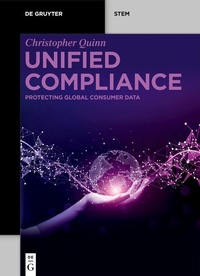
Unified Compliance
Description

Unified Compliance was written to bridge the gap between technical implementation and regulatory
understanding in a the rapidly expanding digital landscape. This comprehensive guide decodes the
world's most important compliance frameworks, including HIPAA, GDPR, ISO 27001, NIST, HITRUST,
HITECH, PIPL, DPDP and emerging AI regulations, through clear analysis and structured comparison.
Designed for IT departments, legal teams, engineers, compliance departments, the book offers
practical strategies to meet compliance requirements without sacrificing system integrity. With indepth
coverage of risk management, data protection, and cross-jurisdictional standards, this work
empowers professionals to align operations with modern expectations for privacy, accountability,
and security resilience. Unified Compliance is both a reference and a strategic companion for those
navigating regulatory complexity in global, hybrid, or sector-specific environments.
More details
Other editions
Additional editions
Person
Christopher Quinn is an information security specialist and security engineer, author, and educator whose work bridges high-impact research with hands-on defense. With years of frontline experience, he has served as a red teamer, security architect, and incident responder across critical infrastructure sectors including construction companies, oil and gas and healthcare. Chris is the founder of Purple Team Security, an organization committed to pragmatic, adversary-aware defense strategies. He is the author of Fortifying Healthcare Data: Securing PHI Against Modern Threats (2025), a comprehensive guide to
HIPAA-aligned cybersecurity, and The Root Manifesto: Reclaiming Cybersecurity in a Compromised
World (2025), a bold call for sovereignty and digital resilience in an era of pervasive surveillance. The
Root Manifesto is available in English and German. His prior work, Digital Security Field Manual - 1st
and 2nd Edition (2025), has become a widely referenced handbook for high risk individuals
worldwide, praised for its actionable insights and operational clarity. Holding certifications such as
Certified Ethical Hacker Master, CCNA, Comptia PenTest+, Comptia Security+, eJPT, and more, Chris
combines deep technical skill with a talent for making complex topics accessible. His work in
information security has supported healthcare, infrastruture companies such as contruction and oil
and gas, and other public sector entities across the US and EU. Beyond technical contributions, Chris'
writing engages with the ethical and political dimensions of security, challenging conventional
narratives and advocating for transparency, user agency, and civil liberties in the digital domain. He is
currently focused on research at the intersection of post-quantum cryptography, threat-informed
defense, and secure healthcare systems. Based in Nashville, Tennessee, Chris also supports education
and policy initiatives that promote responsible cybersecurity governance and resilience in underserved
sectors.
