

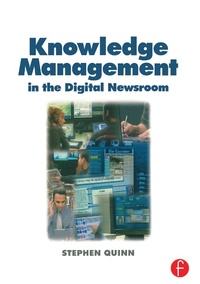
Knowledge Management in the Digital Newsroom
1st Edition
Published on 31. July 2013
224 pages
978-1-136-02889-2 (ISBN)
Description

If you are an editor or newsroom manager seeking new and more efficient ways of managing the ever increasing flow of information through your newsroom, this book will provide the information you need to make informed decisions about crucial organisational and equipment changes.
Case studies from newsrooms worldwide are used to present an overview of the information management tools and processes that are available to help journalists and media executives deal with information. Answers are suggested for some of the most pressing issues, including:
What are the factors driving change in newsrooms?
How are news organizations around the world re-organising their newsrooms to deal with information in new ways?
How are the opposing needs to cut costs and yet maintain journalistic quality being met?
What digital tools are currently available, e.g. for computer-assisted reporting?
How can reporters become more mobile?
How can trainee journalists be better prepared for operating within the changing newsroom environment?
Each chapter is supplemented by a 'how to learn more' section, suggesting further resources for tackling each issue.
Whether you are planning major change in your newsroom or simply wish to keep up with the latest industry trends, this is the book you have been waiting for.
Case studies from newsrooms worldwide are used to present an overview of the information management tools and processes that are available to help journalists and media executives deal with information. Answers are suggested for some of the most pressing issues, including:
What are the factors driving change in newsrooms?
How are news organizations around the world re-organising their newsrooms to deal with information in new ways?
How are the opposing needs to cut costs and yet maintain journalistic quality being met?
What digital tools are currently available, e.g. for computer-assisted reporting?
How can reporters become more mobile?
How can trainee journalists be better prepared for operating within the changing newsroom environment?
Each chapter is supplemented by a 'how to learn more' section, suggesting further resources for tackling each issue.
Whether you are planning major change in your newsroom or simply wish to keep up with the latest industry trends, this is the book you have been waiting for.
Reviews / Votes
"Essential reading for all journalists and managers as we all consider how on earth to make the right decisions as our industry enters the biggest period of technological change it has yet faced."Mike Fairhead, 'Newspaper Techniques' (monthly publication from IFRA)
"It captures current thinking very clearly by identifying key authors and their arguments and ultimately analysing the most likely agents of future change."
David Dunn, in The Journal of European Area Studies
More details
Language
English
Place of publication
London
United Kingdom
Publishing group
Taylor & Francis Ltd
Target group
Professional and scholarly
Product notice
Reflowable
File size
10,66 MB
ISBN-13
978-1-136-02889-2 (9781136028892)
Copyright in bibliographic data and cover images is held by Nielsen Book Services Limited or by the publishers or by their respective licensors: all rights reserved.
Schweitzer Classification
Other editions
Additional editions
Stephen Quinn
Knowledge Management in the Digital Newsroom
Book
07/2017
1st Edition
Routledge
€244.50
Shipment within 10-20 days
Stephen Quinn
Knowledge Management in the Digital Newsroom
Book
01/2002
1st Edition
Focal Press
€73.20
Shipment within 15-20 days
Person
Stephen Quinn is an associate professor of journalism in the Faculty of Arts at Deakin University in Australia. He previously served as an associate professor of journalism at Ball State University and as both the director of the Center for Media Training and Research and an associate professor of journalism at Zayed University in Dubai in the United Arab Emirates. He has also taught journalism in the UK, Australia and New Zealand.
Between 1975 and 1990, Quinn worked full time as a reporter, writer, editor and columnist in Australia, Thailand, the UK and New Zealand. He started with regional newspapers in Australia (the Newcastle Herald) and has worked -- in chronological order -- for the Bangkok Post, the Press Association in London, BBC-TV, the Australian Broadcasting Corporation, Television New Zealand, Independent Television News in London, and The Guardian in London.
He received his bachelor's degree from the University of Newcastle in Australia, his master's degree from The City University in London and his Ph.D. from the University of Wollongong in Australia.
Quinn is the author of Convergent Journalism and Conversations on Convergence (both New York: Peter Lang 2005) Knowledge Management in the Digital Newsroom (Oxford: Focal Press 2002), Digital Sub-Editing and Design (Oxford: Focal Press 2001), Newsgathering on the Net second edition (Melbourne: Macmillan 2001) and The Art of Learning (Sydney: UNSW Press 1999).
Between 1975 and 1990, Quinn worked full time as a reporter, writer, editor and columnist in Australia, Thailand, the UK and New Zealand. He started with regional newspapers in Australia (the Newcastle Herald) and has worked -- in chronological order -- for the Bangkok Post, the Press Association in London, BBC-TV, the Australian Broadcasting Corporation, Television New Zealand, Independent Television News in London, and The Guardian in London.
He received his bachelor's degree from the University of Newcastle in Australia, his master's degree from The City University in London and his Ph.D. from the University of Wollongong in Australia.
Quinn is the author of Convergent Journalism and Conversations on Convergence (both New York: Peter Lang 2005) Knowledge Management in the Digital Newsroom (Oxford: Focal Press 2002), Digital Sub-Editing and Design (Oxford: Focal Press 2001), Newsgathering on the Net second edition (Melbourne: Macmillan 2001) and The Art of Learning (Sydney: UNSW Press 1999).
Content
Foreword; Introduction; Acknowledgements; Knowledge management and journalism; The re-defined newsroom; The coming of multiple-journalism; Intranets and knowledge management; New tools for journalists; Mobile journalism; How to involve and evolve the newsroom; About the author
