

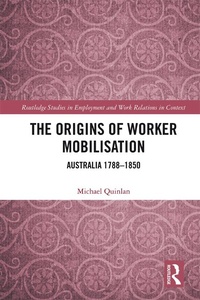
The Origins of Worker Mobilisation
Australia 1788-1850
Published on 13. November 2017
328 pages
978-1-351-62056-7 (ISBN)
Description

This is a book on how and why workers come together. Almost coincident with its inception, worker organisation is a central and enduring element of capitalism. In the 19th and 20th centuries' mobilisation by workers played a substantial role in reshaping critical elements of these societies in Europe, North America, Australasia and elsewhere including the introduction of minimum labour standards (living wage rates, maximum hours etc), workplace safety and compensation laws and the rise of welfare state more generally.
Notwithstanding setbacks in recent decades, worker organisation represents a pivotal countervailing force to moderate the excesses of capitalism and is likely to become even more influential as the social consequences of rising global inequality become more manifest. Indeed, instability and periodic shifts in the respective influence of capital and labour are endemic to capitalism.
As formal institutions have declined in some countries or unions outlawed and severely repressed in others, there has been growing recognition of informal strike activity by workers and wider alliances between unions and community organisations in others. While such developments are seen as new they aren't. Indeed, understanding of worker organisation is often ahistorical and even those understandings informed by historical research are, this book will argue, in need of revision.
This book provides a new perspective on and new insights into how and why workers organise, and what shapes this organisation. The Origins of Worker Mobilisation will be key reading for scholars, academics and policy makers the fields of industrial relations, HRM, labour economics, labour history and related disciplines.
Notwithstanding setbacks in recent decades, worker organisation represents a pivotal countervailing force to moderate the excesses of capitalism and is likely to become even more influential as the social consequences of rising global inequality become more manifest. Indeed, instability and periodic shifts in the respective influence of capital and labour are endemic to capitalism.
As formal institutions have declined in some countries or unions outlawed and severely repressed in others, there has been growing recognition of informal strike activity by workers and wider alliances between unions and community organisations in others. While such developments are seen as new they aren't. Indeed, understanding of worker organisation is often ahistorical and even those understandings informed by historical research are, this book will argue, in need of revision.
This book provides a new perspective on and new insights into how and why workers organise, and what shapes this organisation. The Origins of Worker Mobilisation will be key reading for scholars, academics and policy makers the fields of industrial relations, HRM, labour economics, labour history and related disciplines.
Reviews / Votes
"This is a truly path-breaking study of the collective impulse among workers, with important pointers for the global historiography of labour."Terry Irving, University of Wollongong, Australia
"Quinlan sees much in common with today's world of work and the period he examines. He writes with the radical certainty that those who are oppressed can only redress their grievances by making those who rule uneasy, with even the smallest actions contributing to this unease. All of which, collectively and eventually, makes a difference. Overall, Quinlan's book is testament to the possibilities and persistence of dissent and rebellion despite draconian and oppressive hegemonies that would have it otherwise - yesterday, today, and tomorrow."
Rowan Cahill, Labour History Melbourne
In its own terms, Quinlan's book is a major achievement, not least because it has the
capacity to propel the history of class structures here and overseas in new directions.
Moreover, it is timely, as he points out, to consider this history in a period when precarious
labour and informal methods of struggle return, as the global working class' reality,
in the neo-liberal era.
Terry Irving, University of Wollongong, Australia
"Its major contribution will remain the depth of its inquiry into a period when unfree and free labour underpinned economic growth, in often extremely harsh working conditions, but tempered by the challenges that workers, individually and collectively, threw up to them"
Mark Finnane Griffith University
This is a remarkable, and remarkably useful, book. It is the outcome of an exhaustive project aEUR" over 30 years of excavating the history of workersaEUR (TM) struggles, exactly the kind of work that the neoliberal university has no time for. From those decades of systematic and comprehensive trawling through the colonial press and an enormous variety of official and personal records, Michael Quinlan has created an updateable data base (the empirical material on which the book is based) from which the earliest history of class struggle in this country can be fully appreciated.
Diane Fieldes, Marxist Left Review
"This is perhaps the most significant book published for some time on Australian labour history...This is the work of a scholarly career...Michael Quinlan's documentation of labour resistance is formidable. As a historical work it will give some aid and comfort to those in the labour movement who believe that agitation does not require continuing organization in the form of unions."
John Michael O'Brien, University of Sydney
"[This work] by Quinlan in many respects constitutes an outstanding resource for coming to grips with the detail of the origins and development of Australian labour law specifically."
John Howe, University of Melbourne and Richard Mitchell, Monash University
More details
Series
Language
English
Place of publication
London
United Kingdom
Publishing group
Taylor & Francis Ltd
Target group
College/higher education
Product notice
Reflowable
Illustrations
34 s/w Tabellen
34 Tables, black and white
File size
6,48 MB
ISBN-13
978-1-351-62056-7 (9781351620567)
Copyright in bibliographic data and cover images is held by Nielsen Book Services Limited or by the publishers or by their respective licensors: all rights reserved.
Schweitzer Classification
Other editions
Additional editions
Book
12/2019
1st Edition
Routledge
€65.90
Shipment within 15-20 days
Book
11/2017
1st Edition
Routledge
€215.41
Shipment within 10-20 days
Person
Michael Quinlan is professor of industrial relations in the School of Management at the University of New South Wales, Australia. He is also an adjunct professor in the School of History and Classics at the University of Tasmania and a visiting professor at the Business School, Middlesex University in London. Born in Sydney he divides his time between this city and Launceston, Tasmania where much of this book was written.
Content
1. Reconsidering the Collective Impulse and the Colonial Context
2. Law, the Courts and Inequality at Work
3. Overview of Worker Organisation, 1788-1850
4. Analysing the Components of Organisation
5. Organisation in Transport and Maritime Activities
6. Organisation in the Rural and Extractives Sectors
7. Organisation in Construction and Building Materials
8. Organisation in Manufacturing and Related Trades
9. Organisation in Government and Community Services
10. Organisation in Commercial, Personal Services and Retailing
11. Peak and Political Organisation
12. Re-evaluating Worker Mobilisation
2. Law, the Courts and Inequality at Work
3. Overview of Worker Organisation, 1788-1850
4. Analysing the Components of Organisation
5. Organisation in Transport and Maritime Activities
6. Organisation in the Rural and Extractives Sectors
7. Organisation in Construction and Building Materials
8. Organisation in Manufacturing and Related Trades
9. Organisation in Government and Community Services
10. Organisation in Commercial, Personal Services and Retailing
11. Peak and Political Organisation
12. Re-evaluating Worker Mobilisation
