

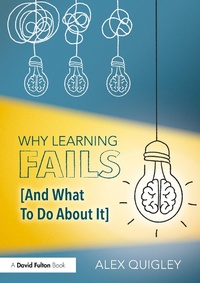
Why Learning Fails (And What To Do About It)
1st Edition
Published on 8. May 2024
160 pages
978-1-040-03075-2 (ISBN)
Description

It is a truth universally acknowledged that pupils do not learn all that they are taught. They may learn something, they may even learn a lot, but it may not be a lot of what we think we have taught them or they may struggle to apply knowledge successfully. In this book, bestselling author Alex Quigley characterises how the long and winding road of successful learning is paved with many failures along the way.
Presenting eight key reasons why learning fails, alongside concepts from cognitive science and research evidence explained concisely and accessibly, the chapters span issues of pupils' limited memory, their patchwork prior knowledge, flawed planning, struggles with independent learning, motivation, limits of attention, and more. Each chapter explores real-life examples of key learning failures and what can be done about it, before ending with five steps to success, along with practical teaching strategies and tools that can be used to secure success in every classroom.
Packed with practical advice and examples for teachers across all phases at every stage of their teaching career, this book offers a vital guide to support pupils to overcome common barriers to learning and go on to flourish while challenging the societal stereotypes that see us shy away from failures.
Presenting eight key reasons why learning fails, alongside concepts from cognitive science and research evidence explained concisely and accessibly, the chapters span issues of pupils' limited memory, their patchwork prior knowledge, flawed planning, struggles with independent learning, motivation, limits of attention, and more. Each chapter explores real-life examples of key learning failures and what can be done about it, before ending with five steps to success, along with practical teaching strategies and tools that can be used to secure success in every classroom.
Packed with practical advice and examples for teachers across all phases at every stage of their teaching career, this book offers a vital guide to support pupils to overcome common barriers to learning and go on to flourish while challenging the societal stereotypes that see us shy away from failures.
Reviews / Votes
"This is an important book and a reassuring read for teachers and school leaders. Failure is an integral part of the learning process, but it can be frustrating for the teacher, students and parents. Quigley offers a wealth of helpful advice rooted in evidence with his own classroom and leadership experiences shining through. From memory to misconceptions and much more, this book covers the challenges and barriers faced in the classroom with advice as to how we can overcome them to enhance teaching and supporting learning."- Kate Jones, Senior Associate for Teaching and Learning with Evidence Based Education.
"Why Learning Fails sets out what many teachers will instinctively know: that teaching is not a production line, brains are not empty vessels to be filled and that as far as pedagogy, goes A plus B does not always equal C. This unreliability of learning necessitates failure. Whilst the process of learning might be unreliable, Quigley is reliably brilliant, distilling complex ideas into engaging prose that is immediately relevant and applicable to the classroom."
- Caroline Spalding, Deputy Headteacher
"Do you think learning is difficult? If so, this book is for you, because Alex Quigley reveals the barriers that make learning difficult for everyone and the tools anyone can use to overcome them!"
- Professor John Dunlosky, Director of SOLE Center in the Department of Psychological Sciences at Kent State University
More details
Edition
1. Auflage
Language
English
Place of publication
London
United Kingdom
Publishing group
Taylor & Francis Ltd
Target group
College/higher education
Professional and scholarly
Illustrations
1 Tables, color; 2 Tables, black and white; 4 Line drawings, color; 1 Line drawings, black and white; 8 Halftones, color; 12 Illustrations, color; 1 Illustrations, black and white
ISBN-13
978-1-040-03075-2 (9781040030752)
Copyright in bibliographic data and cover images is held by Nielsen Book Services Limited or by the publishers or by their respective licensors: all rights reserved.
Schweitzer Classification
Other editions
Additional editions

Alex Quigley
Why Learning Fails (And What To Do About It)
Book
05/2024
1st Edition
Routledge
€200.56
Shipment within 10-20 days
Alex Quigley
Why Learning Fails (And What To Do About It)
Book
05/2024
1st Edition
Routledge
€24.00
Shipment within 10-20 days
Person
Alex Quigley is Head of Content and Engagement at the national educational charity, the Education Endowment Foundation, UK. Previously, he was Director of Huntington Research School and an English teacher at Huntington School, York. He is also a columnist for TES and writes at this website: www.theconfidentteacher.com.
Content
1. Introduction 2. Learning Failure #1 The Narrow Limits of Working Memory 3. Learning Failure #2 A Patchwork of Prior Knowledge 4. Learning Failure #3 The Nagging Nature of Misconceptions 5. Learning Failure #4 A Curious Case of Overconfidence 6. Learning Failure #5 Faulty Planning Strategies 7. Learning Failure #6 An Inability to Learn Independently 8. Learning Failure #7 Wandering Attention and Miserly Mental Effort 9. Learning Failure #8 Falling Motivation in the Face of Failure 10. Supporting Teachers to Succeed
