

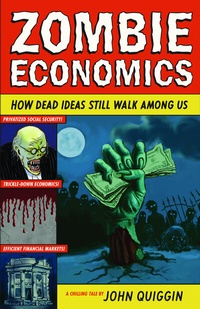
Zombie Economics
How Dead Ideas Still Walk among Us
1st Edition
Published on 18. November 2019
288 pages
978-1-4008-4208-7 (ISBN)
Description

In the graveyard of economic ideology, dead ideas still stalk the land.
The recent financial crisis laid bare many of the assumptions behind market liberalism--the theory that market-based solutions are always best, regardless of the problem. For decades, their advocates dominated mainstream economics, and their influence created a system where an unthinking faith in markets led many to view speculative investments as fundamentally safe. The crisis seemed to have killed off these ideas, but they still live on in the minds of many--members of the public, commentators, politicians, economists, and even those charged with cleaning up the mess. In Zombie Economics, John Quiggin explains how these dead ideas still walk among us--and why we must find a way to kill them once and for all if we are to avoid an even bigger financial crisis in the future.
Zombie Economics takes the reader through the origins, consequences, and implosion of a system of ideas whose time has come and gone. These beliefs--that deregulation had conquered the financial cycle, that markets were always the best judge of value, that policies designed to benefit the rich made everyone better off--brought us to the brink of disaster once before, and their persistent hold on many threatens to do so again. Because these ideas will never die unless there is an alternative, Zombie Economics also looks ahead at what could replace market liberalism, arguing that a simple return to traditional Keynesian economics and the politics of the welfare state will not be enough--either to kill dead ideas, or prevent future crises.
In a new chapter, Quiggin brings the book up to date with a discussion of the re-emergence of pre-Keynesian ideas about austerity and balanced budgets as a response to recession.
The recent financial crisis laid bare many of the assumptions behind market liberalism--the theory that market-based solutions are always best, regardless of the problem. For decades, their advocates dominated mainstream economics, and their influence created a system where an unthinking faith in markets led many to view speculative investments as fundamentally safe. The crisis seemed to have killed off these ideas, but they still live on in the minds of many--members of the public, commentators, politicians, economists, and even those charged with cleaning up the mess. In Zombie Economics, John Quiggin explains how these dead ideas still walk among us--and why we must find a way to kill them once and for all if we are to avoid an even bigger financial crisis in the future.
Zombie Economics takes the reader through the origins, consequences, and implosion of a system of ideas whose time has come and gone. These beliefs--that deregulation had conquered the financial cycle, that markets were always the best judge of value, that policies designed to benefit the rich made everyone better off--brought us to the brink of disaster once before, and their persistent hold on many threatens to do so again. Because these ideas will never die unless there is an alternative, Zombie Economics also looks ahead at what could replace market liberalism, arguing that a simple return to traditional Keynesian economics and the politics of the welfare state will not be enough--either to kill dead ideas, or prevent future crises.
In a new chapter, Quiggin brings the book up to date with a discussion of the re-emergence of pre-Keynesian ideas about austerity and balanced budgets as a response to recession.
More details
Other editions
Additional editions
Book
05/2012
Princeton University Press
€16.50
Shipment within 10-20 days
Person
John Quiggin is professor of economics at the University of Queensland in Australia.
Content
- Cover
- Title
- Copyright
- Contents
- Preface to the Paperback Edition
- Preface to the First Edition
- Introduction
- Chapter 1 The Great Moderation
- Birth: Calm after the Storms
- Life: The Great Risk Shift
- Death: The Dissenters and Their Vindication
- Reanimation: A Global Crisis or a Transitory Blip?
- After the Zombies: Rethinking the Experience of the Twentieth Century
- Further Reading
- Chapter 2 The Efficient Markets Hypothesis
- Birth: From Casino to Calculating Machine
- Life: Black-Scholes, Bankers, and Bubbles
- Death: The Crisis of 2008
- Reanimation: Chicago Revives the Dead
- After the Zombies: The State and the Market
- Further Reading
- Chapter 3 Dynamic Stochastic General Equilibrium
- Birth: From the Phillips Curve to the NAIRU, and Beyond
- Life: Rationality and the Representative Agent
- Death: How Did Economists Get It So Wrong?
- Reanimation: How Obama Caused the Global Financial Crisis
- After the Zombies: Toward a Realistic Macroeconomics
- Further Reading
- Chapter 4 Trickle-Down Economics
- Birth: From Supply-side Economics to Dynamic Scoring
- Life: Excuses for Inequality
- Death: The Rich Get Richer and the Poor Go Nowhere
- Reanimation: Mobility without Movement
- After the Zombies: Economics, Inequality, and Equity
- Further Reading
- Chapter 5 Privatization
- Birth: We Are All Market Liberals Now
- Life: A Policy in Search of a Rationale
- Death: Puzzles and Failures
- Reanimation: Dead for Good?
- After the Zombies: The Mixed Economy
- Further Reading
- Chapter 6 Expansionary Austerity
- Birth: The Treasury View
- Life: The Great Depression
- Death: The Success of Keynesianism
- Reanimation: Expansionary Austerity and the Euro
- After the Zombies: The Case for Hard Keynesianism
- Further Reading
- Conclusion: Economics For The Twenty-First Century
- Rethinking the Experience of the Twentieth Century
- A New Approach to Risk and Uncertainty
- What Is Needed in Economics
- References
- Index
- A
- B
- C
- D
- E
- F
- G
- H
- I
- J
- K
- L
- M
- N
- O
- P
- Q
- R
- S
- T
- U
- V
- W
- Y
- Z
