

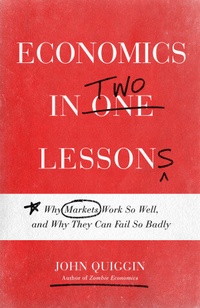
Economics in Two Lessons
Why Markets Work So Well, and Why They Can Fail So Badly
1st Edition
Published on 20. May 2019
408 pages
978-0-691-18610-8 (ISBN)
Description

A masterful introduction to the key ideas behind the successes-and failures-of free-market economics
Since 1946, Henry Hazlitt's bestselling Economics in One Lesson has popularized the belief that economics can be boiled down to one simple lesson: market prices represent the true cost of everything. But one-lesson economics tells only half the story. It can explain why markets often work so well, but it can't explain why they often fail so badly-or what we should do when they stumble. As Nobel Prize-winning economist Paul Samuelson quipped, "When someone preaches 'Economics in one lesson,' I advise: Go back for the second lesson." In Economics in Two Lessons, John Quiggin teaches both lessons, offering a masterful introduction to the key ideas behind the successes-and failures-of free markets.
Economics in Two Lessons explains why market prices often fail to reflect the full cost of our choices to society as a whole. For example, every time we drive a car, fly in a plane, or flick a light switch, we contribute to global warming. But, in the absence of a price on carbon emissions, the costs of our actions are borne by everyone else. In such cases, government action is needed to achieve better outcomes.
Two-lesson economics means giving up the dogmatism of laissez-faire as well as the reflexive assumption that any economic problem can be solved by government action, since the right answer often involves a mixture of market forces and government policy. But the payoff is huge: understanding how markets actually work-and what to do when they don't.
Brilliantly accessible, Economics in Two Lessons unlocks the essential issues at the heart of any economic question.
Since 1946, Henry Hazlitt's bestselling Economics in One Lesson has popularized the belief that economics can be boiled down to one simple lesson: market prices represent the true cost of everything. But one-lesson economics tells only half the story. It can explain why markets often work so well, but it can't explain why they often fail so badly-or what we should do when they stumble. As Nobel Prize-winning economist Paul Samuelson quipped, "When someone preaches 'Economics in one lesson,' I advise: Go back for the second lesson." In Economics in Two Lessons, John Quiggin teaches both lessons, offering a masterful introduction to the key ideas behind the successes-and failures-of free markets.
Economics in Two Lessons explains why market prices often fail to reflect the full cost of our choices to society as a whole. For example, every time we drive a car, fly in a plane, or flick a light switch, we contribute to global warming. But, in the absence of a price on carbon emissions, the costs of our actions are borne by everyone else. In such cases, government action is needed to achieve better outcomes.
Two-lesson economics means giving up the dogmatism of laissez-faire as well as the reflexive assumption that any economic problem can be solved by government action, since the right answer often involves a mixture of market forces and government policy. But the payoff is huge: understanding how markets actually work-and what to do when they don't.
Brilliantly accessible, Economics in Two Lessons unlocks the essential issues at the heart of any economic question.
All prices
More details
Language
English
Place of publication
Princeton, NJ
United States
Publishing group
De Gruyter
Target group
Professional and scholarly
Edition type
Digital original
Product notice
Reflowable
Illustrations
6 b&w illus. 4 tables.
File size
1,59 MB
ISBN-13
978-0-691-18610-8 (9780691186108)
Schweitzer Classification
Other editions
Additional editions
Book
04/2021
Princeton University Press
€23.50
Article not available at the moment
Book
04/2019
Princeton University Press
€30.95
Shipment within 10-20 days
Person
John Quiggin is the President's Senior Fellow in Economics at the University of Queensland in Brisbane, Australia. His previous book, Zombie Economics: How Dead Ideas Still Walk among Us (Princeton), has been translated into eight languages. He has written for the New York Times and the Economist, among other publications, and is a frequent blogger for Crooked Timber and on his own website: www.johnquiggin.com. Twitter @JohnQuiggin
Content
- Cover
- Title
- Copyright
- CONTENTS
- ACKNOWLEDGMENTS
- Introduction
- Outline of the Book
- Further Reading
- LESSON ONE, PART I: THE LESSON
- Chapter 1. Market Prices and Opportunity Costs
- 1.1. What Is Opportunity Cost?
- 1.2. Production Cost and Opportunity Cost
- 1.3. Households, Prices, and Opportunity Costs
- 1.4. Lesson One
- 1.5. The Intellectual History of Opportunity Cost
- Further Reading
- Chapter 2. Markets, Opportunity Cost, and Equilibrium
- 2.1. TISATAAFL (There Is Such A Thing As A Free Lunch)
- 2.2. Gains from Exchange
- 2.3. Trade and Comparative Advantage
- 2.4. Competitive Equilibrium
- 2.5. Free Lunches and Rents
- 2.6. Adam Smith and the Division of Labor
- Further Reading
- Chapter 3. Time, Information, and Uncertainty
- 3.1. Interest and the Opportunity Cost of (Not) Waiting
- 3.2. Information
- 3.3. Uncertainty
- Further Reading
- LESSON ONE, PART II: APPLICATIONS
- Chapter 4. Lesson One: How Opportunity Cost Works in Markets
- 4.1. Tricks and Traps
- 4.2. Airfares
- 4.3. The Cost of (Not) Going to College
- 4.4. An Exception That Proves the Rule: The Boom and Bust in Law Schools
- 4.5. TANSTAAFL: What about "Free" TV, Radio, and Internet Content?
- Further Reading
- Chapter 5. Lesson One and Economic Policy
- 5.1. Why Price Control Doesn't (Usually) Work
- 5.2. To Help Poor People, Give Them Money
- 5.3. Road Pricing
- 5.4. Fish and Tradable Quota
- 5.5. A License to Print Money: Property Rights and Telecommunications Spectrum
- 5.6. Concluding Comments
- Further Reading
- Chapter 6. The Opportunity Cost of Destruction
- 6.1. The Glazier's Fallacy
- 6.2. The Economics of Natural Disasters
- 6.3. The Opportunity Cost of War
- 6.4. Technological Benefits of War?
- Further Reading
- LESSON TWO, PART I: SOCIAL OPPORTUNITY COSTS
- Chapter 7. Property Rights and Income Distribution
- 7.1. What Lesson Two Tells Us about Property Rights and Income Distribution
- 7.2. Property Rights and Market Equilibrium
- 7.3. The Starting Point
- 7.4. Property Rights and Natural Law
- 7.5. Pareto and Inequality
- 7.6. Conclusion
- Further Reading
- Chapter 8. Unemployment
- 8.1. Macroeconomics and Microeconomics
- 8.2. The Business Cycle
- 8.3. The Experience of the Great and Lesser Depressions
- 8.4. Are Recessions Abnormal?
- 8.5. Unemployment and Opportunity Cost
- 8.6. The Macro Foundations of Micro
- 8.7. Hazlitt and the Glazier's Fallacy
- Further Reading
- Chapter 9. Monopoly and Market Failure
- 9.1. The Idea of Market Failure
- 9.2. Economies of Size
- 9.3. Monopoly
- 9.4. Oligopoly
- 9.5. Monopsony and Labor Markets
- 9.6. Bargaining
- 9.7. Monopoly and Inequality
- Further Reading
- Chapter 10. Market Failure: Externalities and Pollution
- 10.1. Externalities
- 10.2. Pollution
- 10.3. Climate Change
- 10.4. Public Goods
- 10.5. The Origins of Externality
- Further Reading
- Chapter 11. Market Failure: Information, Uncertainty, and Financial Markets
- 11.1. Market Prices, Information, and Public Goods
- 11.2. The Efficient Markets Hypothesis
- 11.3. Financial Markets, Bubbles, and Busts
- 11.4. Financial Markets and Speculation
- 11.5. Risk and Insurance
- 11.6. Bounded Rationality
- 11.7. What Bitcoin Reveals about Financial Markets
- Further Reading
- LESSON TWO, PART II: PUBLIC POLICY
- Chapter 12. Income Distribution: Predistribution
- 12.1. Income Distribution and Opportunity Cost
- 12.2. Predistribution: Unions
- 12.3. Predistribution: Minimum Wages
- 12.4. Predistribution: Intellectual Property
- 12.5. Predistribution: Bankruptcy, Limited Liability, and Business Risk
- Further Reading
- Chapter 13. Income Distribution: Redistribution
- 13.1. The Effective Marginal Tax Rate
- 13.2. Opportunity Cost of Redistribution: Example
- 13.3. Weighing Opportunity Costs and Benefits
- 13.4. How Much Should the Top 1 Percent Be Taxed?
- 13.5. Policies for the Present and the Future
- 13.6. Geometric Mean
- Further Reading
- Chapter 14. Policy for Full Employment
- 14.1. What Can Governments Do about Recessions?
- 14.2. Fiscal Policy
- 14.3. Monetary Policy
- 14.4. Labor Market Programs and the Job Guarantee
- 14.5. One Lesson Economics and Unemployment
- 14.6. Summary
- Further Reading
- Chapter 15. Monopoly and the Mixed Economy
- 15.1. Monopoly and Monopsony
- 15.2. Antitrust
- 15.3. Regulation and Its Limits
- 15.4. Public Enterprise
- 15.5. The Mixed Economy
- 15.6. I, Pencil
- Further Reading
- Chapter 16. Environmental Policy
- 16.1. Regulation
- 16.2. Environmental Taxes
- 16.3. Tradeable Emissions Permits
- 16.4. Global Pollution Problems
- 16.5. Climate Change
- 16.6. Summary
- Further Reading
- Conclusion
- BIBLIOGRAPHY
- INDEX

