

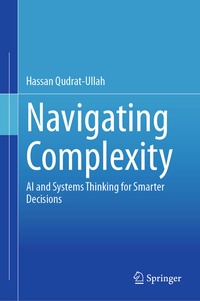
Navigating Complexity
Description

More details
Other editions
Additional editions
Person
Dr. Hassan Qudrat-Ullah is a distinguished Professor of Decision Sciences at York University, Toronto, with over two decades of experience in academia and industry. His research focuses on integrating systems thinking and emerging technologies to address complex decision-making challenges including supply chains and sustainable energy policies. Dr. Qudrat-Ullah has authored numerous publications and books including 24 books (and edited volumes) and 43 journal articles) in the fields of decision sciences, system dynamics, and sustainable energy. Recognized as one of the world's top 2% scientists by Stanford University in 2022, his work has had a profound impact on both academic research and practical applications. He is Founding Editor of Book Series: Systems Thinking and Sustainable Development (by Edward Elgar). Through his innovative approach, Dr. Qudrat-Ullah continues to shape the future of decision-making in complex environments. He has been honored as a state guest of Pakistan in 2016 and 2017. He loves traveling and the exploration of various cultures across the globe. He has been to 140 countries: part business and part pleasure.
Content
1. Introduction: Overview of Complexity in Decision-Making.- 2. Theoretical Foundations of Complexity.- 3. Integrating Systems Thinking and AI.- 4. Tools and Techniques.- 5. Applications in Various Domains.- 6. Ethical, Social, and Practical Considerations.- 7. Future Directions and Innovations.- 8. Conclusion and the Way Forward.
